


Laser Correction of Presbyopia in Switzerland
- We restore your vision so that you don't have to put up with second-rate eyesight
Renowned LASIK surgeon Dr. Victor Derhartunian FEBO for laser eye surgery in Zurich? Get your eyes lasered now at EyeLaser in Zurich: Gain visual freedom today with our Swiss laser eye method for exceptional laser eye surgery!
Not everyone is suitable for laser eye surgery.
The first step is to determine whether your eyes are eligible. Call us or book an appointment online.
During a free initial consultation, we thoroughly examine your eyes and take the time to address your needs and expectations. Once we’ve identified the best treatment for you, you’ll feel confident and reassured about your next steps.

After treatment at our state-of-the-art clinic, you will admire our craftsmanship and experience exceptional, natural vision—free from glasses and contact lenses.
Presbyopia Correction with Uncompromising Quality and Precision
Several procedures are available for the permanent correction of presbyopia.
All procedures can be performed on an outpatient basis and are completely painless for you.
Monovision or PresbyMax is suitable for people with presbyopia who can cope well with a “distance vision” and a “near vision” eye (this is simulated with contact lenses before the procedure).
Lens replacement is advisable if laser correction is not an option, you are over 50 years old and the natural lens is already slightly cloudy (incipient cataract).
In a refractive lens exchange, the natural lens is removed using computer-controlled ultrasound and replaced with a suitable artificial lens.
At EyeLaser, we use state-of-the-art multifocal lenses (trifocal lenses), EDOF lenses, which enable good near and far vision as well as covering the area between near and far vision (intermediate range) very well.
You can see very well again without glasses just a few days after the procedure
If there are still residual visual defects after lens replacement, these can usually be corrected very well with the help of laser correction.
Monovision is used to treat presbyopia.
Each eye is subjected to a different refractive correction in order to prepare one eye for long-sightedness and the other for short-sightedness. In other words, a short-sighted eye and a long-sighted eye are artificially created!
The guide eye is corrected for distance vision, the other for near vision. Some patients tolerate this method perfectly, while others do not feel comfortable with it. Our job is to find out your preferences before the operation by simulating them with trial glasses or contact lenses. Ultimately, you decide whether monovision is suitable for you, depending on your profession and personal feelings.
This monovision can be performed in different ways: With the help of contact lenses, through laser eye treatment or through the implantation of intraocular lenses. As a rule, people between the ages of 35 and 65 are suitable for monovision – mainly those who are short-sighted and have already developed presbyopia.
In the best case scenario, monovision can achieve a high degree of independence from glasses or reading glasses. An average result is at least a reduction in visual impairment, which can be accompanied by a reduction in the diopter values for reading aids.
Monovision treatment steps:
The preparation
A contact lens trial adapted to your needs simulates the possible outcome of the treatment over one to two weeks. This allows you to assess in advance whether monovision is an option for you.
The treatment
In the case of monovision, you undergo femto-LASIK surgery, implantation of phakic lenses (ICL) or lens exchange. With both methods, your dominant eye is corrected for distance vision and your non-dominant eye for near vision.
PresbyMAX – modern laser eye method for the treatment of presbyopia
The PresbyMAX laser eye treatment only takes a few minutes and does not touch or replace the sensitive lens of the eye.
The modeling of the cornea, on the other hand, is achieved using fast laser pulses – precisely, gently and quickly.
The principle of the PresbyMAX method is similar to that of contact or intraocular lenses. The focal points of the eye are calculated precisely. For this purpose, the cornea is modeled for near vision (in the center) and far vision (towards the periphery). This results in good visual acuity at all distances – whether near or far.
There are various treatment options for the PresbyMAX method, which we will be happy to explain to you individually.
Refractive lens exchange (RLA) is mainly used for patients with cataracts, but also for people with severe short- or long-sightedness or presbyopia and astigmatism.
Through a small incision in the cornea, the natural lens (cloudy in cataracts) is removed and a lens made of compatible plastic (acrylate) is inserted instead.
We determine which method of lens surgery is most suitable for you in a personal consultation, including an ophthalmological examination by a specialist.
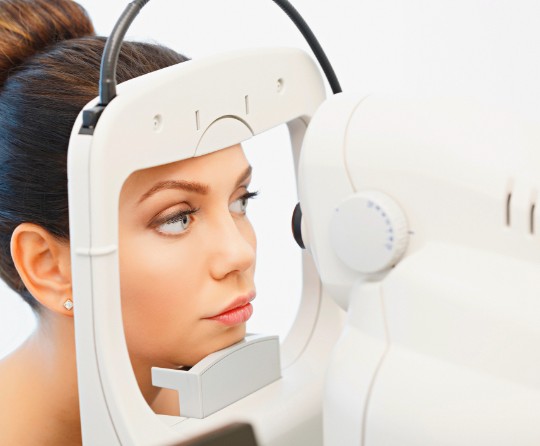
After the age of 40, most of us need reading glasses (even if we have never needed glasses before)! Independence from reading glasses is achievable, but not all eyes can be treated. Make an appointment to find out if you are suitable for presbyopia correction:
book an assessmentWir sind stolz darauf, mit erstklassigen privaten Krankenversicherungen zusammenzuarbeiten


Find out everything you need to know about correcting presbyopia
PresbyMAX technology
We perform the PresbyMAX eye laser procedure with the Schwind Amaris 1050RS laser platform. The laser is fast and has 7-dimensional eye tracking. This means it has an incredible level of precision, maximizing visual comfort and complete independence from glasses.
Refractive lens exchange technology
After your refractive lens exchange, we can customize the lenses to your individual needs. For example:
Laser eye surgery for presbyopia
| without other visual defects | PresbyMax/Femto-LASIK Monovision/lens exchange/ICL |
|---|---|
| Hyperopia/myopia +3 to -5 dpt | PresbyMax/Femto-LASIK/Monovision Presbyopia-LASIK/lens exchange |
| All visual defects | Lens exchange with monofocal/multifocal implants from Physiol x Zeiss, Hoya or Panoptix |
Monovision risks and side effects
A separation of the functions of both eyes is generally well accepted – if both eyes work together perfectly, the brain can easily perceive the overall picture. Although there are effects on spatial vision, these are not a disadvantage for most activities. Depending on your wishes and personal preferences, you will be able to determine whether this method is suitable for you during the preliminary examination.
The brain definitely needs time after the treatment to get used to the new conditions. If you notice after the treatment that the result is not satisfactory for you after all, both eyes can be adjusted to distance vision afterwards. You would then still need reading glasses for near vision. We will be happy to inform you of any other risks.

Everything we do is optimised down to the very finest detail.

The right clinic is not too cheap, too “chain” or too costly. The right clinic is precisely right.

Our vision correction method leaves no room for disappointment.
Discover our laser eye surgeons in the heart of Zurich
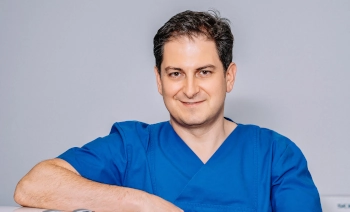
Having learned his craft from the two pioneers of laser surgery, Dr. Victor Derhartunian is among the leading surgeons in Europe. The head eye surgeon at EyeLaser in Zurich can consult his patients in 5 languages.
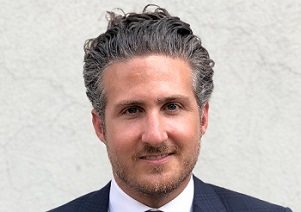
Dr. Valery Lenzt Wittwer joined the EyeLaser Zurich team in 2024. He specializes in lens surgery and enables patients to live without cataracts and/or refractive errors through cataract surgery and ICL lens implantation.

With over 20 years of experience and 10,000+ surgeries, Dr. Myron Kynigopoulos is among Switzerland’s leading experts. Specializing in high-end lens surgery and laser procedures, he combines precision with empathetic patient care.
You can find more information about the correction of presbyopia under the following links
Presbyopia affects everyone sooner or later. It usually begins around the age of 50, slightly later for those with myopia. Click here to read more.
What is it like if you are short-sighted but age-related long-sightedness is gradually becoming noticeable? Click here to read more.
The aim of the study was to demonstrate good visual rehabilitation with monovision or trifocal intraocular lenses. Patients with monovision (n=52) achieved a high binocular uncorrected visual acuity at distance and near. Click here to read more.
Get a comprehensive overview of everything you need to know to get rid of your reading glasses

Wie funktioniert Monovision? Die Monovision ist eine Möglichkeit der Alterssichtigkeitskorrektur. Erfahren Sie mehr…

Was verändert sich für Patienten nach der PresbyMAX-Behandlung? Erfahren Sie wie es Patienten geht nachdem sie keine Lesebrille mehr brauchen

Was ist eine Multifokallinse? Eine Multifokallinse ist eine Speziallinse zur Korrektur der Alterssichtigkeit. Lernen Sie mehr…
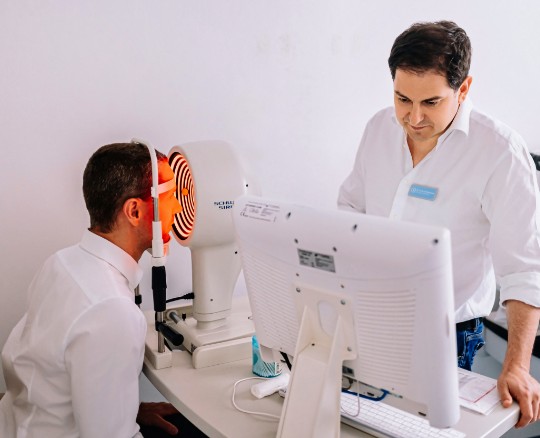
Things like age, eye shape, history and lifestyle make an eye treatment perfect for one person, but not another. Find out which treatment (if any) could free you from glasses and contacts
Take a quizFAQ
Laser treatment for presbyopia primarily aims to improve near vision. The cornea is reshaped and the refractive power is corrected. Either a monovision procedure or multivision can be applied. With monovision, one eye is corrected for distance vision and the other eye for near vision. Alternatively, multifocal or spherical laser profiles can be used to cover all visual ranges.
Laser treatment for presbyopia is particularly suitable for patients between 40 and 60 years of age who already have mild to moderate presbyopia and no severe other eye conditions (e.g., cataracts). It is important that the cornea is not too thin and that there are no other refractive errors that cannot be corrected by laser eye surgery. Otherwise, lens replacement is a good alternative.
The following laser procedures are commonly used for correcting presbyopia:
Advantages:
Disadvantages:
Lens surgery (e.g., implantation of a multifocal or EDOF intraocular lens) is the better choice when: