Understanding nearsightedness & treating it strategically

Eyelaser Zürich

Nearsightedness has now become a widespread condition. The eye has grown too long, and the focal point lies in front of the retina. Distance vision is blurred, near vision is sharp. In Zurich, we correct this error every day – but the path to freedom from glasses is as individual as your fingerprint.

It is not enough to simply “laser away the diopters”. We need to understand the anatomy of your eye and your lifestyle.


Freedom in everyday life in Zurich

Eyelaser Zurich

In Zurich, we live a dynamic mix of business and nature. Nearsightedness is often a silent brake here.

  • The “disappearing trick” of contact lenses: Anyone who enjoys swimming in Lake Zurich or the Limmat knows the fear of losing expensive lenses or getting an infection from lake water.
  • Winter sports & fogging: Whether on the Uetliberg or in the Alps – fogged-up glasses under a ski mask are a safety risk.
  • Vulnerability: Many patients tell us about a deep-seated fear: “What do I do if it burns at night and I cannot find my glasses?”

Anatomical limits: when laser is not suitable

Many patients are turned away by other clinics because their cornea is too thin or its surface is irregular. At EyeLaser Zurich, diagnostics do not end here – they simply become more precise.

Ein Leben ohne Brille – Erfolgsgeschichten aus Zürich
  1. Plan A (laser): If the cornea is thick and stable enough, SmartSight, LASIK, or TransPRK are the treatments of choice. We use “Tissue Saving” profiles (Schwind Amaris) to remove as little tissue as possible.
  2. Plan B (ICL phakic lens): If the cornea is too thin or irregular, laser treatment is contraindicated (risk of instability). In this case, we often recommend the ICL. This artificial lens is additionally placed into the eye. The optical quality is brilliant (“High Definition”).
  3. The limit of Plan B (anterior chamber depth): The ICL also requires space. We measure the depth of the “anterior chamber” (the space between the cornea and the iris). If this is too shallow ( < 2.8 mm), the ICL would not have enough room without endangering the chamber angle or your natural lens.
    • The EyeLaser philosophy: In this case, we do not operate at any cost. We check for alternatives (e.g., lens exchange for older patients) or honestly advise glasses. Your long-term safety takes priority over revenue.

Nearsightedness from age 45

A 25-year-old patient and a 50-year-old patient may have the same values at -2.0 diopters, but completely different needs.

From the age of 45, presbyopia begins.. The natural lens loses elasticity.

ICL

The correction dilemma

A patient with -2.0 diopters sees poorly in the distance, but can read perfectly without glasses.. They use their nearsightedness as a “built-in magnifying glass”.

  • Scenario: We laser this 50-year-old patient to 0.0 diopters (perfect distance vision).
  • The Result: He sees the Uetliberg in razor-sharp focus. But: When he looks at his phone or a menu, everything is blurred. He has lost his “magnifying glass” and needs immediately reading glasses.

Bus driver vs. watchmaker: individual goals

  • The bus driver: They must recognize signs 100 meters away. For them, full correction to 0.0 is ideal. The fact that they need reading glasses to read timetables hardly bothers them. -> Recommendation: full correction (distance dominance).
  • The watchmaker / precision mechanic: They work up close all day. If we lasered them to 0.0, they would be unable to work without reading glasses. -> Recommendation: no surgery or deliberate undercorrection (“mini-monovision”).
Eyelaser Zurich

The solution: PresbyMAX & monovision

For everyone who wants both, we offer compromise solutions:

  • PresbyMAX: A highly developed laser profile that increases the eye’s depth of field. You gain good distance vision and usable near vision at the same time.
  • Monovision: One eye is set for distance, the other slightly for near. The brain blends the images together.

Traffic light system for suitability

We visualize your suitability transparently.

Keratoconus
  • 🟢 Green light (Ideal):
    • Sufficient corneal thickness & regular surface.
    • Age 18–45 (for pure distance correction).
    • Stable values for 1 year.
    • Sufficiently deep anterior chamber.
  • 🟡 Yellow light (special procedure):
    • Thin cornea: -> ICL (if the anterior chamber is deep enough).
    • Age 45+: -> Consultation on PresbyMAX or lens exchange required (consider loss of near vision!).
    • Dry eyes: -> Prior treatment required.
  • 🔴 Red light (no surgery or alternatives):
    • Anterior chamber too shallow: No ICL possible.
    • Keratoconus (advanced): No laser (cross-linking/rings only).
    • Unstable values: The eye is still growing.
    • Retinal problems: Acute holes or detachments (treat first!).

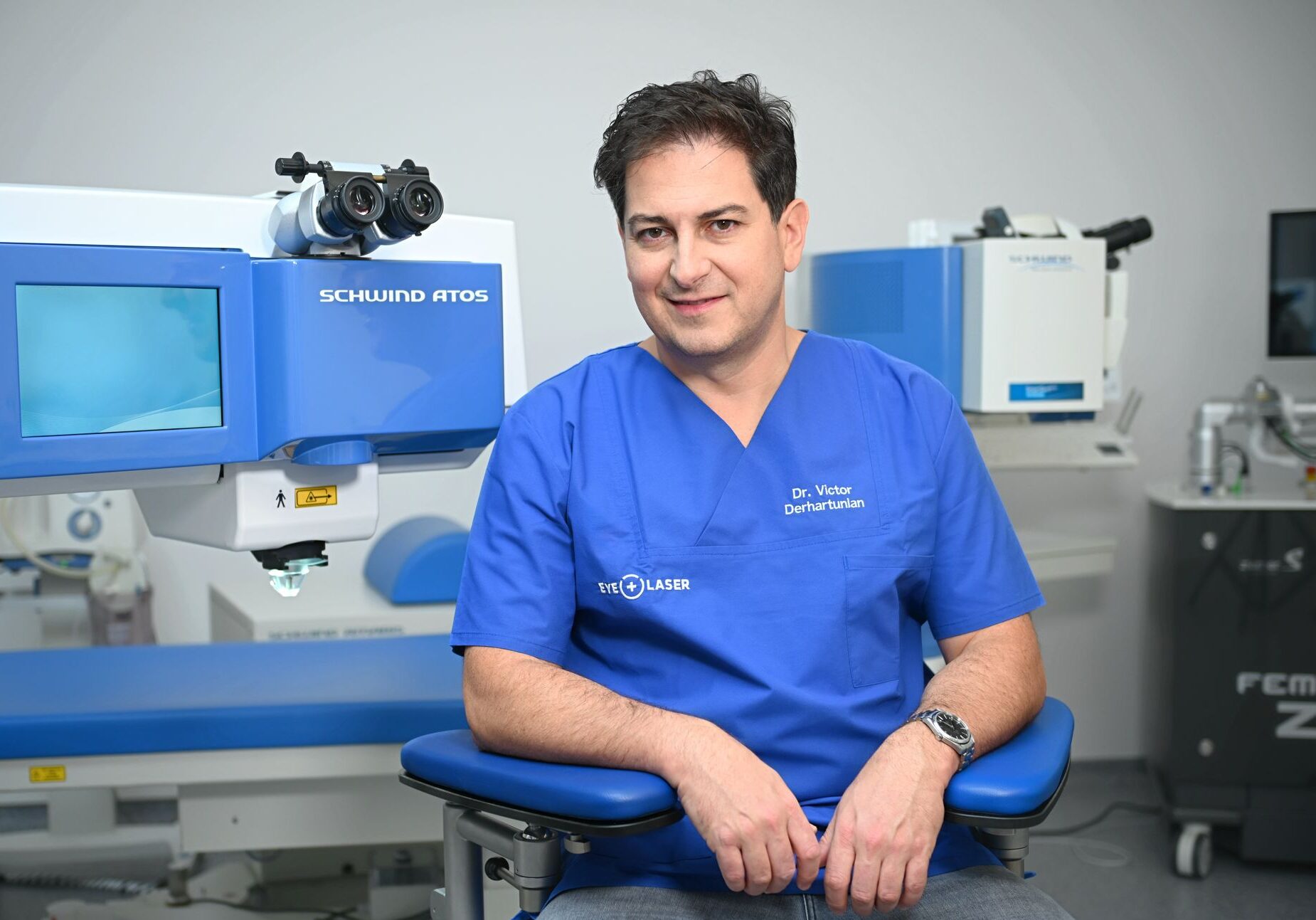
Expert opinion from Dr. Victor Derhartunian

Dr. Victor Derhartunian

“Nearsightedness is more than just a number on your prescription. It determines how we move and how safe we feel. My goal at EyeLaser is not only to bring diopters to zero. I want to give my patients the confidence to be able to rely on their own eyes in any situation. But we also have to be honest: not every eye is feasible. Saying ‘no’ to surgery is sometimes the most important medical advice I can give.”

Comparison of methods

Method Ideal for Special feature Limit
SmartSight / LASIK Standard myopia, thick cornea. Fast, painless. Corneal thickness must be sufficient.
TransPRK Athletes, thinner cornea. No incision (“no touch”). Healing takes 3–5 days.
ICL (phakic lens) Very high prescriptions, thin cornea. Reversible, excellent optics. Requires sufficient anterior chamber depth.
PresbyMAX Patients aged 45–50 and over. Extends depth of focus (distance + PC/phone). A slight compromise in contrast is possible.
Lens exchange (RLE) Patients aged 55+. Replaces your natural lens (as with cataract surgery). More invasive than laser.

Recommendations for patients

So that we can measure the anatomical limits (cornea & anterior chamber) precisely:

Presbipia
  1. Contact lens break: Stop wearing soft lenses 1 week and hard lenses 2 weeks before the appointment. This is the only way we can see if your cornea is “truly” irregular or just deformed by the lenses (“warpage”).
  2. Retina check: In cases of high myopia, the eyeball is stretched. We scan your retina to ensure there are no weak spots.
  3. Self-test for 45+: If you are over 45 and nearsighted: take off your glasses and read something in small print. Works well? Be aware that this ability would disappear after laser surgery to 0.0. We are happy to simulate this with you during the consultation.

Laser, lens or PresbyMAX? Find your path in Zurich.

We do not only check your diopters; we also measure the anterior chamber, corneal thickness and pupil dynamics. We only operate when all lights are green.

✔ Assessment of anatomical feasibility (ICL/laser) ✔ Simulation of presbyopia (for patients 45+) ✔ Non-binding suitability check in 15 min

Book a consultation appointment now

FAQ – Comprehensive answers

I was turned down elsewhere because my cornea is too thin or irregular. Do you have a solution?

Very often, yes. If the cornea is not suitable for laser ablation (too thin or irregular), the ICL (implantable contact lens) is often the ideal “Plan B”. It leaves the cornea intact. However, the prerequisite is that your anterior chamber is anatomically deep enough (at least 2.8 mm) so that the lens sits safely. We measure this precisely with the Pentacam.

What happens if neither laser nor ICL is possible?

If the cornea is too thin AND the anterior chamber is too shallow (less than 2.8 mm), we honestly advise against refractive surgery on a healthy eye. In this case, the risk to the internal eye structures (endothelial cell loss, glaucoma) would be too high. We never operate if the anatomical parameters are not optimal.

Do I need to worry about my retina if I have high myopia?

Yes, regardless of surgery. A highly myopic eye is “longer” than normal, which puts the retina under tension and can make it thinner. The risk of retinal holes or detachment is statistically increased. Important: laser surgery does not change this risk – it remains. That is why EyeLaser performs a thorough retinal examination before every procedure and also recommends regular follow-up checks with an ophthalmologist after surgery.

Can nearsightedness come back after laser treatment (regression)?

The removed tissue does not grow back. However, in rare cases (approx. 1–5%), especially with very high initial prescriptions, a slight regression can occur because the cornea responds biomechanically. Usually, these are small values (e.g., -0.5 dpt). We offer guarantees for this and can often perform an uncomplicated enhancement (“enhancement”).

I am 50 years old and nearsighted. Why do you warn me about "perfect distance vision"?

Because you currently have an advantage: you can read without glasses. If we fully correct your nearsightedness to 0.0, you will see perfectly in the distance, but you will immediately lose the ability to see sharply up close (due to natural presbyopia). You would then need reading glasses for your phone, menu and computer.

What is the best solution for me if I am 50?

That depends on your profession and lifestyle:

  • Bus driver/pilot: Needs perfect distance vision. Full correction is ideal here. Reading glasses are accepted.
  • Watchmaker/office worker: Needs perfect near vision. Full correction would be fatal here.
  • The compromise (PresbyMAX): We use a special laser profile that increases the depth of field. You see well in the distance and have usable vision up close. It is a compromise that makes you largely glasses-free in everyday life.
Does laser eye surgery hurt?

The procedure itself is painless because the eye is fully numbed with drops. You only feel touch or water.

  • After the procedure: With LASIK/SmartSight, you will have a foreign body sensation for about 4-6 hours. With TransPRK, the first 2-3 days are often painful and sensitive to light, which is why we provide you with painkillers.
What happens if I blink or cough during surgery?

This is the most common fear, but it is technically solved.

  1. An eyelid speculum keeps the eye open (you cannot blink).
  2. The laser has a high-performance eye tracker. It tracks your eye over 1,000 times per second. If you cough, flinch, or move your eye, the laser stops immediately and only continues when everything is still again. Nothing can be “lasered incorrectly.”
Can I go blind from the procedure?

Blindness from laser eye surgery is extremely unlikely and virtually non-existent in modern literature. Since we only work on the cornea (surface), the optic nerve and retina remain untouched. The risk of infection exists in theory (1:5000), but is minimized by antibiotics and our Swiss hygiene standards.

When can I return to work?
  • LASIK / SmartSight / ICL: Often after just 24-48 hours. Screen work is possible, but eyes may be dry initially.
  • TransPRK: Plan for 4–5 days off work, as the top corneal layer must regrow first.
How long do I need to avoid sports?
  • Jogging/fitness: Possible after 2–3 days (avoid sweat).
  • Swimming (Lake Zurich/indoor pool): Strict break of 2 weeks due to infection risk from bacteria in the water.
  • Martial arts: Here we recommend methods without a corneal flap (TransPRK, SmartSight, ICL) to prevent eye injuries.
Am I allowed to drive after the surgery?

Not on the day of surgery. On the day after after the surgery, you will come in for a check-up. Most patients already reach the legally required visual acuity at this point. As soon as the doctor gives the “OK,” you are allowed to drive again.

I am pregnant or breastfeeding. May I have laser treatment?

No. Hormonal changes can make the cornea thicker (water retention) and distort the diopters. We would laser “incorrect” values. Please wait until 3 months after you have stopped breastfeeding.

Does health insurance pay for the procedure?

Basic insurance (KVG) does not pay, as it is considered a lifestyle procedure.

  • Exception: Extremely large differences between the eyes (> 3 dpt anisometropia) or medically proven intolerance of BOTH glasses AND lenses (very rarely approved).
  • Supplementary insurance (VVG): Some insurance plans (e.g., Helsana, Swica) contribute between CHF 200 and CHF 1,000. We are happy to issue the receipts for you.
Is installment payment available at EyeLaser Zurich?

Yes. We understand that it is an investment. We work with financing partners who offer installment payments. Please note: the procedure often costs about as much as 3–4 years of wearing contact lenses – but it lasts permanently.