Which Refractive Errors We Treat at EyeLaser

To guarantee you the best possible treatment, we must understand the cause of your vision impairment precisely. We treat the full spectrum of refractive disorders:

Trifokallinsen
  • Myopia (Nearsightedness): The eyeball is too long. Light rays focus in front of the retina. Distant objects appear blurry.
  • Hyperopia (Farsightedness): The eyeball is too short. Light focuses behind the retina. Near vision (and later distance vision as well) is strenuous or blurred.
  • Astigmatism (Corneal Curvature): The cornea is asymmetrically curved. Points are perceived as lines, resulting in a distorted image at all distances.
  • Presbyopia (Age-Related Farsightedness): The natural aging process of the lens. From around age 45, the lens loses its elasticity; focusing at short distances (reading) becomes increasingly impossible.
  • Cataract: The age-related clouding of the natural eye lens, which causes colors to fade and severely limits night vision.
  • Keratoconus: A progressive thinning and cone-shaped bulging of the cornea. We stop the process through crosslinking.

The Traffic Light System: Is Treatment Suitable for You?

Whether you are traveling directly from Zurich, Winterthur, Zug, St. Gallen, or the 150-km surrounding area—your safety comes first. Not every eye may be lasered.

Eyelaser Zürich

🟢 Green Light (Ideally Suitable):
You are between 18 and 50 years old, your vision has been stable for at least 12 months, your cornea is sufficiently thick and healthy. You have realistic expectations about the procedure.

🟡 Yellow Light (Extended Diagnostics Required):
You suffer from mildly dry eyes, have an above-average thin cornea, or very high diopter values. Our Solution: Often, touch-free TransPRK or the implantation of ICL lenses is the safer choice than classic LASIK.

🔴 Red Light (Currently Not Suitable):
You are pregnant or breastfeeding, under 18 years old, suffer from severe untreated rheumatism, uncontrolled diabetes, or acute untreated keratoconus. Our Philosophy: If a procedure is not 100% safe, we do not perform it.

Treatment Comparison: Which Method Is Right for You?

Method Myopia Farsightedness Astigmatism Presbyopia Healing Duration Special Feature
SmartSight (without flap) up to -10 D up to 5 D Very fast (24h) No flap, extremely gentle on corneal nerves
FemtoLASIK 7D up to -8 D up to +3 D up to 5 D Very fast (24h) The global gold standard, highest precision
TransPRK (Touch-Free) up to -6 D up to 3 D Medium (3-5 days) No contact with the eye, ideal for athletes
ICL Lenses (Phakic) up to -18 D up to +10 D up to 6 D Fast (24-48h) Reversible, for thin cornea / very high values
Refractive lens exchange All values All values All values ✔️ Yes Fast (2-3 days) EDOF/trifocal lenses, lifelong protection against cataracts

Before Treatment: Your Checklist

To enable us to measure your eyes with millimeter precision, we ask you to make the following preparations:

Ein Leben ohne Brille – Erfolgsgeschichten aus Zürich
  1. Contact Lens Break: Discontinue soft lenses for at least 1 week, hard lenses for 2-3 weeks before the main examination.
  2. On the Day of Surgery: Do not wear makeup, perfume, or facial creams (vapors can interfere with laser precision).
  3. Companion: Bring an accompanying person. You may not operate a vehicle after the procedure (your driver’s license is suspended on this day).

Healing Process and Timeline: Your Path to Clear Vision

We accompany you every step of the way. With modern methods (SmartSight, FemtoLASIK), your healing process typically looks like this:

Day of Treatment (Day 0)

After 15 minutes, everything is complete. Your vision is still slightly hazy (like being underwater). You go home and rest.

After 24 Hours

You notice a dramatic “wow effect.” Vision is usually already at 80–100%. You can work at the computer again, read, and take light walks. First follow-up examination at our Zurich location.

After 7 Days

Jogging and light strength training are permitted again. Eye makeup may be carefully applied again.

After 1 Month

Swimming, sauna sessions, and contact sports are fully permitted. The brain has adapted to the new, razor-sharp vision.

State-of-the-Art Technology for the Highest Swiss Quality Standards

We understand that respect for an eye procedure is significant. That is why we leave nothing to chance.

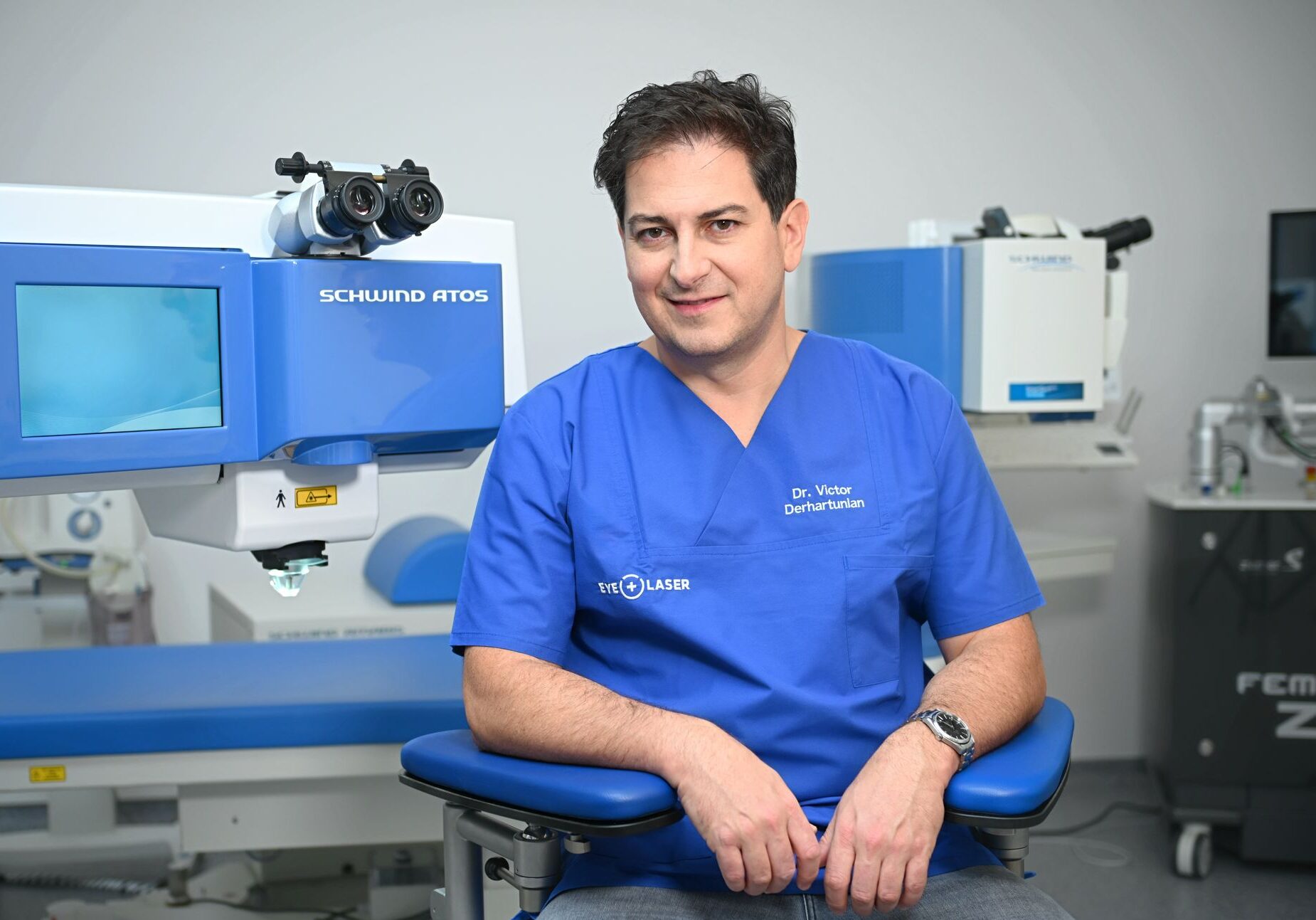
Dr. Victor Derhartunian

“A perfect medical outcome is not achieved through courage, but through meticulous preparation, the use of the world’s best technologies, and absolute respect for the individuality of each eye. My medical goal is to give you back not only your vision, but a piece of boundless quality of life.”
— Dr. Victor Derhartunian, FEBO, Lead Eye Surgeon EyeLaser Zurich

Swiss Precision in Detail: We rely on the global elite of medical technology. With the SCHWIND Amaris 1050RS (including 7D eye tracking, which compensates for even the finest micro-movements of the eye in real time) and the state-of-the-art SCHWIND ATOS femtosecond laser for SmartSight treatment, we work with devices that represent the absolute pinnacle of physical possibilities.

Safety and Transparency According to Swiss Standards

Ein Leben ohne Brille – Erfolgsgeschichten aus Zürich

As a reputable Swiss eye clinic, we do not promise unrealistic miracles or give dubious healing guarantees. Medicine is not exact mathematics, but a highly innovative science. Our promise to you is highest predictability and maximum risk minimization.

Transparency About Risks: Every surgical procedure carries risks. The most common temporary side effects include dry eyes in the first weeks and light effects (halos or glare) during nighttime driving. By using extremely gentle technologies (such as SmartSight), we reduce the risk of dry eyes to an absolute minimum. Before each procedure, we inform you honestly, clearly, and without time pressure about all aspects.

Frequently Asked Questions (FAQ) About Eye Treatment in Zurich

What Do Treatments at EyeLaser in Zurich Cost?

Prices vary depending on medical indication and method used (e.g., TransPRK from approximately CHF 1,500 per eye, SmartSight/FemtoLASIK at higher prices, premium lenses depending on model). After the non-binding initial examination, you will receive a transparent, guaranteed fixed price.

Are There Installment Payment Options for Swiss Patients?

Yes, to make visual freedom accessible to everyone, we offer flexible financing and installment payment models. Speak to our team discreetly about this during the initial consultation.

Which Services Are Included in the Price?

Our fixed price includes the surgical procedure, use of state-of-the-art lasers, all medical consumables, and essential follow-up examinations within the defined period.

Does Health Insurance Contribute to Eye Laser Treatment?

In Switzerland, basic insurance (KVG) generally does not cover eye laser treatments, as they are considered lifestyle procedures. However, many supplementary insurance policies (VVG) contribute with flat-rate payments. Clarify this directly with your insurance company in advance.

How Long Does the Entire Pre-Examination Take?

Plan approximately 1.5 to 2 hours for the comprehensive medical pre-examination. We measure your eyes with state-of-the-art diagnostics to micrometer precision and dilate your pupils to assess the retina precisely.

Must I Be Picked Up by an Accompanying Person on the Day of Surgery?

Yes. Since you will receive medication after the procedure and your vision will initially be blurred, an accompanying person is mandatory for your safe journey home.

May I Drive Myself After the Operation?

On the day of surgery, you may not drive under any circumstances. We will typically confirm at the follow-up examination the next day when you may use the steering wheel (and your driver’s license) regularly again.

How Long Before the Examination Should I Not Wear Contact Lenses?

Soft lenses must be discontinued for at least one week, rigid (hard) contact lenses for at least two to three weeks before the main examination, as they temporarily alter the shape of the cornea.

Does Eye Laser Surgery Hurt?

No. The eye is completely anesthetized with special drops before the procedure. You may feel at most slight pressure or a slight cold sensation, but no pain.

What happens if I blink or move my eye during lasing?

Do not worry, this is a myth. A lid speculum prevents blinking. In addition, we use a 7D eye tracker that monitors the position of your eye over 1,000 times per second. At the slightest movement, the laser immediately adjusts or switches off in milliseconds.

How Safe Is the SmartSight Method Compared to SMILE?

SmartSight is the latest evolution of lenticule extraction. Unlike older procedures, the SCHWIND ATOS laser uses active cyclotorsion tracking. This means: when you lie down and the eye rotates slightly, the laser detects this and compensates for the axes—extremely important for astigmatism.

Can I Go Blind from Eye Laser Surgery?

In modern refractive laser surgery with today’s safety standards, complete blindness from the laser is practically impossible. We always work on the outermost layer of the eye, the cornea, not inside at the optic nerve.

Why Do You Offer TransPRK Instead of Classic PRK?

SmartSurface TransPRK is a “touch-free” procedure. The laser removes the epithelium more gently and precisely than would ever be possible mechanically. This significantly accelerates healing and reduces discomfort after surgery.

What Are Evo Visian ICL Lenses and Who Are They Suitable For?

ICL are implantable contact lenses that are placed in the eye in addition to the natural lens. They are ideal for patients with very high refractive errors, extremely thin corneas, or severe dry eye, as no corneal tissue is removed.

How Do You Effectively Treat Presbyopia?

The most permanent and elegant solution from approximately age 50-55 is refractive lens exchange. The natural lens is replaced with high-tech lenses (trifocal or EDOF). This allows you to see sharply at all distances and you can never develop cataracts later.

Can Cataracts Be Removed with a Laser?

Yes, at EyeLaser we also offer laser cataract surgery. Here, a femtosecond laser performs the highly precise incisions, making the procedure even gentler and more predictable than the manual scalpel method.

How Long Will I Be on Sick Leave After the Procedure?

Depending on the method and occupation. With SmartSight, FemtoLASIK, and ICL, you can often return to work after 1–2 days. With TransPRK, it is best to plan for 4–5 days of downtime (especially for screen work).

When May I Exercise Again or Go to the Gym?

Light jogging is often possible after 3-5 days. Heavy strength training, swimming, or ball sports should be paused for approximately 4 weeks to protect against infections or injuries.

When May I Use Eye Makeup Again?

You should avoid mascara, eyeshadow, and eyeliner for at least one week to prevent tiny particles from entering the eye or rubbing vigorously when removing makeup.

Are Enhancements Included in the Price if the Goal Is Not Immediately Achieved?

Our medical goal is your independence from glasses. Should the desired result not be fully achieved after the initial healing phase in rare cases, medically appropriate enhancement laser corrections within a predefined period (often 1 year) are included in the treatment price.

Why Does EyeLaser Use SCHWIND Brand Devices?

SCHWIND is a renowned manufacturer whose systems (such as the Amaris 1050RS) are known industry-wide for their unmatched ablation speed, tissue preservation, and unique eye-tracking systems. It is uncompromising top quality.

What Is Keratoconus and How Do You Stop Its Progression?

Keratoconus is a progressive corneal weakness. To avoid a later corneal transplant, we strengthen the corneal fibers with a UV light-based method called crosslinking (CXL), or insert modern CAIRS segments.

Is Eye Laser Surgery Suitable if I Have Extremely Dry Eyes?

With severe dry eyes (Sicca syndrome), we advise against LASIK. Better alternatives are then ICL lens implantation or the tissue-sparing SmartSight method, which barely severs the fine corneal nerves.

How Long Does the Result of Eye Laser Treatment Last?

The corneal modification by the laser is permanent. Your farsightedness, nearsightedness, or astigmatism is permanently corrected. Only natural presbyopia (from mid-40s) affects everyone and may later require wearing reading glasses.

How Quickly Can I Get an Appointment for the Free Brief Examination in Zurich?

We strive to serve patients promptly. We can often offer you an appointment for the eligibility check or our live Q&A webinar within a few days. Contact us directly by phone or online!