


Refractive revision surgery in Zurich: expert repair for eye laser & lens complications
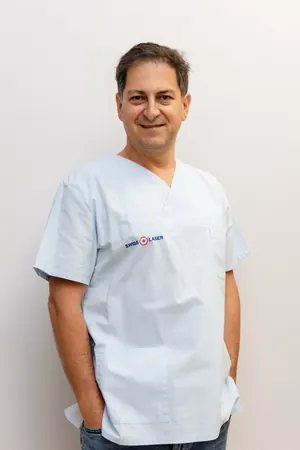
Last updated on 4 October 2026. First published on 27 April 2026. Medically reviewed by Dr. med. univ. Victor Derhartunian, FEBO — specialist in refractive surgery.
Deciding to undergo eye laser or lens surgery is a step toward freedom. All the more distressing when the result is impaired by optical side effects, anatomical factors, or insufficient diagnostics. Light sensitivity, ghosting, chronic dryness, or displaced implants often rob those affected of their quality of life.
The most important message for you is: You do not have to accept compromised vision.
Modern refractive surgery now offers new options to correct even the most complex side effects of previous treatments (such as PRK, LASIK, SMILE, SmartSight or lens implants). As a specialized center for refractive revision surgery, EyeLaser Zurich provides a medical infrastructure designed to correct past errors with the technology of the future. We offer you an independent, data-driven second opinion — and a solution.
Swiss precision and global expertise: Dr. Victor Derhartunian
Correcting a previously treated cornea or replacing an implant is the undisputed supreme discipline of eye surgery. It requires not only steady hands, but also a deep understanding of physics and anatomy.
Dr. med. univ. Victor Derhartunian, FEBO, FWCRS stands for this uncompromising expertise:
- Shaped by the pioneers in Zurich: He completed his specialization, among other places, under Prof. Dr. Theo Seiler at the IROC in Zurich — the place where modern refractive surgery (such as crosslinking) was significantly co-developed.
- AI-assisted planning: As a Key Opinion Leader (KOL) for Schwind Eye-Tech-Solutions, he is involved in the development of AI-assisted surgical planning (ForeSight AI).
- Surgical experience: With around 25,000 refractive procedures, Dr. Derhartunian regularly takes on the highly complex revision cases that other clinics have to decline.
High-end diagnostics: we do not treat based on gut feeling, but on data
A revision procedure requires diagnostic precision work. Our clinic in Zurich has an array of instruments that goes far beyond the standard of traditional ophthalmology. We measure what remains invisible to others:
- Corneal wavefront (MS39, 2nd generation AL): This high-resolution OCT system scans the cornea with over 100,000 measurement points. It provides micrometer-accurate 3D scans down to the deepest corneal layers to precisely localize tissue weakness and irregular astigmatism.
- Ocular wavefront (PERAMIS aberrometer): With 45,000 ultra-high-resolution measurement points, the Peramis analyzes the optical properties of your entire eye. We can precisely trace optical distortions (higher-order aberrations) and, quite literally, see through your eyes.
- Schwind ForeSight AI: This artificial intelligence simulates the surgical outcome in virtual reality before the Schwind Amaris 1050RS laser is activated. The AI calculates an optimised ablation profile to specifically reduce side effects such as halos or double vision.
Our treatment spectrum for complications and side effects
We correct and repair complications from all refractive pre-treatments.
1. Correction of ICL and lens complications
Intraocular lenses (such as the EVO ICL) are excellent implants, but they react extremely sensitively to miscalculations during the initial procedure. We address:
- Incorrect vaulting (lens distance): If the ICL sits too high, there is a risk of an acute glaucoma attack; if it sits too low, the natural lens can become cloudy (cataract). We analyze the fit on OCT and replace the lens with precision.
- Rotation of toric lenses: A rotated ICL leads to significant astigmatism. We reposition the implant precisely to the required axis.
- Endothelial cell loss or intolerance: Safe explantation and switching to alternative procedures.
2. Reconstruction for corneal ectasia (keratectasia)
Instability and bulging of the cornea (often years after LASIK or SMILE) is a serious finding that we can effectively stop and rehabilitate:
- CAIRS implantation (Corneal Allogenic Intrastromal Ring Segments): Instead of rigid plastic rings, we implant customized, biocompatible donor tissue into the cornea to flatten it and improve vision.
- Customized crosslinking (CXL + laser): We combine topography-guided laser smoothing with proven UV stiffening (whose foundations were developed in Zurich) to stabilize the cornea long term.
3. Optical rehabilitation after laser procedures (LASIK, SMILE, PRK)
- Halos, glare & starbursts: Usually the result of optical zones that are too small with older lasers. Using wavefront-guided AI ablations, we enlarge and harmonize these zones with millimeter precision.
- Ghosting & double vision: Caused by decentered (shifted) laser treatments. We re-center the optical profile on your visual axis using the 7D eye tracker.
- Incomplete lenticule extraction: We remove residual tissue left in the cornea after a SMILE or SmartSight procedure.
Second opinion & individualized cost planning
A revision procedure is highly individualized medical precision work and cannot be priced as a flat rate. During a detailed consultation in Zurich, we analyze your eyes using our high-end diagnostics. Dr. Derhartunian will then personally discuss with you the realistic chances of recovery and the exact, transparent cost framework for your specific level of complexity.
Do not give up hope for good vision. Trust in measurable data, artificial intelligence, and absolute medical discretion. Schedule your second-opinion appointment at EyeLaser Zurich.
Frequently asked questions (FAQ) about refractive complications
Can a botched LASIK or SMILE procedure be repaired?
Yes, in the vast majority of cases. Even severe optical side effects such as decentered optical zones or irregular astigmatism can now be repaired or significantly alleviated thanks to AI-assisted wavefront analyses (ForeSight AI) and ultra-precise lasers. We calculate the corrective ablation with micrometer precision.
What can be done about halos, starbursts and glare sensitivity at night?
These phenomena often occur when the treated optical zone from the initial procedure is smaller than your pupil in the dark. With a wavefront-guided enhancement (often touch-free via Trans-PRK), we can enlarge and harmonize this zone, significantly reducing halos and glare.
My ICL lens is causing problems (eye pressure, poor vision) — what now?
Problems after lens implantation are often due to incorrect “vaulting” (the distance between the ICL and the natural lens) or rotation of a toric lens. Using our high-resolution MS39 OCT, we analyze the lens position precisely. An ICL can be repositioned, exchanged, or completely removed using minimally invasive techniques.
What is corneal ectasia, and is it curable?
Keratoconus-like ectasia is a dangerous bulging of the cornea that can occur months or years after an initial procedure. We stop the process with “customized crosslinking” (CXL). To improve vision again, we use modern CAIRS implants (natural donor tissue) to gently flatten the cornea.
How long do I need to wait after the initial procedure before a revision procedure is possible?
That depends on the type of complication. Refractive fluctuations often require a waiting period of 3 to 6 months until the eye has stabilized. However, in acute cases (e.g., high ICL vaulting, flap folds after LASIK, or severe inflammation), action must be taken immediately.
Can extremely dry eyes (dry eye syndrome) after LASIK be treated?
Yes. Chronic dry eyes after a laser procedure are often caused by severed corneal nerves. Before we plan a surgical repair procedure, we stabilize the ocular surface with modern therapies (e.g., punctum plugs or autologous serum drops). In severe cases, we use custom-made scleral lenses to protect the cornea and rehabilitate vision.
Is a second procedure more dangerous than the first operation?
A repair is more complex because the tissue has already been altered. With the right diagnostics, however, it is highly safe. Thanks to our touch-free methods and pre-simulation with ForeSight AI, we drastically minimize the risk. We only operate when our measurements confirm a safe residual corneal thickness.
Does Swiss health insurance cover the costs of the repair?
In Switzerland, refractive procedures are generally considered self-pay services (not covered by basic insurance). However, if the goal is to stop progressive corneal ectasia (a condition with disease value), crosslinking (CXL) is generally covered by mandatory health insurance. We will be happy to clarify cost approval with your insurer on an individual basis.
Which laser treatment is right for your eyes? – The suitability test in 45 seconds
Things like age, eye shape, medical history and lifestyle make an eye treatment perfect for one person but not another. Find out which treatment (if any) could free you from glasses and contact lenses.