More than just a procedure: A strategic treatment

At our clinic, crosslinking is not an isolated procedure but part of an individual, strategic treatment plan. While CXL takes over the biochemical stabilization, it can be useful in some cases to first mechanically stabilize and shape the cornea.

In advanced cases, we may therefore first implant biological ring segments (CAIRS). These immediately strengthen the cornea and improve its shape. Only in a second, later step do we then perform crosslinking – often combined with a surface-smoothing laser treatment – to finally secure the result.

What is corneal crosslinking?

Array

The ultimate goal: Avoiding a corneal transplant

EDOF

A corneal transplant (keratoplasty) is a major surgical procedure with a long healing period and the risk of rejection.

Our modern treatment philosophy has changed this paradigm. Through the early and targeted use of crosslinking to stop the disease, and the use of advanced procedures such as CAIRS to rehabilitate the corneal shape, a corneal transplant can now be successfully avoided in the vast majority of cases. Preserving and strengthening your own tissue is always the best and safest option.

The treatment process: Your day at EyeLaser Zurich

We have designed the entire process to be as comfortable and stress-free as possible for you.

The crosslinking procedures in detail: Safe and individual

We select the most suitable procedure for you after a careful examination.

Feature Epi-off Crosslinking (The gold standard) Epi-on Crosslinking (The gentler alternative)
Procedure The top cell layer of the cornea (epithelium) is gently removed. The epithelium is chemically loosened or remains intact.
Advantage Maximum effectiveness and highest success rate, as the riboflavin can penetrate optimally. Significantly less discomfort in the first few days, faster regeneration.
Recommended for The vast majority of patients to achieve the best possible, lasting result. Selected cases, e.g. for very pain-sensitive patients.

Special case thin cornea: The Sub400 protocol
A corneal thickness of 400 micrometers has long been considered the lower limit. For patients who fall below this value, we offer the special Sub400 protocol We use special riboflavin drops that allow the cornea to swell to a safe thickness before UVA irradiation. This allows us to treat eyes with thinner corneas safely and effectively.

Our expertise: Why the surgeon’s experience is crucial

With crosslinking, precision and experience are key to success.

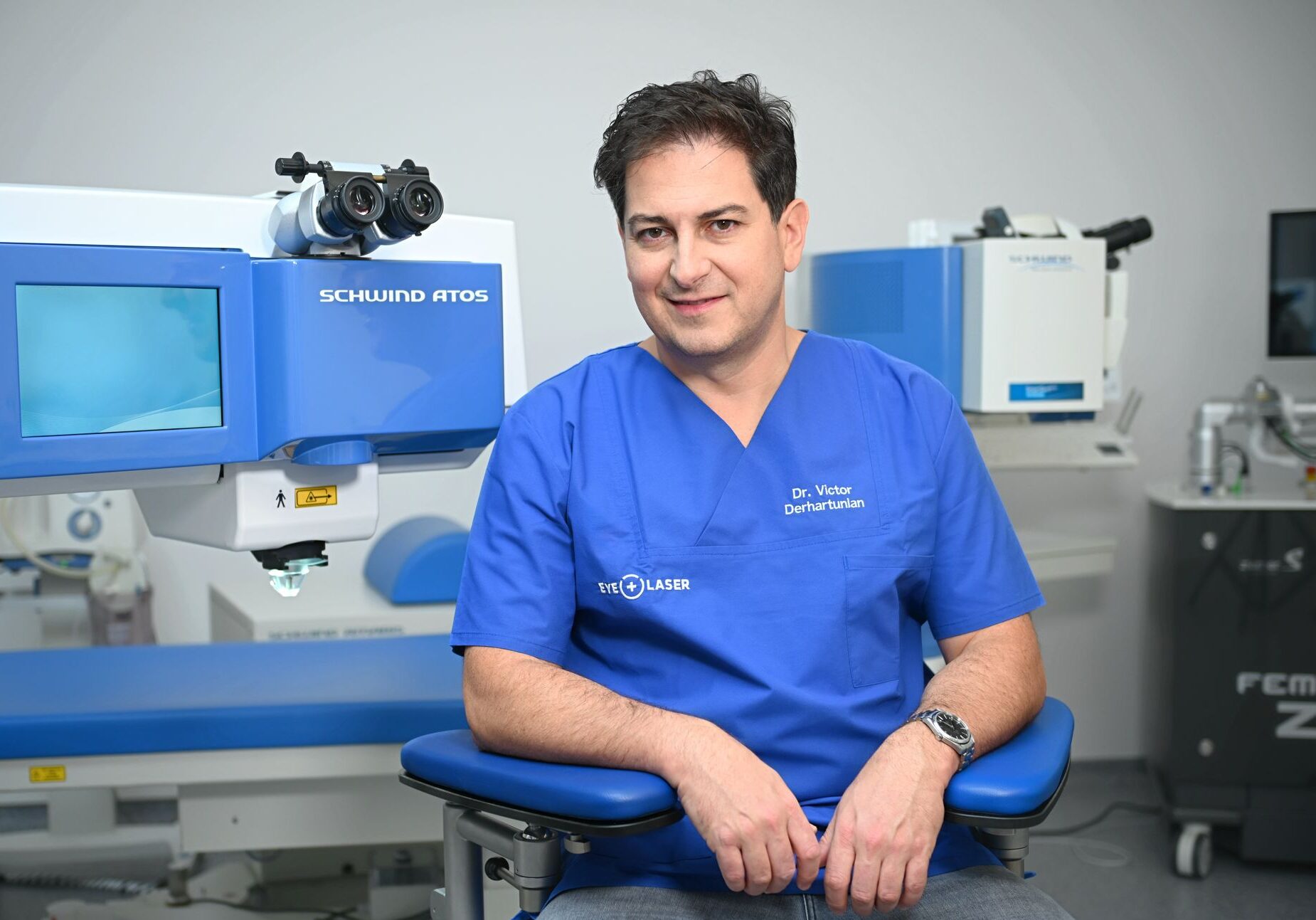
Dr. Derhartunian about his experience:
“I had the privilege of accompanying crosslinking from the very beginning. When I started it at the University Hospital Frankfurt in 2007, it was a brand new, hopeful method. Later, at the IROC Clinic in Zurich, I was able to learn directly from Professor Theo Seiler – the inventor of the procedure. I now pass on this profound experience and understanding of the nuances of the treatment to each and every one of my patients.”

This unique combination of many years of practice and training with the pioneers of the method offers you an invaluable degree of safety at EyeLaser.

Treat degenerative diseases & prevent damage

Crosslinking can stop the protrusion or stiffening (PMD), slow down its progression or cause it to regress. The result: a stable cornea.

Low-risk & effective treatment option

With a success rate of over 95%, crosslinking is extremely effective and can be performed again if stability decreases. The complication rate is less than 3 % .

Correction of visual defects through follow-up treatment

Caused and pre-existing visual defects can be corrected by regularizing the cornea. Lens implantation or trans-PRK improves your vision, allowing you to gain quality of life.

Treat degenerative diseases & prevent damage

Crosslinking can stop the protrusion or stiffening (PMD), slow down its progression or cause it to regress. The result: a stable cornea.

Low-risk & effective treatment option

With a success rate of over 95%, crosslinking is extremely effective and can be performed again if stability decreases. The complication rate is less than 3 % .

Correction of visual defects through follow-up treatment

Caused and pre-existing visual defects can be corrected by regularizing the cornea. Lens implantation or trans-PRK improves your vision, allowing you to gain quality of life.

Advantages of crosslinking for corneal bulging

The two active ingredients used are riboflavin (vitamin B2) and UV radiation. By removing the uppermost corneal layer (epi-off procedure), the vitamin B2 can penetrate deeper into the stroma, where it is activated by UV radiation to produce the desired effect:

Keratoconus is stopped by the fact that the active ingredients stimulate the formation of collagen cross-links and cross-links on the cornea . The absence or insufficient presence of these cross-links causes the instability that ultimately results in the protrusion.

After crosslinking, your cornea has so many stabilizing crosslinks that further curvature is not possible and the cornea can even regulate itself. This in turn creates the perfect conditions for subsequent vision correction.

Your eyes will be anesthetized with eye drops so that you do not feel any pain during the treatment. The top layer of the cornea is then removed, allowing the vitamin B2 (riboflavin) to penetrate deeper into the tissue and the UV light is not filtered out as much. The riboflavin ensures that the UV-A radiation to which the eye is subsequently exposed can be sufficiently absorbed. In crosslinking, the eye is irradiated with UV radiation for half an hour after the administration of vitamin B2.

The intensity of the radiation is regulated in such a way that no tissue damage occurs and yet the formation of new cross-links on the cornea is stimulated. These cross-links provide the necessary stability and prevent the cornea from bulging further. The corneal curvature is then much more uniform, so that the visual defect can be corrected by wearing glasses or by refractive treatment (e.g. lens implantation or Trans-PRK).

Costs and health insurance clarification: We can help you

The question of costs and processing with the health insurance company should not be an additional burden for you.

  • Crosslinking is a recognized mandatory benefit of basic insurance for a diagnosed, progressive keratoconus.
  • A “cost approval” from your health insurance company is required for reimbursement.
  • Our service for you: Our experienced team actively supports you in obtaining cost approval and professionally compiles all the necessary medical documents and reports for you.

The first step towards a stable future: Get advice

Crosslinking is the most important decision to regain control over keratoconus. If you are looking for a safe and proven method performed by one of the most experienced specialists, you have come to the right place.

FAQ: Frequently asked questions about crosslinking in Zurich

Crosslinking can slow down, stop or slightly reverse the protrusion of your cornea. However, visual defects that have already developed remain . Your visual defect can be improved with the help of lens implantation or trans-PRK.

However, before we can correct your visual defect, the cornea must stabilize through crosslinking and the existing (regular or irregular) astigmatism needs time to regularize. Follow-up treatments are possible after six months:

What exactly does crosslinking do for my keratoconus?

Crosslinking is a kind of “reinforcement therapy” for your cornea. Through the combination of vitamin B2 drops (riboflavin) and UVA light, hundreds of new, stable connections are created between the collagen fibers of your cornea. This makes the tissue significantly stiffer and more resistant again, which stops further progression of the cone-shaped bulge in over 95% of cases.

Is the result of crosslinking permanent?

Yes. According to current scientific knowledge and long-term studies over more than 10 years, the stiffening of the cornea achieved by crosslinking is permanent. The goal is to stop the disease once, so that no further interventions are necessary for stabilization.

Will I be able to see better with crosslinking?

The primary and most important goal of crosslinking is to stop the progression of keratoconus, not to improve vision. In some patients, a slight flattening of the cornea and thus a slight improvement in vision occurs as a positive side effect. However, you should not rely on this. A targeted improvement in vision is achieved through other, subsequent procedures.


Do I have to be treated immediately after diagnosis?

Not necessarily. Treatment is necessary when a clear progression – i.e. a deterioration – of keratoconus is proven. We use our high-precision diagnostics with the MS-39 to objectively measure changes and determine the perfect treatment time for you.


Is the crosslinking treatment painful?

The procedure itself is completely painless thanks to numbing eye drops. However, we often hear this concern. Honestly, the first 1-3 days after the procedure (especially with the Epi-off procedure) are uncomfortable. You may experience pain, a foreign body sensation, and severe light sensitivity. However, we will give you effective painkillers and an exact eye drop plan to get you through this phase well.


How long will I be unable to work after crosslinking?

Plan for a downtime of about one week. During this time, the top layer of the cornea (the epithelium) heals. For office work, you can usually return to work after 5-7 days. You should avoid physically strenuous or dirty work for at least two weeks.


When can I drive again after the procedure?

Your vision will fluctuate in the first few weeks after the procedure. You may not drive again until you feel absolutely safe and the legally required visual acuity has been stably achieved again. This can take several weeks and will be checked during the follow-up examinations.


When can I exercise or go swimming again?

Light sporting activities such as jogging or the gym are usually possible again after 1-2 weeks. You should refrain from visiting swimming pools, saunas and steam baths, as well as contact sports, for at least one month to protect against infection.


How much does a crosslinking treatment cost in Switzerland?

The costs for such a specialized procedure can vary. At EyeLaser, you will receive a detailed and transparent cost estimate as part of the preliminary examination. However, the question of cost coverage is more important.


Will my health insurance (basic insurance) cover the costs of crosslinking?

Yes. For a diagnosed and demonstrably progressive (progressing) keratoconus, corneal crosslinking is a recognized mandatory service of Swiss basic insurance. The prerequisite for this is a cost approval, which must be obtained from your health insurance company before the procedure. Our experienced team actively supports you in this process.


My cornea is very thin. Can I still be treated?

Yes, in many cases. The previous lower limit of 400 micrometers is no longer absolute today. At EyeLaser, we use special and safe protocols for such cases, such as the “Sub400 protocol”. The cornea is swollen to a safe thickness with special drops before the treatment is carried out.


Can both eyes be treated at the same time?

For safety reasons and to make your regeneration phase as pleasant as possible, we usually treat the eyes at separate appointments. The interval between treatments is usually one to four weeks.


What are the risks of crosslinking?

Crosslinking is a very safe and proven procedure. As with any procedure, there are rare risks such as delayed healing, infection, or temporary corneal clouding (“haze”). In the hands of an extremely experienced surgeon like Dr. Derhartunian, who has been using the procedure since 2007, the risk is minimal.


Can crosslinking be combined with laser treatment?

Yes, that is one of our great strengths. You can combine the laser (topo-guided Trans-PRK/PTK) directly with crosslinking to stabilize the cornea and smooth its surface at the same time. This can significantly improve the quality of vision.


Why should I have crosslinking performed at EyeLaser in Zurich?

Because you benefit from a unique combination: the immense experience of Dr. Derhartunian, who learned the procedure directly from the inventor, state-of-the-art diagnostics for precise planning, and a team that accompanies you not only medically but also personally throughout the entire process.

Crosslinking costs: TARMED benefit & assumption of costs by the health insurance company

100 percent cost coverage

Crosslinking is now a so-called TARMED health insurance benefit in Switzerland. If you are diagnosed with keratoconus or a similar eye condition, the treatment costs will be covered by your health insurance – even by your basic insurance.

Costs for a life without glasses: Crosslinking vision correction

Since crosslinking has been covered by health insurance as a TARMED service, even the costs for subsequent vision correction – as a combination treatment – can be covered. Crosslinking can be combined with Trans-PRK Premium or ICL treatment:

Healing after crosslinking: what you can expect

After epi-off crosslinking – the preferred method at EyeLaser Zurich – the cornea needs a certain amount of time to regrow the ablated tissue.

Effective & safe: crosslinking risks at a glance

Keratoconus has been successfully treated with crosslinking for over 20 years. 95 percent of all treatments have the desired effect and for every 100 treatments, fewer than three patients have complications – usually only minor ones. This makes crosslinking extremely low-risk, effective and safe for patients.

The UV radiation used has no negative effects on the cornea or the eye. Studies have shown that the exposure is too short and not intense enough to cause damage.

Only a few side effects and after-effects have been documented since 2002, and no serious, irreparable damage has been observed since then. In exceptional cases, it is possible that a:

  • prolonged wound healing.
  • scarring of the cornea, although this is particularly rare and reversible.
  • infection of the cornea (probability > 1 percent).

Get to know the eye experts

Discover our laser eye surgeons in the heart of Zurich

Dr. Victor Derhartunian
Ophthalmologist, specialist in refractive surgery
FEBO

Having learned his craft from the two pioneers of laser surgery, Dr. Victor Derhartunian is one of the leading surgeons in Europe. The senior eye surgeon at EyeLaser in Zurich can advise his patients in 5 languages.

LEARN MORE
Ophthalmologist and eye surgeon
FEBO

Since 2024, Dr. Valery Lenzt Wittwer joins the EyeLaser Zurich team. He specializes in lens surgery and enables patients to live without cataracts and/or visual defects through cataract surgery and ICL lens implantation.

Learn more
Dr. Victor Derhartunian
Ophthalmologist, specialist in refractive surgery
FEBO

Having learned his craft from the two pioneers of laser surgery, Dr. Victor Derhartunian is one of the leading surgeons in Europe. The senior eye surgeon at EyeLaser in Zurich can advise his patients in 5 languages.

LEARN MORE
Ophthalmologist and eye surgeon
FEBO

Since 2024, Dr. Valery Lenzt Wittwer joins the EyeLaser Zurich team. He specializes in lens surgery and enables patients to live without cataracts and/or visual defects through cataract surgery and ICL lens implantation.

Learn more

Questions & answers about crosslinking: