What exactly is CAIRS? The natural solution

Augenlasern Zürich

Imagine you want to support a weakened wooden framework. Would you force in a rigid plastic wedge, or insert a precisely fitting, sturdy piece of wood that integrates perfectly into the structure? CAIRS follow exactly this second, superior principle. They are precisely shaped ring segments made of pure, acellular collagen obtained from a human donor cornea.

The key advantage: Why biological tissue is better than plastic

Choosing CAIRS instead of conventional PMMA rings is a decision for maximum safety and biocompatibility.

Feature CAIRS (Biological tissue) PMMA rings (plastic)
Material Human collagen tissue Acrylic glass (Plexiglas)
Biocompatibility Excellent. The tissue is accepted by the body as “its own” and integrates completely. Moderate. The material always remains a foreign body in the eye.
Risk of complications Very low. Inflammation, melting, or expulsion (extrusion) are extremely rare. Increased. Inflammation, infections, displacement, or extrusion are known risks.
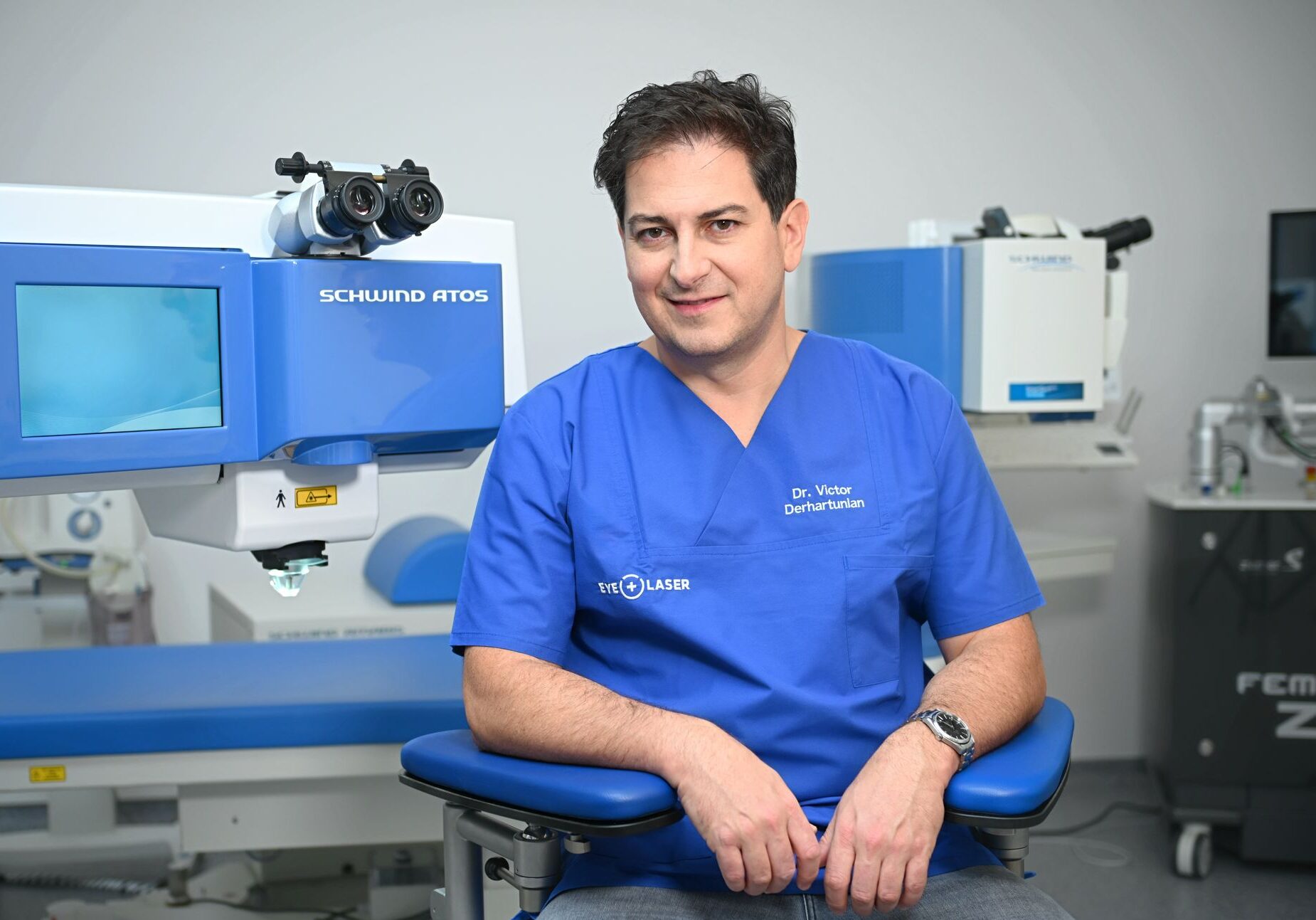
Dr. Victor Derhartunian

Dr. Derhartunian on CAIRS:

“The introduction of CAIRS is one of the greatest advances in the treatment of advanced keratoconus. We can now strengthen and shape the cornea in a way that is in harmony with the eye’s natural structure. The safety and results are far superior to the old plastic rings.”

The blade-free and safe treatment process

Step 1: Precise tunnel creation

Using the femtosecond laser, we create an exact tunnel—completely blade-free and computer-controlled.

Step 2: Gentle implantation

The biological segment is gently placed into the prepared pocket.

Step 3: Immediate stabilization

The segment strengthens the cornea immediately from within and begins to integrate into the tissue.

Results you can see: anonymized case studies

Ein Leben ohne Brille – Erfolgsgeschichten aus Zürich

Initial situation: 32-year-old patient with advanced keratoconus, very poor visual acuity, and intolerance to rigid contact lenses.

Treatment plan: CAIRS implantation for structural stabilization and improved shape.

Result: The corneal shape has improved significantly. The patient can wear glasses again and achieves good everyday visual acuity. A corneal transplant was successfully avoided.

An investment in your quality of life

Presbyopia Zurich

We understand that choosing an advanced procedure such as CAIRS is also a financial consideration. Do not see it as a cost item, but for what it is: a one-time investment in the long-term health of your eyes and in your quality of life. Consider the value: the potential burdens of a corneal transplant are avoided, and the freedom to see more clearly again is priceless.

The traffic-light system: Are you an ideal candidate for CAIRS?

Augenlasern Zürich

🟢 Green light:

  • Patients with moderate to advanced keratoconus.
  • Clear intolerance or insufficient vision correction with rigid gas-permeable contact lenses.
  • The desire to avoid a corneal transplant.
  • No pronounced scarring in the center of the cornea.
Augenlasern in Zürich – Sicher, modern & persönlich

🟡 Yellow light:

  • Patients with early central opacities or a very thin cornea.
  • Cases where a combination with other procedures (e.g., cross-linking) must be planned from the outset.

🔴 Red light:

  • Patients with large, dense scars in the center of the cornea.
  • A cornea that is too thin to provide a safe space even for CAIRS.
  • Acute inflammation or infection of the eye.

The first step toward restoring your cornea

If you suffer from advanced keratoconus and are looking for a safe, modern, biological alternative to plastic rings, CAIRS could be the right solution for you.

Find out in a personal consultation in Zurich whether you are suitable for CAIRS.

FAQ: Frequently asked questions about CAIRS in Switzerland

What is the main purpose of CAIRS?

The main goal of CAIRS is the mechanical strengthening and reshaping of a severely bulging cornea. It helps to normalize the eye’s “architecture” again, which improves visual quality and often makes a corneal transplant unnecessary.

Where does the donor tissue come from, and is it safe?

The tissue comes from official, certified corneal banks and is subject to the strictest controls. It is specially processed so that it no longer contains any living cells (acellular), making it extremely safe and preventing a rejection reaction.

Can my body reject the CAIRS implant?

No. Because the tissue is acellular (free of donor cells), your immune system does not recognize it as foreign. It serves as a purely biological support scaffold that is integrated into your own cornea.

Does CAIRS implantation replace cross-linking?

No, the procedures complement each other perfectly. CAIRS provide mechanical support and reshaping, while cross-linking increases the biochemical stability of the entire cornea. CAIRS are often implanted first and cross-linking is performed in a second step, sometimes even in combination with a laser.

Will CAIRS improve my vision immediately?

CAIRS improve the corneal shape immediately, leading to a rapid improvement in visual quality. However, full integration of the tissue and final stabilization of vision may take several months.

Is CAIRS implantation painful?

No. The procedure is performed with numbing eye drops and is painless. In the first few days afterwards, you may experience a mild foreign-body sensation or pressure, but no severe pain.

How long will I be unable to work after the procedure?

Most patients can return to office work after 3–5 days. You should avoid physically strenuous or dirty work for about two weeks.

How much does CAIRS treatment cost in Switzerland?

CAIRS is a highly advanced elective procedure. The costs are higher than standard cross-linking, but significantly lower than the burdens of a corneal transplant. We will provide you with a transparent, detailed cost estimate.

Will my health insurance cover the costs of CAIRS?

As a rule, the costs of CAIRS are not covered by basic insurance, as it is an advanced procedure for visual rehabilitation. Some supplementary insurance plans may contribute. We will support you in clarifying this.

What is the difference between CAIRS and Intacs/Kerarings?

The fundamental difference is the material: CAIRS are made of natural human tissue, while Intacs or Kerarings are made of rigid plastic (PMMA). This makes the biocompatibility and safety profile of CAIRS far superior.

How long do the CAIRS segments last?

Because they fully grow into the cornea and become part of the tissue, they are designed as a permanent, lifelong solution.

Can the segments be removed again if necessary?

Although they are designed to remain permanently, the segments can be surgically removed if needed.

I do not live directly in Zurich. How involved is the treatment?

We regularly care for patients from all over Switzerland—from Geneva to Bern and down to Ticino. Since CAIRS implantation is an outpatient procedure, you generally only need to be in Zurich for the treatment day and the important first follow-up check. Further check-ups can often be coordinated in consultation with your local ophthalmologist.

Is there an age limit for CAIRS?

There is no strict age limit. What matters is the condition of the cornea and the overall health of the eye. The procedure is used in adults of all ages when indicated.

What happens if I still need glasses after CAIRS?

That is normal. CAIRS optimize the corneal shape, but some residual refractive error may remain. This can often be corrected very well with much weaker, simpler glasses. In some cases, an ICL lens can also be implanted for final correction.