Our procedures for vision improvement: An overview

We do not see these procedures as isolated options, but as tools in a modular system that we combine individually for you.

Augenlasern Zürich

1. Topography-guided surface lasers (Trans-PRK / Trans-PTK): Smoothing the cornea

The cornea, deformed by keratoconus, causes distorted vision, glare, and halos. Topography-guided laser treatment acts like a high-precision digital tool that gently and specifically smooths this irregular surface.

The decisive difference from a normal eye laser treatment lies in the goal: it is not primarily refractive (i.e., the correction of a prescription), but therapeutic. Therefore, this procedure is often referred to as phototherapeutic keratectomy (PTK) or in its contactless form as Trans-PTK, while the technical execution is similar to a Trans-PRK . The goal is always the regularization of the corneal shape to achieve better visual quality.

2. Biological stabilization with CAIRS: Strengthening the foundation

For eyes with severe bulging, CAIRS (Corneal Allogenic Intrastromal Ring Segments) are a revolutionary option. Instead of artificial plastic implants, we use precisely shaped segments made of human donor corneal tissue. These are excellently accepted by the body, strengthen the tissue from within, and flatten the steep bulge.

Eyelaser

3. Implantable Contact Lenses (ICL): The final visual acuity

After the shape of the cornea has been improved as much as possible, residual refractive error can often remain. The implantable contact lens (ICL) is a wafer-thin, flexible lens that is implanted into the eye in addition to the body’s own lens to precisely correct even high refractive errors.

Direct comparison of the procedures

Procedure Main Goal Ideal for… Type of Procedure
Topo-guided Trans-PRK / Trans-PTK Smoothing & regularizing the surface Patients with stable corneas where irregular astigmatism is the main cause of poor vision. High-precision therapeutic surface laser treatment
CAIRS Strengthening structure & improving shape Patients with severe bulging and structurally weakened cornea, often as the first step of rehabilitation. Implantation of biological tissue
ICL Precisely correcting refractive error Patients whose corneal shape is already stabilized and improved, to correct the remaining residual refractive error. Implantation of an additional lens in the eye

First stabilize, then rehabilitate

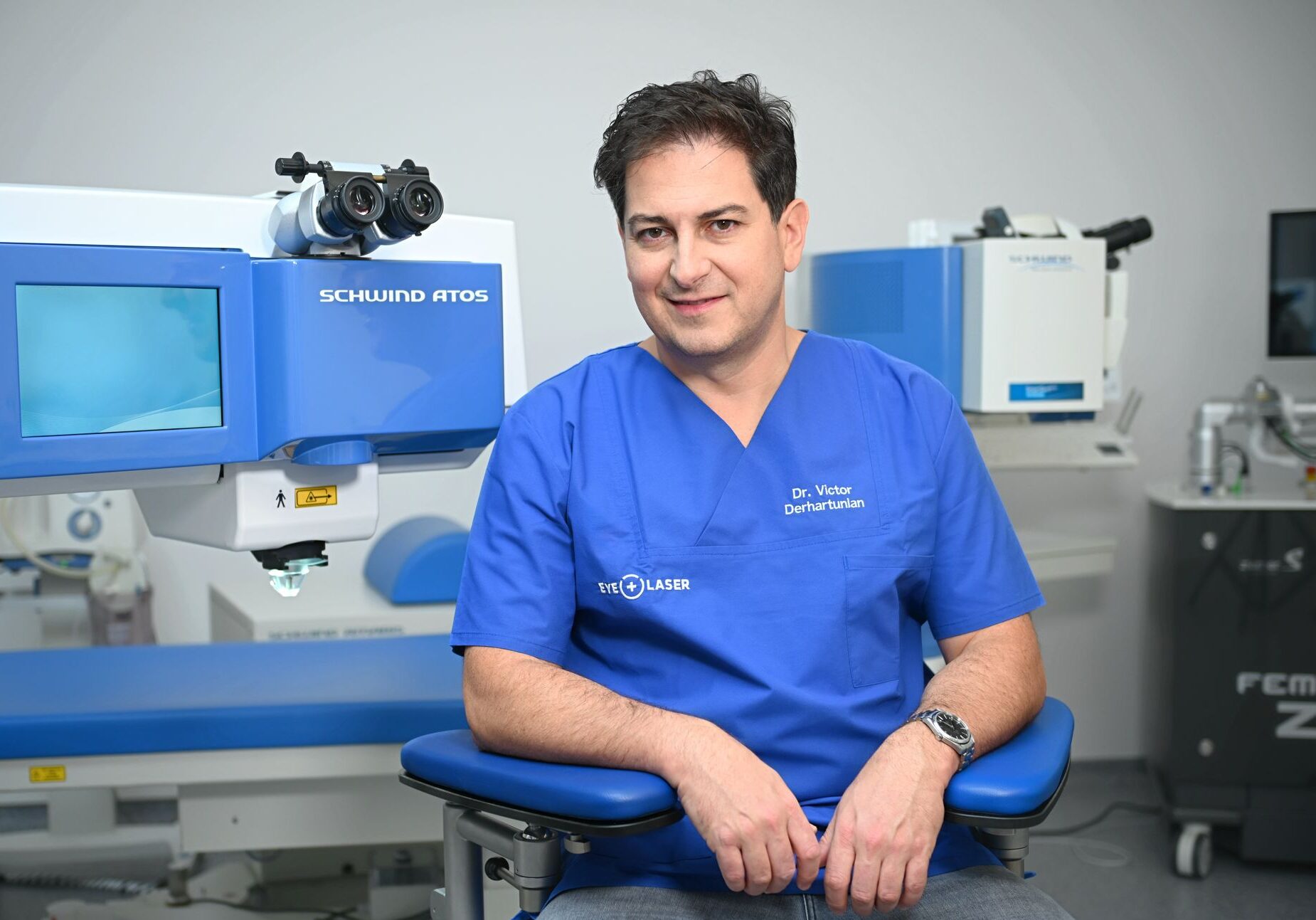
Dr. Victor Derhartunian

Our philosophy is clear: First stabilize, then rehabilitate. At EyeLaser Zurich, we offer you a spectrum of state-of-the-art, proven procedures to improve the shape of your cornea, reduce optical errors, and give you back the best possible vision.

Dr. Derhartunian on visual rehabilitation:

“Stopping keratoconus is an exact science. Restoring vision afterwards is an art. It requires a deep understanding of corneal biomechanics and the ability to strategically combine various state-of-the-art procedures. Our goal is to develop a tailor-made plan for each individual that safely and effectively utilizes their full visual potential.”

Results you can see: anonymized case studies

Ein Leben ohne Brille – Erfolgsgeschichten aus Zürich

Case study:

  • Initial situation: 28-year-old patient with advanced keratoconus, could no longer drive at night due to severe glare and halos.
  • Treatment plan: Step 1: CAIRS implantation. Step 2 (6 months later): Crosslinking + Topo-guided Trans-PTK.
  • Visual proof: [Image of corneal topography BEFORE (red, steep)] vs. [Image of corneal topography AFTER (green, flatter, more centered)]

Result: Cornea significantly regularized. Patient can drive safely again at night and achieves good visual acuity with light glasses.

Your guide: Which step could be relevant for you?

Presbyopia Zurich

This tool is for orientation purposes only and does not replace medical advice.

  • Question 1: Has your keratoconus been medically confirmed but not yet stopped by crosslinking?
  • Question 2: Is your keratoconus already stable, but you suffer from severely distorted vision, halos, or glare?
    • Yes, visual quality is my main problem. -> Then procedures for shape improvement such as Topo-guided Trans-PRK/PTK or CAIRS are relevant for you.
  • Question 3: Is your vision already good after treatment, but the remaining high glasses prescription bothers you?

Discover your full visual potential

The most important step has been taken: your keratoconus is under control. Let us find out together what possibilities modern eye surgery offers you to improve your vision and quality of life.

Schedule a consultation in Zurich and find out what is possible for your eyes.

FAQ: Frequently asked questions about visual rehabilitation

What is a realistic goal for vision improvement?

The goal is to achieve your best-corrected visual acuity and minimize disruptive optical errors. Complete freedom from glasses is possible but not always the primary goal. Improving quality of life, e.g., through safe night driving, is the priority.

Do I have to undergo all the procedures mentioned here?

No, absolutely not. Many patients only require a single step, e.g., a Topo-guided Trans-PRK/PTK in combination with crosslinking. The multi-stage plan is reserved for complex or very advanced cases.

How long do I have to wait between individual treatment steps?

The healing and stabilization phases are crucial. Typically, you wait at least 6 months between major procedures such as a CAIRS implantation and the next step (e.g., laser).

Why can't I just continue to wear hard contact lenses?

For many patients, rigid gas permeable contact lenses are an excellent long-term solution. Surgical rehabilitation is primarily intended for patients who cannot tolerate lenses, suffer from dry eyes, or desire a lifestyle without the daily handling of contact lenses.

Does health insurance cover the costs of these procedures?

While crosslinking for stabilization is a mandatory benefit, vision improvement procedures (laser, CAIRS, ICL) are usually considered elective services and are not always covered by basic insurance. We will provide you with a transparent and detailed cost estimate.

Are these procedures painful?

All procedures are performed under local anesthesia with eye drops and are painless. With Trans-PRK/PTK, discomfort may occur in the first 2-3 days after the procedure, which we can treat effectively with medication.

What are the main risks of CAIRS implantation?

Since it involves biological tissue, the risks are very low. As with any surgical procedure, there is a minimal risk of infection. The risks of rejection or extrusion, which exist with plastic rings, are practically eliminated with CAIRS.

How is it decided whether laser or CAIRS is better for me?

Simply put: the laser (Trans-PRK/PTK) is ideal for “fine-tuning” and smoothing an already good basic corneal shape. CAIRS are ideal for fundamentally “reconstructing” and supporting a severely deformed cornea. The decision is made based on your exact corneal topography.

Can my vision also deteriorate after one of these procedures?

The risk of permanent vision deterioration is extremely low when the indication is correct and the procedure is performed by an experienced surgeon. However, temporary fluctuations in vision during the healing phase are normal and to be expected.

Can keratoconus progress again after successful rehabilitation?

If crosslinking has been performed, the risk of renewed progression is extremely low. According to current knowledge, the stability achieved through CXL is permanent.