Two paths to perfect vision: Understanding the difference

Eyelaser

Zurich is a city that tolerates no compromises—from the luxury storefronts on Bahnhofstrasse to the panoramic view from Uetliberg. To truly enjoy the architectural details of Niederdorf or the sparkle of Lake Zurich, you need vision of the highest quality.

Many patients come to our practice in Seefeld and ask, in general terms, for “lens implantation.” In modern ophthalmology, however, this term is ambiguous. Our task is to differentiate precisely in order to find the method that suits your age and lifestyle.

Global standards (ESCRS, AAO) and our clinical experience clearly distinguish:

  1. ICL (Implantable Collamer Lens) – phakic lenses: An “additional” lens for younger people.
  2. RLE (Refractive Lens Exchange) – lens exchange: A “replacement lens” for people in the second half of life.


Phakic lenses (ICL) – the option for young and active people

Eyelaser Zurich

Imagine a contact lens that you never feel, never have to remove, and that does not dry out. That is the phakic ICL lens (e.g., EVO Visian ICL). It is placed between your natural iris and your body’s own lens.

The key benefits of ICL:

  • Reversibility: Unlike laser treatment, the lens can theoretically be removed again (e.g., if you develop cataracts in 30 years).
  • High corrections: Corrects prescriptions that a laser cannot treat safely (up to -18 diopters).
  • UV protection: The Collamer material offers an integrated UV filter—ideal for summer at the lido or winter in the Swiss Alps.

Refractive lens exchange (RLE) – freedom from 45

Eyelaser Zurich

With age, the natural lens loses elasticity (presbyopia) and later becomes cloudy (cataract). Pure corneal laser correction cannot restore the lens’s elasticity. The solution is lens exchange (RLE)—technically identical to cataract surgery, but with the goal of freedom from glasses.

In doing so, we remove the worn natural lens and replace it with a state-of-the-art implant (e.g., trifocal or EDOF lenses).

The key benefits of RLE:

  • No more reading glasses: You can see your smartphone, the dashboard, and mountain peaks sharply.
  • No more cataracts: The artificial lens cannot become cloudy. An investment for the rest of your life.

Emotions, fears, and decisions – What matters to patients in Zurich?

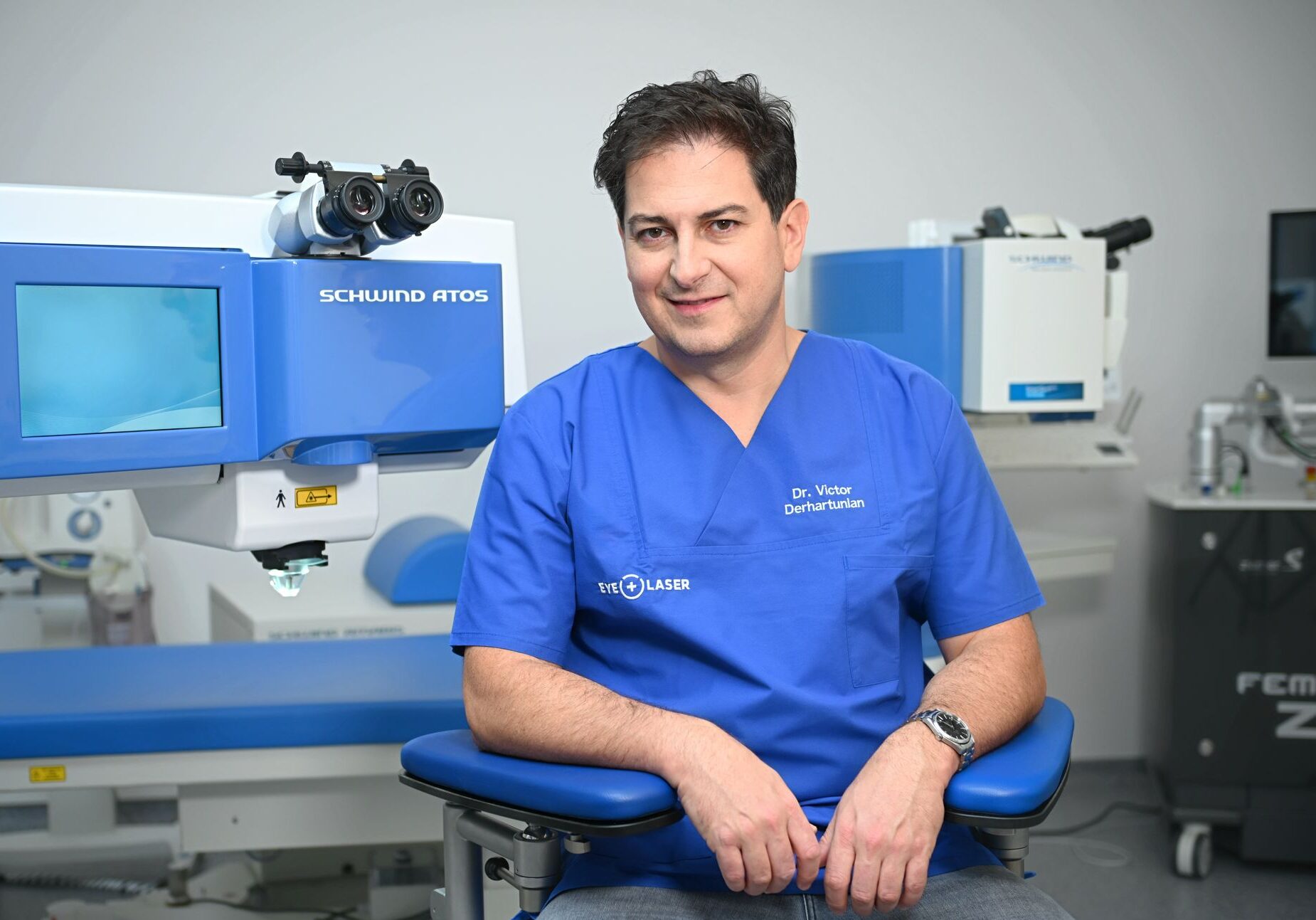
Dr. Victor Derhartunian

The decision to undergo eye surgery is rarely purely rational, even if we Swiss like to weigh up the facts. In Zurich, where high professional demands (banking, tech, medicine) meet an active lifestyle, the fear of losing control is the central issue.

Typical thoughts are: “What if something goes wrong?”, “Can I afford time off work?”, “Is the result permanent?”. Set against this is the deep desire for freedom—waking up in the morning without having to search for your glasses, or having clear vision while swimming in the Limmat.

Expert opinion:

“In my practice in Zurich, I see every day that patients are not simply looking for ‘diopter correction.’ They are looking for safety, trust, and an improvement in their quality of life. Many tell me: ‘Doctor, I do not want to be dependent anymore.’ I understand that behind every eye there is a person with hopes and fears. That is why at EyeLaser we do not offer assembly-line treatment, but a tailored transformation with the guarantee of personal responsibility.”
Dr. med. Victor Derhartunian, Chief Physician, EyeLaser Zurich

Suitability traffic light: Which procedure is right for me?

Ein Leben ohne Brille – Erfolgsgeschichten aus Zürich

This system helps you with initial orientation. The final decision is always made by the surgeon after a thorough examination.

🟢 GREEN LIGHT (ideal candidates):

  • For ICL: Age 21–45, stable prescription for >1 year, high myopia (over -6 to -8 dpt) or cornea too thin for laser.
  • For RLE: Age 50+, reading glasses are a major nuisance (presbyopia), early cataract, desire for total freedom from glasses (replacement for progressive lenses).
Ein Leben ohne Brille – Erfolgsgeschichten aus Zürich

🟡 YELLOW LIGHT (assessment required):

  • People with diabetes (provided values are stable and there is no retinal damage).
  • Patients after previous eye surgeries.
  • People with unrealistic expectations of “eagle eyes” in every lighting condition (especially with multifocal RLE).
  • Professional drivers who primarily drive at night (here the lens type, e.g., EDOF instead of trifocal, must be chosen carefully).

🔴 RED LIGHT (not suitable – look for alternatives):

  • Active eye inflammations.
  • Severe degenerative retinal diseases (e.g., advanced macular degeneration).
  • Pregnancy and breastfeeding (hormones change refractive power).
  • Anterior chamber depth too shallow (for ICL) – risk of glaucoma.

Method comparison: At a glance

Feature Phakic lens (ICL) Lens exchange (RLE / RLA)
Primary goal Correction of high prescriptions in younger patients Correction of presbyopia & cataract
Natural lens Remains in the eye (accommodation preserved) Is removed and replaced
Reversibility Yes, fully reversible No, permanent change
Typical age 21–45 years 45–80+ years
Reading correction No (except monovision) Yes (via multifocal/EDOF technology)
Cataract risk Minimal (possible later in life) Eliminates the risk forever
Investment Premium price segment Premium price segment

The process: Your path to new vision

To reduce anxiety, we will walk you through your surgery day at EyeLaser Zurich

Arrival (08:00)

Reception at our practice in Seefeld. Relaxed atmosphere.

Preparation (08:15)

You will receive numbing eye drops and, if desired, a mild sedative tablet.

The procedure (08:45)

Dr. Derhartunian performs the implantation. Duration approx. 15 minutes. You will feel pressure, not pain.

Relaxation (09:05)

A short rest break with coffee or tea.

Journey home (09:30)

You will leave the clinic wearing sunglasses. Please arrange to be picked up.

Behavioural recommendations

Presbyopia Zurich

Your safety at EyeLaser Zurich is our top priority.

  • Before the Procedure: Observe a contact lens break (soft: 1 week, hard: 2–3 weeks). No make-up on the day of surgery.
  • After the procedure: Do not rub your eyes. Follow the eye-drop schedule strictly. Take it easy for 2 weeks (no sauna, no intense sport).

Your “Zurich Concierge” service

We know that our patients have a busy schedule.

  • Location: Our practice is centrally located right next to Bahnhofstrasse, with excellent access.
  • Travel: For patients from Zug, Lucerne, or Eastern Switzerland, we are happy to arrange hotel recommendations nearby for the first night after the procedure, so you can start the next day feeling relaxed.

Suitability check in Zurich in 15 minutes

Do not guess whether ICL or RLE is better for you. Get clarity with a non-binding short check at our practice in the heart of Zurich.

Book your suitability check now

FAQ – 15 frequently asked questions (Zurich region & Switzerland)

Here you will find answers to specific questions that patients from the Canton of Zurich and German-speaking Switzerland frequently ask us.

What exactly does lens implantation (ICL or RLE) cost in Zurich?

Costs are in the premium segment, typically between CHF 4,500 and CHF 6,000 per eye, depending on the lens selected (e.g., toric for astigmatism or multifocal). At EyeLaser Zurich, this usually includes all preliminary examinations, the custom-made lens, the procedure in our state-of-the-art operating theatre, and aftercare.

Does Swiss health insurance (KVG) or supplementary insurance (VVG) cover the costs?

In principle, the procedure is considered “comfort medicine” and is not a mandatory benefit of basic insurance (KVG).
Exception: In cases of extreme refractive errors (e.g., >10 diopters) or anisometropia (large difference between the two eyes), it may be possible to obtain approval via IV (disability insurance). We support you with the medical justification. Some supplementary insurances (VVG) pay a small contribution (often around CHF 200–500).

Can I pay for the surgery in instalments?

Yes. In cooperation with specialised financial service providers in Switzerland, we offer flexible instalment payment models. Many patients use this to spread the investment in their quality of life over 12 to 24 months.

How quickly can I return to office work/screen work?

Zurich is a city of working people. The good news: with ICL, vision is often already very good the next day. We recommend taking 2–3 days off. With lens exchange (RLE) using multifocal lenses, the brain needs some time to adapt, but office work is usually possible after 2–3 days.

Am I allowed to swim in Lake Zurich or the Limmat after surgery?

We Swiss love our waters. However: in the first 2 weeks, the risk of infection is increased. Public waters (lake, river) and swimming pools contain germs. Showering is allowed (keep your eyes closed), but putting your head under water is off-limits for at least 14 days.

Is skiing or hiking in the Alps safe with implants?

Absolutely. ICL lenses even have integrated UV protection, which is a major advantage in the high-altitude sun of the Swiss Alps. Since the lens sits inside the eye, it cannot fog up or slip.

Can I drive through the Gubrist or Uetliberg tunnel at night? (Topic: glare)

Yes. Modern lenses (especially EVO ICL and EDOF lenses with lens exchange) are optimised for modern driving.

  • With ICL: Night vision is excellent.
  • With multifocal RLE: At first, “halos” (rings of light) may appear around headlights. This is normal and usually disappears as the brain adapts to the new optics (neuroadaptation).
What is the difference between “cataract surgery” and “lens exchange”?

Technically, it is the same procedure. Cataract surgery is performed because the lens is diseased (cloudy) (insurance covers the basic option). Refractive lens exchange (RLE) is performed for lifestyle reasons to achieve freedom from glasses, often with premium lenses (self-pay).

Will I feel the lens in my eye?

No. The lens is placed in an area where there are no nerve endings. It becomes part of your body. You will feel it no more than you feel a dental filling.

Is the ICL really reversible?

Yes, that is its major advantage over laser treatment. If better technology becomes available in 20 years or you develop cataracts, the ICL can be removed without difficulty.

Am I too old for ICL or too young for RLE?
  • Under 45: Usually ICL (preserves accommodation).
  • Over 50: Usually RLE (replacement of the ageing lens).
  • 45–50: The “grey zone.” Here, Dr. Derhartunian decides on an individual basis.
What happens if I have astigmatism?

This is corrected at the same time. We use special “toric” implants. The result is often better and more stable than with contact lenses, which can rotate in the eye.

How safe is the procedure?

No surgery is 100% risk-free, but lens implantations are among the most common and safest procedures in the world. The risk of a severe infection is in the per-mille range and is minimised by our strict hygiene protocols.

Why should I choose Dr. Derhartunian and not a chain clinic?

In chain clinics, doctors often change. At EyeLaser Zurich, you benefit from the “chief physician principle.” Dr. Derhartunian performs the surgery (or supervises it directly). You go straight to the expert.

What if I still do not see perfectly after surgery?

If a slight residual refractive error remains (in around 2–5% of cases), we perform a free fine adjustment (“touch-up”), usually by laser. This is part of our quality promise.