


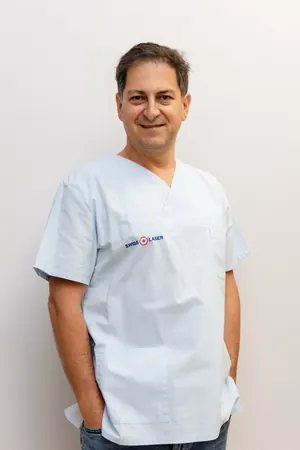
 Medically reviewed by Dr. med. univ. Victor Derhartunian, FEBO
Ophthalmologist · Last updated: 16 September 2026
Before the day of surgery: the free consultation.Strehlgasse 33, 3rd floor · five minutes on foot from Zurich main station · Mon–Fri 09:00–18:00
The days before: how to prepare
The full pre-assessment is behind you, the method is decided. The day itself needs little preparation, but the little there is matters.
Soft lenses at least one week, hard lenses four weeks, ortho-k lenses three months before the procedure. The cornea should have its natural shape, as it did at the pre-assessment.
Nothing on eyes and face on the day and the evening before. Residues interfere with sterility and can get into the eye.
No fasting needed, as there is no general anaesthetic. A light breakfast or lunch is in fact sensible. No alcohol on the day.
Take your regular medication as usual. Tell us beforehand what you take if anything has changed since the pre-assessment.
You must not drive yourself. A companion is pleasant but not compulsory if you travel home by train, tram or taxi. Those coming from further away often stay overnight in Zurich and come for the check-up in the morning.
Sunglasses, comfortable clothes, a top with buttons or a zip (nothing to pull over your head), your glasses for the way there and your companion’s phone number.
The day itself: six steps
Arrival and check
We check your prescription one last time, discuss open questions and start the drops. You sign the consent form if that has not already happened.
Anaesthetic drops
Anaesthetic and disinfecting drops. After a few minutes you barely feel the eye. There is no injection and no general anaesthetic.
Positioning and lid holder
You lie comfortably, your head resting in a hollow. A lid holder keeps the eye open, so you do not have to fight the urge to blink. Dr. Derhartunian announces every step.
The laser
Depending on the method the SCHWIND ATOS (SmartSight) or the AMARIS 1050RS (Femto-LASIK, Trans-PRK) is used. You fixate a light; the eye tracker follows every movement. The laser itself works for seconds to a few minutes per eye.
Rest
After both eyes you rest for 20 to 30 minutes with your eyes closed. Then a short check, the drops to take home and the plan for the coming days.
The way home
With sunglasses, because the eyes are sensitive to light. At home: eyes closed, sleep or rest. No television or screens today.
What you feel, by method
| Method | During the procedure | The first hours | The next day |
|---|---|---|---|
| SmartSight | pressure and lights for about 30 seconds per eye | slight burning, watering, blurred vision | usually already fine for everyday life |
| Femto-LASIK | pressure while the flap is created, a brief dark phase | burning and a foreign-body feeling for a few hours | usually already fine for everyday life |
| Trans-PRK | no contact with the eye, only light | stronger burning over two to three days, bandage lens | still blurred, the bandage lens stays |
All three procedures are painless during treatment. The differences show in the first days: Trans-PRK asks for the most patience, but works without a cut and without a flap.
The first 24 hours at home
Drops as planned
Antibiotic and anti-inflammatory drops plus artificial tears. The plan comes in writing; wash your hands first and do not touch the eye with the bottle.
Sleep with protection
On the first night you sleep with the protective goggles provided, so you do not rub your eye in your sleep. No rubbing in the first week.
Screens and reading
Not today. From the next day in short spells, from day two or three usually without restriction. After Trans-PRK it takes about a week.
Light and water
Sunglasses outdoors, no water in the eye while showering, no swimming pool, no sauna and no eye make-up for a week.
The check-up the next day and what follows
The day after the procedure we see you briefly: vision test, a look at the cornea, with Femto-LASIK a check of the flap, with Trans-PRK a check of the bandage lens. Then follow the checks after one week, after one month and after three months; these are included in the fixed price, after which the annual check is chargeable. Sport without physical contact is possible from the second week, contact sport from week four to six. The whole healing process is described on the laser eye surgery overview.
Further reading
laser eye surgery overview · all prices · correction after surgery elsewhere · laser eye surgery abroad or in Zurich · how to spot a good clinic
Frequently asked questions about the day of surgery
How long am I in the clinic on the day?
Plan half a day; you are usually in the clinic for about two hours. The procedure itself takes 15 to 20 minutes for both eyes, the rest is preparation, drops, a short rest and the final check.
Does it hurt?
No. The eye is numbed with drops, there is no injection. You feel pressure and see lights, but no pain. In the first hours afterwards the eyes burn and water, which is normal and passes with drops and rest.
May I eat and drink beforehand?
Yes, eat as usual. No fasting is needed because there is no general anaesthetic. Avoid alcohol on the day.
What if I blink or move during treatment?
A lid holder keeps the eye gently open, so you cannot blink. The laser follows your eye with an eye tracker many hundred times per second and pauses if movement is too large. You cannot do anything wrong.
Can I drive home myself?
No. You must not drive on the day because vision is still blurred and the drops affect the pupil. Come with a companion, by public transport or by taxi. The clinic is five minutes on foot from the main station.
When will I see clearly again?
After SmartSight and Femto-LASIK most people see well enough for everyday life the next day. After Trans-PRK a bandage lens stays for a few days and vision clears over the first week. The final result stabilises over weeks to a few months.
When can I work again?
Screen work is usually possible from the second or third day after SmartSight and Femto-LASIK, after about a week following Trans-PRK. Many people schedule the procedure for a Thursday or Friday and use the weekend to recover.
What do I do if something feels wrong in the evening?
You have the surgeon’s mobile number, around the clock. Severe pain, a sudden deterioration or a markedly red eye are reasons to call at once. Burning, watering and light sensitivity on the first evening are normal.
Ready for the first step?Free consultation, also by video call · How to find us