Our patients rate us 4.9 out of 5 — 118 Google reviews

Around 25’000 refractive procedures2’500–3’000 laser procedures a year
Since 2006 in refractive surgeryevery laser procedure performed personally by Dr. Derhartunian

Read all reviews →

In brief

What is presbyopia, and what helps in Zurich?

Presbyopia is the age-related loss of near focusing: from around 40, the eye’s lens becomes stiffer and small print blurs. At EyeLaser Zürich, there are three ways to be free of reading glasses: PresbyMAX for CHF 3’300 per eye, Allotex TransForm or a lens replacement for CHF 5’000 per eye each. The pre-examination shows which one is suitable.

Presbyopia at a glance — EyeLaser Zürich
Medical term presbyopia, colloquially age-related farsightedness; ICD-10 H52.4
Who is affected? Every eye, usually from around 40; around 1.8 billion people worldwide (Fricke et al. 2018)
Typical signs holding your phone and newspaper further and further away, needing more light to read, tired eyes after screen work
Assessment pre-examination CHF 300 (credited if you have treatment): corneal tomography, lens density, pupil, tear film
Treatments PresbyMAX (laser, usually as hybrid monovision) · Allotex TransForm (corneal inlay) · lens replacement with an EDOF or trifocal lens
Health insurance basic health insurance: no (elective procedure); supplementary insurance sometimes pays CHF 500–1’500 — obtain cost approval before the procedure, we will support you with this

What is presbyopia? A simple explanation

Presbyopia is not a disease but a natural change in the eye that sooner or later affects everyone, usually from around 40. Behind the pupil lies the eye’s lens, which is elastic in younger years and can curve more strongly when looking at something close. In this way, the eye automatically adjusts its focus from distance to near, and specialists call this ability accommodation. With increasing age, the lens becomes firmer and can no longer curve enough to focus on near objects. Text and objects close up then become blurred, while distance vision remains sharp.

Why age-related farsightedness is not the same as farsightedness

Colloquially, presbyopia is also called age-related farsightedness, but it has nothing to do with actual farsightedness (hyperopia). People are usually farsighted from a young age, because the eye is slightly too short in relation to its refractive power. Presbyopia, on the other hand, affects every eye, whether it has normal vision, is nearsighted or farsighted. Nearsighted people often notice it later, because they can still read well up close without glasses.

How to recognize presbyopia in everyday life

  • You hold your phone, newspaper or menu further and further away from your eyes when reading.
  • You need much more light to read than before, especially in the evening and in dim lighting.
  • After reading or working at a screen for a long time, your eyes burn, sometimes with headaches or tiredness.
  • Switching your gaze from your phone to the distance and back takes longer until everything is sharp again.

How presbyopia develops over the years

The first signs usually appear at around 40, a little earlier for some and much later for others. After that, presbyopia slowly increases until around the age of 60 and then remains largely the same. This is why reading glasses have to be strengthened several times during these years, and unfortunately eye training does not stop this development, because the lens itself loses elasticity over time.

What helps against presbyopia

Reading glasses or progressive glasses reliably compensate for the missing near vision, but always have to be within reach. Multifocal contact lenses are an invisible alternative, provided the surface of the eye is not too dry. If you want to live permanently without reading glasses, you will find three treatments below: PresbyMAX, Allotex TransForm and lens replacement. Only the pre-examination with precise measurements of the cornea and lens shows which option suits your eyes.

Who treats presbyopia at EyeLaser Zürich?

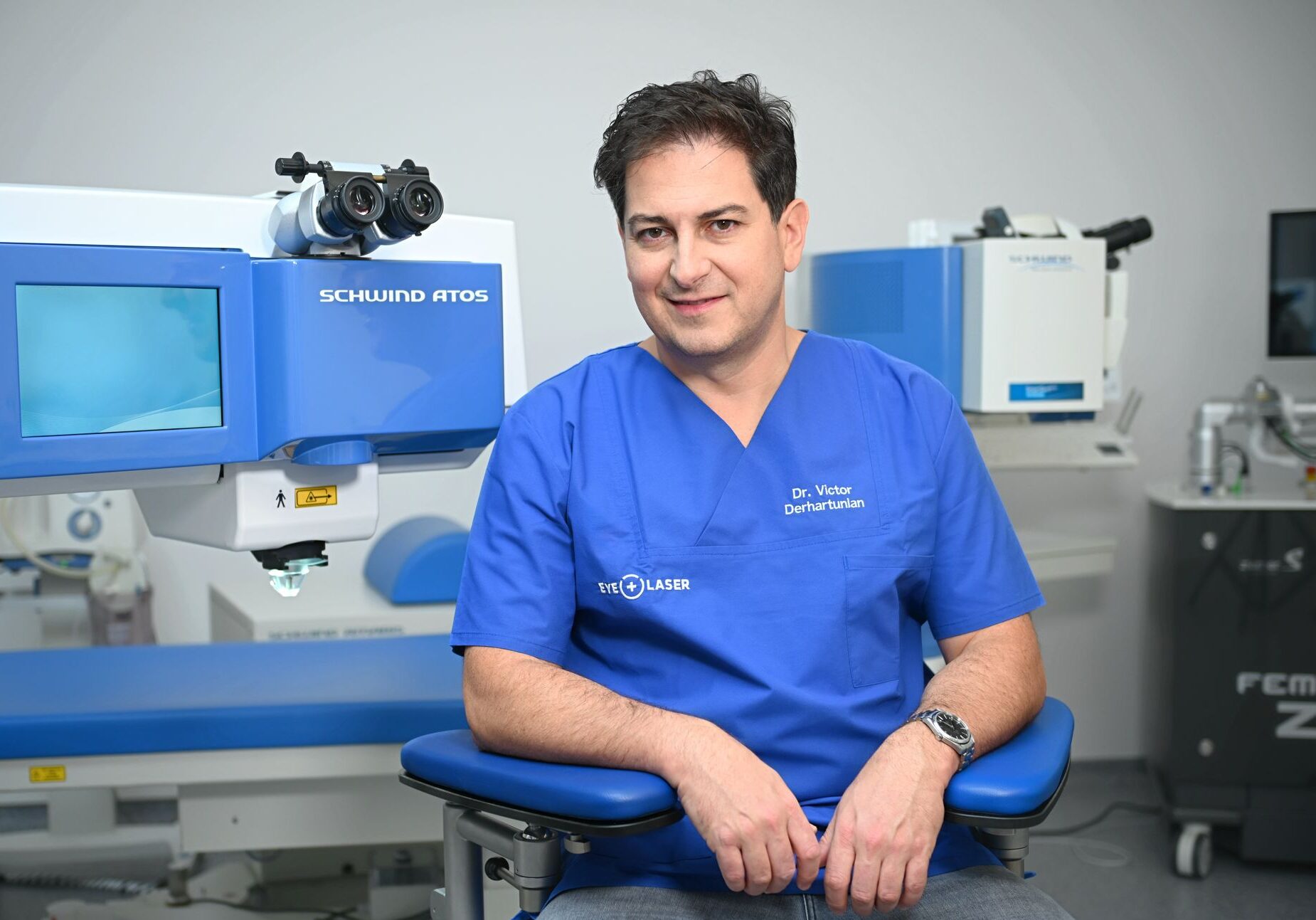
Dr. Victor Derhartunian

Dr. Victor Derhartunian personally performs all laser procedures, including PresbyMAX. He has been working in refractive surgery since 2006; around 25’000 refractive procedures are attributable to him. With the Allotex TransForm inlay, he is one of the few pioneers worldwide. Depending on the case, refractive lens exchange is performed by Dr. Derhartunian, Dr. Myron Kynigopoulos or Dr. Valery Vinzent Wittwer, under his medical direction.

  • Laser: SCHWIND AMARIS 1050RS with 7D eye tracking; the flap is cut by the SCHWIND ATOS femtosecond laser.
  • Measurement: corneal tomography and biometry with MS-39 AL and Anterion.
  • All three options in one place: laser, inlay and lens replacement at Strehlgasse 33 in Zurich.

More about Dr. Victor Derhartunian

Your Path to Glasses Freedom in 4 Steps

Free initial consultation

You describe your wishes, and in around 20 to 30 minutes we clarify whether treatment is an option in principle. The consultation is not conducted by a doctor; you will see the doctor at the pre-examination.

Pre-examination (CHF 300, credited if you have treatment)

In around 90 minutes, we measure the cornea, lens, pupil and tear film and then determine the procedure and the binding price.

The treatment

outpatient at Strehlgasse 33; the eye is numbed with drops. PresbyMAX takes around 15 minutes for both eyes.

Follow-up checks

the check-ups in the first three months are included in the price; after that, an annual check-up for CHF 180.

Video: Why does reading become more difficult from 40?

Discover why your reading vision deteriorates with age

Which presbyopia treatment is an option for you?

Presbyopia suitability traffic light — EyeLaser Zürich
Color When does this apply to you? What we usually recommend
🟢 Green from around 45, own lens clear, cornea healthy and thick enough, values stable for at least one year PresbyMAX, usually as hybrid monovision; with good distance vision without glasses, also Allotex TransForm
🟡 Yellow dry eyes, a lot of driving at night, thin cornea, beginning lens opacity, high nearsightedness or farsightedness measure and weigh up first: often treat the dry eyes first; with lens opacity, lens replacement is more likely
🔴 Red cataract, keratoconus or another corneal disease, wish for guaranteed complete freedom from glasses no laser on the cornea; assessment of the findings and, depending on the situation, lens replacement or cataract surgery

The traffic light does not replace an examination. Only the measurements from the pre-examination show whether you are suitable. The eligibility test gives you an initial assessment.

What treatments are there for presbyopia?

Eye Laser

If you want to keep your own lens — usually between 45 and 55

  • PresbyMAX (laser, CHF 3’300 per eye): the laser reshapes the cornea in several steps. We almost always combine this with hybrid monovision: one eye emphasizes distance, the other slightly near. Nearsightedness or farsightedness is corrected in the same procedure.
  • Allotex TransForm (corneal inlay, CHF 5’000 per eye): a wafer-thin implant made of processed donor corneal tissue in the non-dominant eye, for people who see well at a distance without glasses. It can be removed again.
Ältere Frau mit grauem Haar lächelt – der Graue Star betrifft meist Menschen ab etwa 60

If the lens is replaced — more common from 55, but there is no fixed age limit

  • Refractive lens exchange (CHF 5’000 per eye, regardless of the artificial lens; with femtosecond laser plus CHF 1’000): your own lens is replaced. Presbyopia does not return, and a cataract can no longer develop.
  • Trifocal lenses: three focal ranges, strongest at near; halos at night are more common.
  • EDOF lenses: extended depth of focus from distance to the screen; weaker at near than trifocal, but with fewer light effects.

The guide PresbyMAX or lens replacement? compares in detail which option is suitable when.

The decision

Three options — and why age alone does not decide

From around 55, all three options are possible. Which one is suitable depends less on your year of birth than on what you rule out for yourself: one person does not want an invasive procedure, another does not want a procedure where the values can still change, a third does not want donor tissue. That is why we decide this together at the pre-examination — not according to a set formula.

Your own lens stays
PresbyMAX
The laser reshapes the cornea, and your natural lens remains untouched. This is the smallest procedure of the three — but accommodation continues to decline over the years, and the values can still change.
Reversible
Allotex TransForm™
A wafer-thin inlay made of donor corneal tissue is inserted into the cornea. It can be removed again. If a cataract develops later, the inlay is removed beforehand, depending on the findings. If you rule out donor tissue for yourself, choose one of the other options.
Permanently resolved
Refractive lens exchange
Your own lens is replaced with a premium artificial lens. This is the most invasive step of the three — but also the final one: presbyopia does not return, and a cataract can never develop.

All three options require a stable refractive error and unremarkable eye findings. Only the measurements show what is an option for you.

What is monovision, and who is it suitable for?

Monovision means: one eye is set for distance, the other slightly nearsighted for near. The brain always uses the sharper image. At EyeLaser Zürich, monovision is almost never a separate procedure, but part of PresbyMAX: we call this hybrid monovision. The distance eye receives a profile for distance, the near eye a multi-step profile with some near vision. This means a smaller difference between the eyes is sufficient than with classic monovision. The price is the same as for PresbyMAX: CHF 3’300 per eye.

How we check whether monovision suits you

  • Determining the dominant eye: the eye you use to aim usually remains the distance eye.
  • Trial with contact lenses: in most cases, we test monovision beforehand with contact lenses. You wear contact lenses with the same setting for a few days and find out in your own everyday life whether you can cope with it.
  • Measuring binocular vision: if you find it difficult to cope with different images, monovision is not suitable for you.

Monovision is less suitable if you drive a lot at night for work, do very fine spatial work or do not cope well during the trial. Allotex TransForm or a lens replacement then remain as options. In a review, 59 to 67 % of contact lens wearers coped well with classic monovision; difficulties arose mainly when driving at night (Evans 2007). The same review recommends surgical monovision only after a successful trial. That is why, in most cases, we test beforehand.

PresbyMAX, Allotex or lens: the options compared

Presbyopia treatments compared — EyeLaser Zürich
Procedure Principle Own lens Reversible Points to note Price per eye
PresbyMAX laser reshapes the cornea, usually as hybrid monovision stays no adaptation takes weeks to months; enhancement in studies in 14 to 19 % in the first year CHF 3’300
Allotex TransForm inlay made of donor corneal tissue in the non-dominant eye stays yes, the inlay can be removed for people who see well at a distance without glasses CHF 5’000
EDOF lens lens replacement, extended depth of focus is replaced no near vision weaker than trifocal, few light effects CHF 5’000
Trifocal lens lens replacement, three focal ranges is replaced no halos at night possible CHF 5’000

Lens replacement: CHF 5’000 per eye regardless of the artificial lens, with femtosecond laser plus CHF 1’000. PresbyMAX by SCHWIND is comparable to Presbyond® by ZEISS. We do not offer Presbyond.

Your Benefits in Zurich

  • Central Zurich, just a few minutes from Bahnhofstrasse and the Limmat. Tram stop right outside the door, Urania and Jelmoli car parks nearby.
  • Appointments also in the evening and every other Saturday—for your flexibility.
  • We work to Swiss quality standards—modern, precise, trustworthy.
Smiling older man with a white beard at an eye examination, a doctor in a white coat in front of him

How much does presbyopia treatment cost in Zurich?

  • Laser treatment: CHF 3’300 per eye, whichever profile (usually PresbyMAX as hybrid monovision)
  • Allotex TransForm: CHF 5’000 per eye
  • Lens replacement: CHF 5’000 per eye, regardless of the artificial lens chosen; with femtosecond laser (FLACS) plus CHF 1’000
  • Included in the price: the procedure and the follow-up checks in the first three months; enhancement up to ten years after the procedure at no extra cost, provided you have an annual check-up with us (CHF 180)
  • Separate: pre-examination CHF 300 (credited if you have treatment); medication and eye drops on prescription from the pharmacy
  • Instalment payments: six months interest-free directly with us, for PresbyMAX CHF 550 per month and eye; longer terms via heylight with interest
  • Health insurance: basic health insurance does not pay. Supplementary insurance sometimes pays CHF 500–1’500; obtain cost approval beforehand, we will support you with this. More under laser eye surgery and health insurance

All prices at a glance: costs of treatment from 45.

Am I suitable for presbyopia treatment?

Two ways to find out: the one-minute eligibility test or a free initial consultation at Strehlgasse 33 in Zurich.

Check eligibility Call 044 221 95 02

Online appointment

Frequently Asked Questions About Presbyopia in Zurich

Am I suitable for presbyopia treatment?

Whether presbyopia treatment is an option for you depends less on your age than on the findings: for PresbyMAX, your own lens must be clear, the cornea healthy and thick enough, and the values stable. At EyeLaser Zürich, we check this at the pre-examination (CHF 300, credited if you have treatment). If you are not suitable for the laser, Allotex TransForm or a lens replacement often offer another option.

I have heard of Presbyond®. Do you offer that too – or what is the difference to PresbyMAX®?

Presbyond® (“Laser Blended Vision”) is the procedure of the manufacturer ZEISS; we do not offer it. At EyeLaser Zürich, we correct presbyopia with PresbyMAX® by SCHWIND. Both procedures work on a similar principle: the laser shapes the cornea so that one eye is set slightly more for near and the other for distance, with an extended depth of focus in between. The brain combines both images. We clarify which profile suits your eyes at the pre-examination. PresbyMAX costs CHF 3’300 per eye with us.

How much does treatment in Zurich cost?

At EyeLaser Zürich, every laser treatment for presbyopia costs CHF 3’300 per eye, usually PresbyMAX as hybrid monovision. Allotex TransForm and lens replacement each cost CHF 5’000 per eye, with lens replacement regardless of the artificial lens; the femtosecond laser costs CHF 1’000 extra. After the pre-examination, you will receive a binding cost estimate.

Does health insurance in Switzerland cover the costs?

Presbyopia treatment is an elective procedure; basic health insurance does not pay for it. Supplementary insurance sometimes contributes CHF 500 to 1’500. EyeLaser Zürich recommends obtaining cost approval before the procedure and will issue you a cost estimate for this.

Do you offer instalment payments or financing?

Yes. At EyeLaser Zürich, you can pay for the treatment in six interest-free monthly instalments directly with us if you wish, without a bank check; for PresbyMAX, this is CHF 550 per month and eye. For longer terms, we refer you to heylight, where a credit check and standard market interest rates apply.

Is the procedure painful? What if I blink?

No. We numb the eyes with drops; you may feel slight pressure. A gentle lid speculum prevents blinking, and an eye tracker follows every eye movement – for greater safety.

How long does the procedure take and how long will I be off work?

The laser itself takes only a few minutes per eye. Please allow around two hours in total for your visit. Most patients already see well the next day and are able to work.

Are the results permanent?

Yes. Laser correction is permanent; however, the natural ageing of the lens continues. Refractive lens exchange offers a definitive solution for the rest of your life and at the same time prevents cataracts.

Are there side effects such as dry eyes or glare effects (halos)?

Yes, both occur. After PresbyMAX, dry eyes and halos are common in the first few weeks and usually subside; there are no reliable frequency data for this. In studies, 14 to 19 % needed an enhancement in the first year (Luger et al. 2015; Chan et al. 2017). With trifocal lenses, halos at night are more common than with EDOF lenses. The details can be found on the pages of the individual procedures.

Can both eyes be treated at the same time?

Yes – this is standard for laser procedures. It speeds up adaptation and binocular vision. With lens replacement, both eyes are usually operated on a few days apart.

What if I also have astigmatism?

Astigmatism can usually be corrected as part of presbyopia treatment: with PresbyMAX in the same laser procedure, or with a toric artificial lens during lens replacement. At EyeLaser Zürich, how much is possible depends on the recommendations of the KRC and on your corneal thickness, not on a fixed number.

When is lens replacement a better option than a laser procedure?

Typically from around 55 – 60 years of age or with beginning lens opacity (cataract). Lens replacement is then the more sustainable solution, because the natural lens continues to age anyway and would have to be replaced later.

Can you still have laser eye surgery at 50?

Yes, at 50 laser treatment for presbyopia is usually possible if your own lens is clear. At EyeLaser Zürich, this is PresbyMAX for CHF 3’300 per eye. At this age, lens replacement is mainly an option for farsightedness. From around 55, lens replacement is an option for all refractive errors, with PresbyMAX remaining the alternative. If the lens starts to become cloudy, lens replacement is the more lasting solution.

Does laser eye surgery make sense from 60?

From around 60, a laser on the cornea is rarely the first choice, because your own lens then often already begins to become cloudy. At EyeLaser Zürich, we usually recommend a lens replacement at this age for CHF 5’000 per eye: it permanently resolves presbyopia, and a cataract can no longer develop afterwards. If the lens is still clear, we also consider the laser.

What are the disadvantages of laser treatment for age-related farsightedness?

Laser treatment of presbyopia with PresbyMAX is a compromise: near vision improves, while distance vision can become slightly less sharp and night vision lower in contrast. The brain needs weeks to months to adapt. In studies, 14 to 19 % needed an enhancement in the first year (Luger et al. 2015). At EyeLaser Zürich, it is included for up to ten years, with an annual check-up.

What is monovision, and can I test it beforehand?

With monovision, one eye sees sharply at a distance and the other up close. At EyeLaser Zürich, we almost always combine monovision with PresbyMAX (hybrid monovision) at the same price of CHF 3’300 per eye. In most cases, we test beforehand whether you can cope with it: you wear contact lenses with the same setting for a few days. If you do not tolerate the trial, you choose another option.

Does eye training help against presbyopia?

No. With presbyopia, the lens itself loses elasticity; this cannot be stopped with exercises (Glasser and Campbell 1998). Eye training can relax tired eyes, but does not change near focusing. If you want to manage without reading glasses, EyeLaser Zürich offers three options: PresbyMAX, Allotex TransForm or lens replacement.

Sources
  1. Fricke TR, Tahhan N, Resnikoff S et al. Global Prevalence of Presbyopia and Vision Impairment from Uncorrected Presbyopia. Ophthalmology 2018;125:1492–1499. PubMed 29753495
  2. Glasser A, Campbell MC. Presbyopia and the optical changes in the human crystalline lens with age. Vision Res 1998;38:209–229. PubMed 9536350
  3. Evans BJ. Monovision: a review. Ophthalmic Physiol Opt 2007;27:417–439. PubMed 17718882
  4. Luger MH, McAlinden C, Buckhurst PJ et al. Presbyopic LASIK using hybrid bi-aspheric micro-monovision ablation profile. Am J Ophthalmol 2015;160:493–505. PubMed 26025425
  5. Chan TC, Kwok PS, Jhanji V et al. Presbyopic Correction Using Monocular Bi-aspheric Ablation Profile (PresbyMAX) in Hyperopic Eyes: 1-Year Outcomes. J Refract Surg 2017;33:37–43. PubMed 28068445
  6. Kilic A, Cummings A, Stodulka P et al. Corneal Allograft for Near Vision Improvement in Emmetropic Presbyopia: 4-Year Results. J Refract Surg 2026;42:e100–e107. PubMed 41665327
Decision guide

Which procedure for which stage of presbyopia?

With presbyopia, there is no dioptre limit as there is with laser treatment for short-sightedness. What matters is your age, the condition of your natural lens and whether you still see well at a distance.

Your starting point First choice Alternative Why
from about 45, good distance vision, clear lens PresbyMAX, usually as hybrid monovision Allotex TransForm PresbyMAX reshapes the cornea to be multifocal and is almost always combined with monovision: one eye favours distance, the other slightly near (this can be tested beforehand with contact lenses). Your own lens stays. Allotex TransForm is a biological, reversible corneal inlay for near vision.
from about 45, with short- or long-sightedness as well PresbyMAX Lens exchange for long-sightedness PresbyMAX corrects both in a single procedure. With high values or a thin cornea, lens exchange is the safer option.
from about 55 Lens exchange (EDOF or trifocal) PresbyMAX The older you are, the less reserve your own lens has. The exchange resolves presbyopia permanently and prevents cataract.
Lens already becoming cloudy Lens exchange or cataract surgery — In that case, laser treatment of the cornea would be wasted; the clouding would undo the result.
You mainly want to see without glasses at the screen EDOF lens with lens exchange PresbyMAX EDOF lenses cover distance and intermediate vision particularly evenly; trifocal lenses are stronger at near, with more light effects at night.

Guide values from our practice (as of September 2026). The age limits are fluid; we measure lens density during the pre-examination.

PresbyMAX

Laser treatment of the cornea, 15 to 20 minutes for both eyes, your own lens stays. Better near vision while distance vision is preserved. CHF 3’300 per eye.

Lens exchange

Your own lens is replaced with an EDOF or trifocal lens. Permanent; cataract can no longer develop. CHF 5’000 per eye, regardless of the implant; femtosecond laser assistance plus CHF 1’000.

Hybrid monovision

One eye for distance, one slightly short-sighted for near; with us almost always combined with the PresbyMAX profile and at the same price. Not for everyone: in most cases we test it beforehand with contact lenses.

What we tell you openly

No method makes a 45-year-old eye 25 again. The goal is everyday life without glasses; for very small print in poor light, you may still need light reading glasses.

In the end, measurements decide, not tables. During the comprehensive pre-examination, we measure the front and back surfaces of the cornea, epithelial thickness, pupil and tear film (MS-39, Anterion). Only then is it clear which procedure is safe for your eye, and only then do we give you the binding price. About one in ten prospective patients leaves the examination without a surgery date. For presbyopia, we also measure lens density and test your tolerance of multifocality.

One-minute treatment checkFree initial consultationAll procedures compared