Prices & services

Price & services at a glance

Transparent, binding and without hidden costs — as Swiss medicine should be.

FIXED PRICE

Refractive lens exchange (RLE)
CHF 5’000 per eye
Regardless of the implant. With femtosecond laser CHF 6,000 per eye. A cataract can never develop afterwards.
Included in the fixed price
Follow-up checks of the first three months included — the annual check thereafter is chargeable
Fixed-price guarantee — no surcharges after the pre-examination
Touch-up included — if ever needed, at no extra cost
24/7 emergency availability — you receive the surgeon’s personal mobile number
Pre-examination CHF 300 — credited when you have the treatment
Flexible instalments via our partner HeyLight
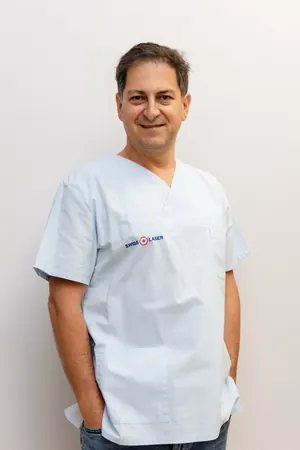
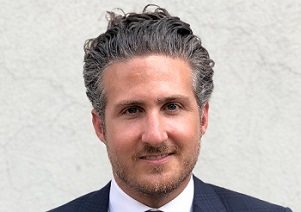
Dr. med. univ. Victor Derhartunian«We recommend the method that suits your eyes — not the one that happens to be available. That is why we have all established procedures in-house and decide only after the comprehensive pre-examination.»
— Dr. med. univ. Victor Derhartunian, FEBO
Your recovery

How your recovery progresses after lens exchange (RLE)

Realistic guide values from practice — your personal course is closely monitored at the follow-up checks.

PLANNING

Both eyes on the same day or separately — entirely according to your wishes and findings.
DAY 1

Follow-up check at the clinic; usually good everyday vision already.
WEEK 1

No heavy lifting, do not rub your eyes.
WEEKS 2–12

Neuroadaptation to the premium optics begins — the brain has to get used to the new vision; this takes time and is completely normal.
MONTHS 3–6

Full adaptation: reading, screen and distance without glasses — accompanied by the follow-up checks. If necessary, fine-tuning is done now.

Transparency

What are the risks — and how do we manage them?

Lens exchange is a proven routine procedure — these points still belong on the table:

iHalos and rings of light with multifocal optics — the brain usually adapts completely within the first weeks to months.
iPosterior capsule opacification (clouding of the capsule) — can occur months later and is corrected in minutes with the YAG laser as an outpatient.
iRetinal risk with high myopia — examined beforehand and discussed openly.
iInfection — very rare; emergency contact around the clock.
Dr. med. univ. Victor Derhartunian«Think of blood-pressure therapy: you start with one tablet, measure again — and adjust the dose until the value is right. It is the same with the correction of presbyopia: we correct, the brain gets used to the new vision, and if necessary we fine-tune. A touch-up is not a setback but part of a precise treatment — and included in our fixed price.»
— Dr. med. univ. Victor Derhartunian, FEBO
Your safety net: Should a touch-up be necessary, it is included in the fixed price at EyeLaser Zurich. And for emergencies you receive the surgeon’s personal mobile number — around the clock, including weekends.

What is a refractive lens exchange?

In refractive lens exchange (also called cataract surgery if the lens is cloudy), the natural lens that causes the refractive error (is affected by cataracts) is replaced with an artificial lens.

At EyeLaser, we offer two lens replacement options, each with two areas of application:

Lifestyle lens exchange: spectacle-free with multifocal lens / EDOF lens

  • Cataract surgery: cataract (incl. holistic vision correction)
  • Correction: severe defective vision(s) incl. presbyopia & astigmatism

Standard lens exchange:
Premium monofocal lens

  • Cataract surgery: cataract (incl. correction of short- or long-sightedness)
  • Correction: severe visual impairment (reading glasses required)

Whether you are having a standard / lifestyle lens exchange to cure cataracts (cataract surgery also in combination with vision correction), to get rid of presbyopia or to correct a visual defect (refractive lens exchange): The procedure of the minimally invasive surgery is always the same. What distinguishes the options are the eligibility requirements, results & costs.

Lifestyle lens exchange by EyeLaser:

The lifestyle version of lens replacement or cataract surgery is characterized by the fact that a high-quality premium lens (multifocal lens) is inserted. The artificial lens can correct all visual defects: Myopia, hyperopia, presbyopia & astigmatism. You will never have to wear glasses or contact lenses again. wear. Like any artificial lens, it is also used to replace a natural lens that has become cloudy due to cataracts.

Multifocal lenses:

Multifocal lenses (MIOL) have more than one focal point, which makes vision possible at near, intermediate and far distances — without having to wear glasses or contact lenses. A particular advantage over monofocal lenses is that MIOL lenses can also correct astigmatism.

EDOF lenses:

We offer you the latest generation of lens types: isofocal lenses (EDOF). These special multifocal lenses image mainly distance and the intermediate range sharply. This works through a zone of extended depth of focus that makes the transition between near and far smoother — for an even more natural and impressive visual experience.

Standard lens replacement by EyeLaser:

With the standard option for lens replacement or cataract surgery, you will receive a premium monofocal lens. This lens has only one focal point, so only one refractive error can be corrected: short- or long-sightedness. This is why patients still need reading glasses after the treatment to see clearly up close. The aspheric lens has a UV filter, a hydrophobic coating, and achieves high image quality.

Astigmatism and presbyopia cannot be treated with a monofocal lens—however, severe farsightedness can (usually in combination with cataracts).

Which lens suits you?

With lens exchange the price is the same for every lens. The choice depends solely on your eyes and your daily life.

Multifocal lenses

Distance, screen and reading at once — the greatest independence from glasses. Halos around lights possible in the first weeks.

Multifocal lenses in detail →

EDOF lenses

Distance and screen in focus, calm vision at night. Reading glasses only for small print.

EDOF lenses in detail →

Trifocal lenses

Three fixed focal points for near, intermediate and far. The classic solution for life without varifocals.

Trifocal lenses in detail →

Do I meet the lens exchange requirements?

Lens exchange offers you a treatment option if you suffer from cataracts, presbyopia and possibly other visual defects. As a rule, we only perform cataract surgery or refractive lens exchange for patients who are older than 55 years or have pronounced long-sightedness (hyperopia).

For younger patients (without cataracts), laser eye surgery with PresbyMAX or an ICL phakic lens is an option. Conventional laser eye surgery is usually not the first choice if presbyopia is present.

Are you suitable? Free aptitude test at EyeLaser

For patients considering lens surgery to finally enjoy sharp vision of the beautiful things in life (without glasses or contact lenses), we offer a free & non-binding suitability test:

CHF 0

Lens surgery costs

Advantages of lens exchange with multifocal lenses (lifestyle)

  • Correct all visual defects:

The multifocal lens corrects nearsightedness, farsightedness, presbyopia and even astigmatism (astigmatism) permanently with just one procedure.

  • Cure cataracts permanently:

No blurred, clouded vision more. The multifocal artificial lens is clear and prevents cataracts from ever developing (again).

  • No more glasses or contact lenses:

You can see clearly over all distances and are no longer dependent on wearing glasses or contact lenses. This gives Quality of life and freedom.

Advantages of lens exchange with monofocal lenses (standard)

  • Cure cataracts permanently:

With one operation remove the clouded lens enjoy the finer things in life without a veil and never suffer (again) from cataracts in the future.

  • Sharp view into the distance:

Even if you wear reading glasses for sharp vision at close range, you can still use your gaze into the distance without having to wear glasses.

  • Cost savings (+ cost absorption):

Compared to multifocal lenses, you save CHF 1’000 per eye and if a cataract is treated, the costs are costs are covered by the health insurance is possible.

Noch präziser & sicherer: Linsentausch in Kombination Augenlasern

At EyeLaser, you have the option of making lens replacement even safer, gentler and more precise by using a femtosecond laser. Where the surgeon would otherwise use a scalpel, the computer-assisted laser makes the incision and fragments the lens with millimetre precision—more delicately than a hand-guided scalpel ever could.

Using the laser for lens replacement is optional (available for standard and lifestyle lens replacement / cataract surgery) and has no effect on visual acuity.

Correction of presbyopia, defective vision & cataract surgery

Whether you choose cataract surgery or lens replacement—standard with a monofocal lens or lifestyle with a multifocal lens—the procedure is always the same and is completely painless, safe and highly promising for you as a patient.

Allow about two hours for the entire visit. The actual refractive lens exchange (RLA) takes only 15 minutes.

Pre-examination & preparation

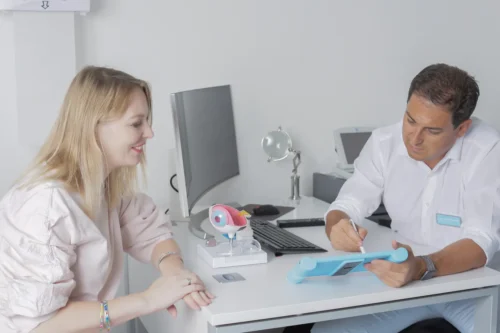
During the pre-examination an individual treatment plan is drawn up for you, optimally designed to correct your refractive error or eye disease. On the day of the operation your pupils are dilated with a medication. After 30 minutes the eye is numbed with anaesthetic drops, so the lens exchange is completely painless for you.

Incision, fragmentation & aspiration

First a tiny incision (2.2–2.4 mm) is made at the edge of the cornea. This is needed so that the lens capsule can be opened in a perfect circle. Using modified ultrasound (phacoemulsification) the natural lens is liquefied or fragmented and aspirated. If you opt for the femtosecond laser, the incision is made not with a scalpel but with high precision by the laser. In both variants the result is that the empty lens capsule (capsular bag) remains.

Inserting the artificial lens

Through the tiny incision the artificial lens (monofocal or multifocal lens) is now implanted with an injector. The rolled lens unfolds and takes the place of the natural lens. The substances used during the operation are then aspirated and the wound is sealed.

Aftercare

To prevent infection we immediately place an antibiotic in the anterior chamber. After the operation you receive eye drops that also prevent inflammation. A protective shield guards the eye against external influences such as rubbing during the first days. Please make sure to:

  • apply no pressure to the operated eye
  • avoid physical exertion
  • avoid swimming pools and saunas
  • read little, so as not to strain the eyes
  • follow the eye-drop schedule

We see you again the very next day at EyeLaser Zurich for the follow-up check (appointment 1 of 2).

Lens exchange costs: Invest in quality of life

The cost of lens replacement is a one-time expense and does not entail any follow-up costs. Not only do the total costs pay off: the improved quality of life in particular makes lens replacement a life-changing treatment whose value can hardly be quantified financially.

Over the course of a lifetime, wearing glasses can quickly cost CHF 10’000 or more. Contact lenses (and daily disposable lenses) are even more expensive. Do you suffer from Cataracts: you cannot alleviate the associated limitations with any conventional visual aid or stop the progression of the clouding of the lens.

Here you can find out more about the possibility of cost coverage by the health insurance company in the case of a lens exchange and the tax treatment of the expenses. Especially with standard cataract surgery, there is a good chance that you will be reimbursed for the costs (at least in part).

Refractive lens exchange

CHF 5’000 per eye

Any lens: multifocal, EDOF, trifocal, toric. Astigmatism correction and the follow-up checks of the first three months included.

Femtosecond laser

+CHF 1’000 per eye

Blade-free, computer-assisted incisions. Total with laser: CHF 6’000 per eye.

Prices are per eye and independent of the implant; financing via HeyLight possible. For a medically indicated cataract with basic insurance, the surcharge on the TARDOC tariff applies instead — see the cataract page.

Refractive lens exchange
CHF 5’000 / eye
  • Flexible instalments with HeyLight possible*
  • Presbyopia, short- and long-sightedness
  • Glasses-free with made-to-measure multifocal lenses (trifocal / EDOF)
  • Astigmatism correction included
Femtosecond laser surcharge
+CHF 1’000 / eye
  • Flexible instalments with HeyLight possible*
  • Computer-assisted, blade-free incisions
  • Total with laser: CHF 6’000 per eye

* Financing available through our partner HeyLight (heylight.com). Prices are per eye and independent of the implant. For a medically indicated cataract with basic insurance, the surcharge on the TARDOC tariff applies instead — see the cataract page.

Refractive lens exchange Risks for the eye & lens

The risk profile is equally low for standard and lifestyle lens replacements. The success rate is over 98 percent. For decades, monofocal and multifocal lenses have given millions of people a better life without cataracts, presbyopia and dependence on glasses or contact lenses.

During your preliminary examination and preparation for lens replacement, EyeLaser will provide you with comprehensive and transparent information about possible risks, side effects and complications:

  • Infection of the eye
  • Increased sensitivity to light and glare
  • Reduced vision in the dark
  • Reduced spatial vision
  • Over- or undercorrection (additional laser eye surgery / other IOL or visual aid required)
  • After cataract – can be cured by laser treatment

However, there can never be a guarantee of success and even a minimally invasive procedure is associated with risks. However, we try to reduce these to an absolute minimum by using state-of-the-art equipment, the highest medical standards and the experience of our surgeons.

Healing process & recovery time after lens replacement surgery

Most patients report immediately after the minimally invasive procedure that their vision vision improved significantlyt has. It will take a few days before you can enjoy full visual acuity. The brain first has to get used to the new monocular or multifocal lens. After After 14 days, adaptation is largely complete and—depending on the artificial lens—you can permanently do without glasses and contact lenses (lifestyle) or see sharply and wear reading glasses if needed (standard).

If the lens is replaced due to a cataract, the blurred vision is immediately a thing of the past once the artificial lens has been inserted. The new lens is clear and cannot become cloudy, so you can never get a cataract again and progressive presbyopia is also halted.

During the healing process, it is not uncommon for temporary symptoms occur, but these disappear quickly and are generally harmless:

  • Slight burning sensation in the eye
  • Poor visibility at dusk and in the dark
  • Light phenomena (halos)
  • Foreign body sensation in the operated eye

Overall, lens replacement and cataract surgery are very safe and tissue-sparing procedures. The healing process is supported by At least two follow-up appointments monitored and accompanied. To ensure rapid healing after your lens replacement, the eye is protected with a flap and you will be given appropriate medication by our doctors to ensure complication-free healing.

Before and after your lens surgery, EyeLaser will provide you with comprehensive information about what you should look out for or avoid after the procedure. It is essential that you adhere to the medical orders hold. Should it come to unexpected side effects occur, we are here for you at any time.

Differences to lens implantation:

Lens implantation is also part of lens surgery and differs from lens replacement in that the natural lens is not removed during implantation. Instead, a phakic lens (EVO/EVO+ VISIAN ICL) is additionally implanted, which can correct your refractive error.

Especially for patients who do not have cataracts, suffer from a severe refractive error (myopia, hyperopia, presbyopia and astigmatism) and are not suitable for laser eye surgery—e.g. due to a cornea that is too thin or dry eyes—the phakic lens is an excellent way to become independent of visual aids and finally see clearly again.

Find out more about lens implantation!

Eignungstest & Voruntersuchung unverbindlich vereinbaren

No matter which lens surgery you choose. One thing is certain: your life will change for the better. To find out whether lens exchange or lens implantation can give you a better life, we invite you to a free suitability test or for a non-binding preliminary examination (CHF 300 incl. an individual treatment plan)* at our clinic in Zurich.

Would you like to know what is possible for you?
Arrange a free aptitude test

Would you like to know how we make it possible?
Arrange a non-binding preliminary examination*

* Money-back guarantee: If it turns out during the preliminary examination that you are not suitable after all or you decide against treatment at EyeLaser, we will only charge you the costs of the ophthalmologic examination.

FAQ: Refractive lens exchange at the laser eye center

Can an artificial lens be exchanged?

Just like refractive lens exchange, the artificial lens can also be exchanged as an outpatient procedure. If the refractive power changes or should be changed, a new, adapted multifocal or toric lens can be implanted. EyeLaser Zurich is happy to support you with refractive lens exchange, renewed correction of presbyopia and all other matters related to lens surgery and laser eye surgery.

How long does a multifocal lens last?

Artificial lenses are generally designed to remain in the eye for life. Unlike the body’s own lens, clouding is not possible, so no (new) cataract can develop. If there are no complications (such as posterior capsule opacification), the artificial lens can stay in the eye forever.

When can I go back to work?

As a rule, patients are given two weeks off work after cataract surgery. This helps you recover fully after the cataract operation or presbyopia correction and not overstrain your eyes at first. Of course, it also depends on your occupation. Physically demanding jobs, and jobs where there is a risk of impact on your eye (even accidentally), should be avoided. We discuss individually with you how long you should stay off work after the procedure and issue a corresponding certificate.

What types of multifocal lenses are there?

There are now different forms of multifocal lenses used to replace the natural lens. The lens is implanted by lens exchange and is decisive for how the patient sees after the operation. At EyeLaser we mainly use multifocal lenses (MIOL) with three focal points (trifocal). With these you can see sharply at near, far and intermediate range. The further development of the MIOL is the so-called EDOF lens. It impresses with improved depth of focus in the intermediate range and provides even more natural transitions — similar to varifocal glasses. Toric lens: if the lens is toric, it can also correct astigmatism in addition to the other refractive errors.

Does health insurance pay for lens exchange?

It depends on your situation, not on the lens. With a medically indicated cataract and basic insurance, the operation is billed under the TARDOC tariff; you pay the surcharge for the lens — CHF 2,700 per eye for EDOF and multifocal lenses, plus CHF 1,000 with the femtosecond laser. Refractive lens exchange without cataract costs CHF 5,000 per eye, CHF 6,000 with the femtosecond laser, regardless of the implant. Without Swiss basic insurance, lens-exchange prices apply to cataract surgery as well.

Meet Your Eye Surgeons in Zurich Personal care from trusted vision correction experts.

Discover our laser eye surgeons in the heart of Zurich

Dr. Victor Derhartunian
Augenarzt, Spezialist für Refraktive Chirurgie
FEBO

Having learned his craft from the two pioneers of laser surgery, Dr. Victor Derhartunian has performed some 25,000 refractive procedures. The head eye surgeon at EyeLaser in Zurich can consult his patients in 5 languages.

LEARN MORE
Dr. med. Valery Vinzent Wittwer
Ophthalmologist and Eye Surgeon
FEBO

Dr. Valery Lenzt Wittwer joined the EyeLaser Zurich team in 2024. He specializes in lens surgery and enables patients to live without cataracts and/or refractive errors through cataract surgery and ICL lens implantation.

Learn more
Dr. med. Myron Kynigopoulos, Augenchirurg bei EyeLaser Zürich
Dr. med. Myron Kynigopoulos
Ophthalmologist and Eye Surgeon
FEBO

With over 20 years of experience and 10,000+ surgeries, Dr. Myron Kynigopoulos is among Switzerland’s leading experts. Specializing in high-end lens surgery and laser procedures, he combines precision with empathetic patient care.

Dr. Victor Derhartunian
Augenarzt, Spezialist für Refraktive Chirurgie
FEBO

Having learned his craft from the two pioneers of laser surgery, Dr. Victor Derhartunian has performed some 25,000 refractive procedures. The head eye surgeon at EyeLaser in Zurich can consult his patients in 5 languages.

LEARN MORE
Dr. med. Valery Vinzent Wittwer
Ophthalmologist and Eye Surgeon
FEBO

Dr. Valery Lenzt Wittwer joined the EyeLaser Zurich team in 2024. He specializes in lens surgery and enables patients to live without cataracts and/or refractive errors through cataract surgery and ICL lens implantation.

Learn more
Dr. med. Myron Kynigopoulos, Augenchirurg bei EyeLaser Zürich
Dr. med. Myron Kynigopoulos
Ophthalmologist and Eye Surgeon
FEBO

With over 20 years of experience and 10,000+ surgeries, Dr. Myron Kynigopoulos is among Switzerland’s leading experts. Specializing in high-end lens surgery and laser procedures, he combines precision with empathetic patient care.