


How to recognise a clouded lens, what speeds it up and when the right time for surgery has come.
Cataract examinationCovered by basic insurance (TARDOC) · Strehlgasse 33, 8001 Zürich
What is a cataract?
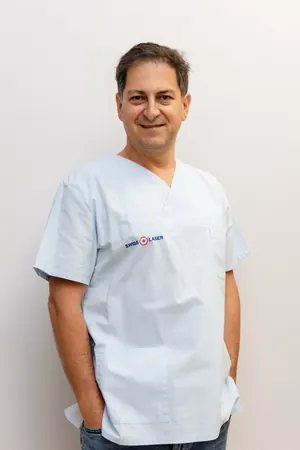 Medically reviewed by Dr. med. univ. Victor Derhartunian, FEBO, FWCRS
Ophthalmologist · Last updated: 30 September 2026
The lens sits behind the pupil and focuses light onto the retina. When it is cloudy, it scatters the light. Worldwide, cataract is the most common cause of blindness, even though it is readily treatable[2].
| Cataract at a glance | |
|---|---|
| Medical term | cataract; the age-related form is called cataracta senilis |
| ICD-10 | H25 (age-related cataract), H26 (other forms, including H26.4 secondary cataract) |
| Typical age | usually from about 60, rarely earlier |
| Main symptoms | hazy vision, glare, faded colours, poorer night vision |
| Diagnosis | slit-lamp examination with dilated pupil |
| Treatment | surgery with an artificial lens; no drops or tablets dissolve the clouding |
| Insurance | Examination and surgery covered by basic insurance (TARDOC) |
What are the symptoms of cataract?
Cataract develops gradually and painlessly. Many people only notice it when the brain can no longer compensate for the deterioration. Typical signs are[1][3]:
- Hazy or foggy vision: everything looks as if you were looking through a steamed-up window.
- Glare: backlight, sunshine and headlights at night bother you more than before.
- Faded or yellowish colours and less contrast, especially at dusk.
- More light needed for reading.
- Frequently changing glasses prescription. Some people temporarily even see better up close and need their reading glasses less often. This is typical of clouding in the lens nucleus.
- Double vision in one eye only, when the lens clouds unevenly.
Often one eye is more affected than the other.
How does cataract develop, and who is at risk?
The lens consists of tightly packed proteins. Over the years they change, clump together and let less light through. Almost everyone goes through this process, but it progresses at different speeds[1].
- Age, the most important factor
- Diabetes
- Smoking
- A lot of UV light over many years without protection
- Cortisone, especially over longer periods as tablets or drops
- Injuries and inflammation of the eye (uveitis)
- Previous eye surgery, for example on the vitreous
- High short-sightedness (myopia)
- Family history
Sunglasses with UV protection, stopping smoking and well-controlled blood sugar can slow progression. Age-related cataract cannot be prevented.
What types of cataract are there?
| Type | What happens | Typical |
|---|---|---|
| Nuclear cataract | The lens nucleus hardens and turns yellowish to brownish | most common age-related form; short-sightedness increases, colours fade |
| Cortical cataract | Spoke-shaped opacities at the edge of the lens | glare, often for a long time without marked loss of vision |
| Posterior subcapsular cataract | Clouding directly in front of the posterior lens capsule | younger age, diabetes, cortisone; strong glare and problems reading |
| Congenital cataract | Clouding from birth or in childhood | must be assessed early, because otherwise vision does not develop |
| Complicated cataract (due to other causes) | Result of injury, inflammation, medication or metabolic disease | often occurs in one eye only or at a younger age |
Source of the classification:[1][3]. Secondary cataract is not a separate type but a clouding after surgery (see below).
How is cataract diagnosed?
The ophthalmologist measures your visual acuity and examines the lens at the slit lamp, a microscope with a slit of light. Drops dilate the pupil for this, and you may not drive for a few hours afterwards. The retina, optic nerve and eye pressure are checked as well, because other conditions can cause similar symptoms.
If surgery is planned, we also measure the eye with the MS-39 AL or the Anterion to calculate the power of the artificial lens.
At EyeLaser Zurich, we bill the cataract examination to basic insurance under TARDOC.
How does cataract progress without treatment?
Cataract usually progresses over years, rarely over months. New glasses help for a while. There are no drops, tablets or supplements that dissolve existing clouding[3].
Untreated, visual acuity keeps declining until, in the end stage, only light and dark can be distinguished. Even then, surgery can usually restore vision, provided the retina and optic nerve are healthy. Rarely, a very advanced cataract can raise the eye pressure or trigger inflammation.
When is the right time for surgery?
It is not the findings that decide, but your everyday life. Surgery makes sense when cataract limits you in reading, driving, working or your hobbies[3]. Waiting for a “ripe” cataract is no longer necessary. Without symptoms, we generally do not operate.
| Your situation | What we recommend | Read more |
|---|---|---|
| Early cataract, hardly any symptoms | Adjust glasses, good lighting, glare protection, check-ups as agreed | – |
| Glare or haze bothers you in daily life | Surgery with an artificial lens | Cataract surgery |
| Surgery planned, wish for laser incisions | Femtosecond laser (FLACS) as an add-on | Laser cataract surgery (FLACS) |
| Visual acuity below the limit for the driving licence | Discuss surgery; do not drive until then | Driving with cataract (German) |
| No Swiss basic insurance | Surgery as a self-payer at the price of lens replacement | Lens replacement |
Note on the driving licence: for passenger cars, the Swiss Traffic Licensing Ordinance requires visual acuity of at least 0.5 in the better eye and 0.2 in the worse eye, or 0.6 if only one eye can see[4].
There are also medical reasons to operate earlier, for example if the clouding obscures the view of the retina or raises the eye pressure[3].
Not sure whether it is time yet?Send us your question or give us a call. Please do not send medical reports via WhatsApp.
How does the surgery work?
The surgery is outpatient and takes around 15 to 20 minutes per eye. The eye is numbed with drops; if you wish, you can be lightly sedated. Through a small incision, the clouded lens is broken up with ultrasound and removed by suction. The folded artificial lens then unfolds in the lens capsule. Most people already see much better the next day.
Procedure, choice of lens and risks: Cataract surgery.
What does the surgery cost, and does health insurance pay?
At EyeLaser Zurich, we bill the examination and surgery to basic insurance under TARDOC, minus your deductible (franchise) and co-payment. In addition, you pay a lens surcharge per eye:
| Surcharge per eye on top of the TARDOC tariff | CHF |
|---|---|
| One distance in focus (Monofocal Plus lens, our standard) | 700 |
| Several distances or astigmatism (EDOF, multifocal, toric, monovision) | 2’700 |
| Femtosecond laser (FLACS), available with both tiers | + 1’000 |
Eye drops after surgery are not included in the surcharge. You receive them on prescription at the pharmacy; they are billed to basic insurance. Details and a worked example are on the page Costs and insurance.
Have your lens examinedExamination covered by basic insurance (TARDOC)
What is secondary cataract?
Secondary cataract (cataracta secundaria, posterior capsule opacification) is a clouding of the posterior lens capsule that holds the artificial lens. It develops months to years after surgery, when remaining lens cells grow on the capsule[5]. It is not a new cataract. The artificial lens itself stays clear.
Vision becomes milky or glary again, similar to before surgery. Our team then opens the clouded capsule with the YAG laser. The treatment is outpatient, painless and takes a few minutes. As a rule, it is only needed once[5]. It takes place at our clinic on Strehlgasse and is billed to basic insurance.
What else is normal after surgery and when you should contact us is explained in the guide After cataract surgery (German).
Who treats cataract at EyeLaser Zurich?
At EyeLaser Zurich, cataract surgery is performed by our highly specialised team, including Dr. med. Myron Kynigopoulos, FMH specialist in ophthalmology and ophthalmic surgery and member of the ESCRS. Secondary cataract is also treated by our team. The clinic is at Strehlgasse 33, 8001 Zürich.
Frequently asked questions about cataract
Can cataract cause blindness?
Yes, untreated cataract can lead to blindness. Worldwide it is the most common cause of blindness[2]. Unlike many retinal diseases, however, vision can usually be restored, because surgery replaces the clouded lens with a clear artificial lens. At EyeLaser Zurich the procedure takes around 15 to 20 minutes per eye and is outpatient.
Can cataract be treated without surgery?
No. There are no eye drops, tablets or vitamins proven to dissolve lens clouding[3]. New glasses and good lighting help for a while in the early stage. As soon as cataract limits you in daily life, surgery is the only effective treatment. At EyeLaser Zurich basic insurance pays for it; the lens costs a surcharge of CHF 700 or CHF 2’700 per eye.
How fast does cataract progress?
Usually slowly, over several years. With nuclear cataract the glasses prescription often changes first; posterior subcapsular cataract can cause symptoms sooner[1]. How fast it progresses in your case only shows when two examinations are compared. At EyeLaser Zurich we set the interval between check-ups according to the findings, often 6 to 12 months.
Can I drive with cataract?
Yes, as long as you meet the minimum values: for passenger cars, the Swiss Traffic Licensing Ordinance requires visual acuity of at least 0.5 in the better eye and 0.2 in the worse eye[4]. Glare at night can still be dangerous. At EyeLaser Zurich we measure your visual acuity during the examination and tell you whether you should still drive. More in the guide Driving with cataract (German).
What is the difference between cataract and glaucoma?
With cataract, the lens becomes cloudy, and the damage can be corrected by surgery. With glaucoma, the optic nerve is damaged, usually by high eye pressure, and lost vision does not return. Both become more common from the age of 40 and go unnoticed for a long time. At EyeLaser Zurich we also check the optic nerve and eye pressure at every cataract examination.
Can cataract come back after surgery?
No, the artificial lens does not cloud over. Months to years later, however, the lens capsule behind it can become cloudy; this is called secondary cataract[5]. Vision then becomes milky again. At EyeLaser Zurich our team opens the capsule with the YAG laser in a few minutes, outpatient and without an incision. As a rule, this is only needed once.
Does health insurance pay for the examination and surgery?
Yes. At EyeLaser Zurich we bill cataract examination and surgery to basic insurance under TARDOC, minus deductible and co-payment. You pay the lens surcharge yourself: CHF 700 per eye for one distance, CHF 2’700 for several distances, each CHF 1’000 more with femtosecond laser. Without Swiss basic insurance, the price of lens replacement applies: CHF 5’000 per eye.
From what age should I have my lens checked?
From about 60, regular eye examinations are advisable; earlier if you have diabetes, take cortisone or are highly short-sighted. See an ophthalmologist sooner if glare, hazy vision or frequently changing glasses prescriptions occur. At EyeLaser Zurich we bill this examination to basic insurance if cataract is suspected.
Sources
- Liu YC, Wilkins M, Kim T, Malyugin B, Mehta JS. Cataracts. Lancet. 2017;390(10094):600–612. doi:10.1016/S0140-6736(17)30544-5 · PMID 28242111
- GBD 2019 Blindness and Vision Impairment Collaborators; Vision Loss Expert Group of the Global Burden of Disease Study. Causes of blindness and vision impairment in 2020 and trends over 30 years … Lancet Glob Health. 2021;9(2):e144–e160. doi:10.1016/S2214-109X(20)30489-7 · PMID 33275949
- Miller KM, Oetting TA, Tweeten JP, Carter K, et al. Cataract in the Adult Eye Preferred Practice Pattern. Ophthalmology. 2022;129(1):P1–P126. doi:10.1016/j.ophtha.2021.10.006 · PMID 34780842
- Swiss Ordinance on the Admission of Persons and Vehicles to Road Traffic (Traffic Licensing Ordinance, VZV), SR 741.51, Annex 1: Minimum medical requirements, first group (German version). fedlex.admin.ch
- Wormstone IM, Wormstone YM, Smith AJO, Eldred JA. Posterior capsule opacification: What’s in the bag? Prog Retin Eye Res. 2021;82:100905. doi:10.1016/j.preteyeres.2020.100905 · PMID 32977000
What happens next?
Do you notice glare, haze or faded colours? Have your lens examined. For cataract, we bill the examination to basic insurance.
Your next stepCataract examination · Strehlgasse 33, 8001 Zürich
Medically reviewed by Dr. med. univ. Victor Derhartunian, FEBO, FWCRS on 30 September 2026 · Last updated on 30 September 2026