The Essentials in 30 Seconds

  • Basic Insurance (KVG): Only covers medical necessity (e.g., >10 diopters, contact lens intolerance, keratoconus, accident-related conditions).
  • Supplementary Insurance (VVG): Packages such as Helsana Completa or Swica Optima often cover CHF 500 to 1,000 for laser or lens procedures.
  • The Tax Advantage: In the Canton of Zurich, self-paid medical expenses exceeding 5% of net income can be deducted.
  • Cataracts: Here, the insurance covers the basic surgery. You only pay the upgrade for premium lenses (trifocal) or laser precision.
  • Our Service: We prepare all necessary cost approvals and tax-compliant receipts for you.

Procedure for cost coverage by basic insurance:

Eyelaser Zürich

If you meet one of the requirements for laser eye surgery to be covered by Swiss basic insurance, your health insurance company can reimburse the costs of the procedure “after special consultation”. To do this, you must submit a certificate from EyeLaser to the insurance company in advance, confirming that the above-mentioned requirements have been met.

Your health insurance company will then decide whether and how much it will pay. It is conceivable that only the costs for one eye will be covered, as glasses could then correct the remaining defective vision. However, if the visual defect is to be completely corrected, you will have to bear the remaining costs yourself.

Conclusion: It depends on the individual case and must be clarified in advance in order to have the necessary certainty.


Have a medical report drawn up by EyeLaser Zurich:

As an eye laser specialist in Zurich, we will be happy to provide you with comprehensive advice regarding your vision correction through laser eye surgery or lens surgery. We are familiar with the process of having the costs of laser eye surgery covered by health insurance and can support you with the necessary medical documents.

In the course of the preliminary examination, your eyes and your defective vision will be comprehensively examined and we will be happy to draw up a corresponding report for you, including the following transparent cost accounting.

Info call
0 CHF
Preliminary examination
300 CHF

*These costs will be credited to the following laser eye treatment. The appointment is non-binding. If you ultimately decide against treatment at EyeLaser Zurich, we will waive the costs of the preliminary examination in full – apart from the costs of the ophthalmologist’s examination. The preliminary examination is therefore completely risk-free for you!


Laser Eye Surgery Supplementary Insurance in Switzerland

The chances that your health insurance company will cover the laser eye surgery costs are significantly higher if you have opted for appropriate supplementary insurance. Whether and up to what amount supplementary insurance will support you depends on the insurer and the selected tariff.

EDOF-Linsen

There are over 50 health insurance companies in Switzerland, each offering different portfolios of supplementary benefits. Below we have compiled an overview of health insurances and their supplementary insurances that cover (at least part of) the costs of laser eye surgery: Please note that our list does not claim to be complete, up-to-date or correct. You should always check for yourself, then consult your health insurance company individually and obtain their approval to be sure that they will cover the costs.

Basic Insurance (KVG) – “The Obligation”

Eye laser surgery Zurich

Mandatory health insurance (OKP) generally classifies refractive surgery as a “non-mandatory benefit.” Glasses and contact lenses are considered reasonable aids.

The Rare Exceptions (according to MiGeL):
Coverage is only possible when glasses no longer provide adequate visual acuity. This applies to cases such as:

  • Extremely High Refractive Error: Over +/- 10 diopters or >3 diopters of astigmatism.
  • Anisometropia: A difference of more than 3 diopters between both eyes (binocular vision impaired).
  • Diseases: E.g., after corneal transplants or scarring.
  • Keratoconus: Crosslinking (CXL) is usually covered in cases of progression.

Supplementary Insurance (VVG) – “The Optional Coverage”

This is where the potential lies. Since laser eye surgery is considered preventive healthcare, many insurers contribute.

Overview of Contributions (Guideline Values):
(Please check your individual policy)

Insurance Package Example Contribution (approx.) Tip
Helsana SANA / COMPLETA 75% up to CHF 1,000 Often applies every 5 calendar years.
Swica OPTIMA up to CHF 1,000 Often applies to “preventive care/vision aids.”
CSS myFlex Ambulant up to CHF 1,000 Depending on tier (Economy/Balance/Premium).
Visana Ambulant CHF 200–500 Often combinable with eyewear credit.
Concordia DIVERSA approx. CHF 200 Rather low contribution.
Sanitas Vital up to CHF 1,000 Depending on tier.

The Tax Deduction (The “Zurich Advantage”)

Ein Leben ohne Brille – Erfolgsgeschichten aus Zürich

Many patients underestimate this point. In the Canton of Zurich (and many others), medical expenses can be deducted as “extraordinary expenses.”

Special Case: Cataracts (The Hybrid Model)

Trifokallinsen

This is often a source of confusion. We provide clarity through the splitting procedure.

  1. Invoice 1 (To Health Insurance): The clinic bills the removal of the cloudy lens and implantation of a standard lens directly according to TARDOC.
  2. Invoice 2 (To You): You only receive the invoice for the “upgrade” to quality of life (e.g., trifocal lens for freedom from glasses or femto laser for precision).
    Advantage: You only pay for the added value, not the entire procedure.

The EyeLaser Traffic Light

Ein Leben ohne Brille – Erfolgsgeschichten aus Zürich

🟢 High Chance of Reimbursement:

  • Supplementary insurance available (VVG).
  • Cataract diagnosis (basic procedure covered by insurance).
  • Zurich residence + middle income (tax deduction).

🟡 Review Required:

  • Very high diopters (>10).
  • Certified contact lens intolerance (we assist with the assessment).
  • Keratoconus (medical indication).

🔴 Self-Pay (Investment):

  • Pure lifestyle decision without supplementary insurance.
  • Solution: Use our 0% financing through heylight.
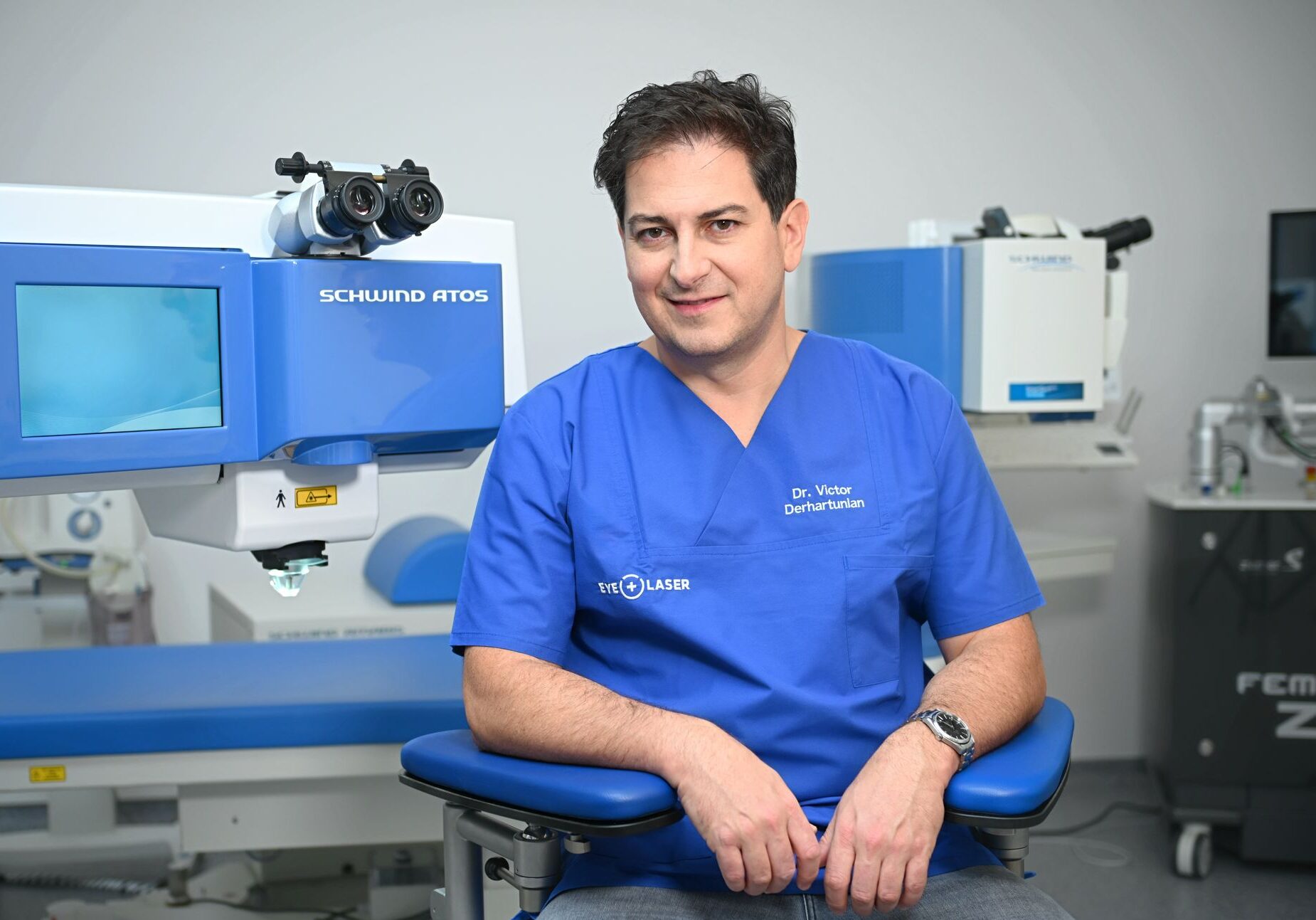
Dr. Victor Derhartunian

Dr. med. Victor Derhartunian
Expert in Refractive Surgery & Patient Advocate


“My goal is not only the best vision for you, but also the fairest path to get there. We fight for every justified reimbursement for our patients and support you with the bureaucracy.”

Frequently asked questions

Does health insurance cover if I depend on good vision for my profession (e.g., pilot, police officer)?

No. Even if the profession requires perfect vision, basic insurance considers this “professional expenses” or a personal choice. There are no exceptions for pilots, drivers, or police officers.

Does disability insurance (IV) cover costs?

Only in extreme exceptional cases involving congenital defects that cannot be corrected with glasses. Disability insurance is not responsible for standard myopia.

Does accident insurance (SUVA) cover costs?

Only if the refractive error is a direct result of an accident (e.g., corneal injury from a splinter). Normal deterioration of vision is classified as “illness,” not “accident.”

Does military insurance (MV) cover costs?

If you sustain an eye injury during military service, yes. For correction of an existing refractive error to become fit for service (e.g., for pilot candidates), military insurance generally does not cover costs.

What if my insurance denies coverage?

This is the standard case with basic insurance. We can support you by preparing a detailed medical letter that medically justifies the necessity (e.g., in cases of severe contact lens intolerance). However, there is no guarantee.

I have eyewear supplementary insurance. Does it also apply to laser surgery?

Often yes! Many insurers (e.g., Visana, Swica) have a budget that can be used for either glasses or or laser treatment. Check whether your credit is defined as “for visual aids.”

Can I split the procedure across two years for insurance purposes?

Yes, that’s a professional tip. If your insurance pays “per calendar year” (e.g., CHF 500 per year), we can treat the left eye in December and the right eye in January. This way, you use the budget twice.

Is it worth switching supplementary insurance before the procedure?

Caution: There is usually a waiting period of 6 to 12 months before benefits can be claimed. Switching “shortly before the procedure” therefore usually does not work.

What does a confirmation for insurance cost at EyeLaser?

Nothing. Completing forms for your supplementary insurance is part of our service.

Does the tax deduction also apply in the Canton of Aargau/Schwyz/Zug?

The principle of “extraordinary expenses” exists at the federal level. However, the thresholds (deductible in %) vary by canton. In Zurich, it is 5%; in other cantons, it is often higher. Check the instructions for your tax return.

Does the 5% threshold refer to gross or net salary?

In the Canton of Zurich, the threshold refers to net income (net). This is advantageous, as this amount is lower than gross, making the 5% threshold easier to reach.

Can I pay the invoice in installments to split it for tax purposes?

For tax deductions, the “cash flow principle” usually applies (when the money was paid). If you finance through heylight the bank pays us immediately (outflow in year 1), and you repay the bank in installments. Clarify with your tax advisor whether the installments count as debt interest or medical expenses.

Does insurance cover crosslinking for keratoconus?

Yes. Crosslinking (CXL) to stabilize the cornea is a mandatory benefit of basic insurance if progression (deterioration) is documented. However, combining it with laser surgery for vision improvement is often a self-pay service.

How does billing work for cataracts with premium lenses?

We use the “splitting procedure.” The clinic bills the basic operation (cataract surgery) and the standard lens directly via TARDOC with the insurance. You only receive a separate invoice from us for the additional cost of the premium lens.

Does insurance cover lens replacement (RLE) from age 50?

No, if there is no medical indication (such as cataracts), lens replacement is a self-pay service (“Clear Lens Exchange”).

Does insurance cover children under 18?

Laser eye surgery is generally not performed on individuals under 18 (the eye is still developing). For medically necessary procedures (e.g., crosslinking in children), insurance covers costs.

Do I need a referral from my general practitioner?

Not for treatment as a self-pay patient. However, if we are to bill a service through basic insurance (e.g., cataracts) and you have a “general practitioner model,” you need a referral.

I am a cross-border commuter / have international insurance. Does it cover costs?

International private insurance policies (e.g., Bupa, Allianz Worldwide) are often much more generous than Swiss insurers and sometimes fully cover refractive surgery. Bring your English policy with you.

Is there a volume discount if I have both eyes treated?

No. Since we use a new, sterile set of disposable instruments and licenses (Schwind ATOS) for each eye, material costs are fixed. Safety is our top priority.

What happens if I lose the invoice?

No problem. We store all receipts digitally and can send you a copy for tax or insurance purposes at any time.