What is lens surgery, and when is it a better fit than the laser?

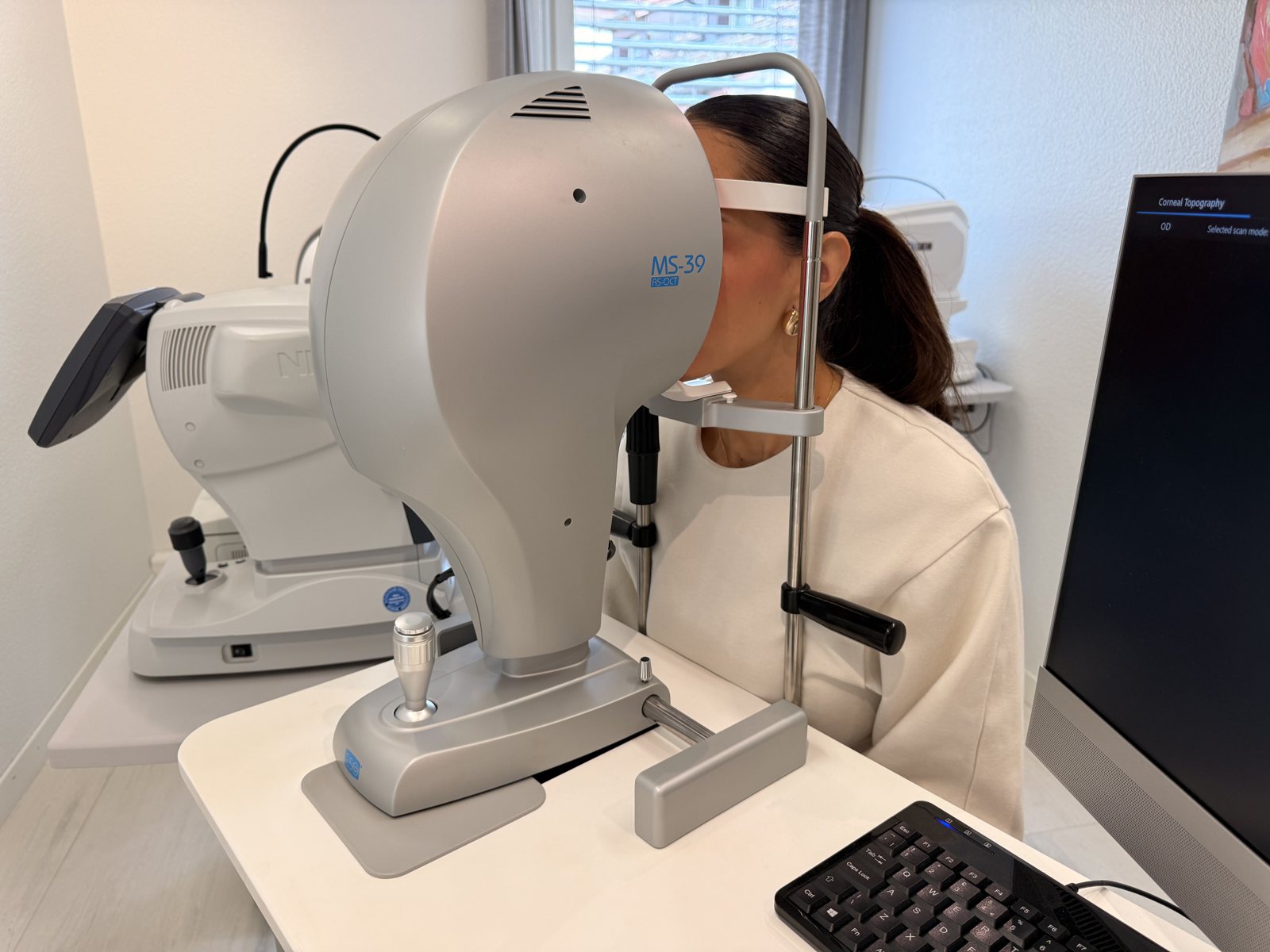
Patient having her visual quality measured on the Visiometrics HD Analyzer (OQAS)
In brief

Lens surgery in Zürich — the key facts at a glance

Lens surgery (lens implantation) is a procedure in which an artificial lens inside the eye corrects the refractive error while the cornea remains untouched. At EyeLaser Zurich there are three options: the ICL for CHF 4’500 per eye, refractive lens exchange for CHF 5’000 per eye, and cataract surgery covered by basic insurance with a surcharge of CHF 700 or CHF 2’700.

✓ICL: additional lens in front of your natural lens, short-sightedness up to −25 dpt, long-sightedness up to +10 dpt, astigmatism up to 6 dpt; around 20 minutes per eye.
✓Refractive lens exchange: artificial lens instead of your natural lens, for long-sightedness from around 45, for all refractive errors from around 55; CHF 5’000 per eye for any lens, with femtosecond laser CHF 6’000.
✓Cataract: surgery billed under TARDOC via basic insurance; surcharge CHF 700 (one distance) or CHF 2’700 (several distances, toric).

Laser eye surgery reshapes the cornea. With lens surgery the cornea stays as it is: either an additional lens is placed in front of your natural lens (ICL), or your natural lens is replaced by an artificial lens (refractive lens exchange, or cataract surgery if the lens has become cloudy).

This is the more suitable route if the refractive error is too high for the laser, the cornea is too thin or irregular, if reading glasses become necessary with presbyopia (from around 45 with long-sightedness, otherwise usually from around 55) or if your natural lens is becoming cloudy. After a refractive lens exchange, a cataract can no longer develop because your natural lens has been removed.

Cataract surgery is performed by our highly specialised team led by Dr. med. Myron Kynigopoulos. Depending on the case, refractive lens exchange is performed by Dr. med. univ. Victor Derhartunian, Dr. Kynigopoulos or Dr. med. Valery Vinzent Wittwer; the ICL is implanted by Dr. Derhartunian or Dr. Kynigopoulos. Dr. Derhartunian is the medical director: he oversees all findings and measurement data and personally performs every laser treatment, including laser fine-tuning after lens surgery.

Refractive lens exchange: when reading glasses become necessary

Your natural lens is replaced by an artificial lens that covers distance, intermediate and near vision (EDOF or trifocal), toric if needed to correct astigmatism. The procedure takes around 15 minutes per eye, with anaesthetic eye drops. A cataract can no longer develop afterwards because your natural lens has been removed; an after-cataract remains possible, which we treat with the YAG laser. CHF 5’000 per eye, regardless of the implant; with femtosecond laser CHF 6’000. If a bothersome residual refractive error remains, laser fine-tuning in the first year after the procedure is included in the price.

Requirements

  • Presbyopia: from around 45 years with long-sightedness, from around 55 with short-sightedness and astigmatism; from around 60, refractive lens exchange is usually the better choice than the laser
  • A prescription too high for the laser (limit according to the KRC recommendations and corneal thickness)
  • Early lens clouding without an insurance indication
  • Healthy retina and optic nerve, no untreated macular disease
  • Realistic expectations: everyday life without glasses; very small print in poor light may still need light readers

Advantages

  • Distance, intermediate and near in one procedure
  • Astigmatism corrected with a toric lens at no extra cost
  • Cataract no longer possible; the artificial lens is made to remain in the eye permanently
  • One price for every lens: the choice is purely medical
  • Both eyes on the same day or separately, entirely as you prefer

Refractive lens exchange  Multifocal lenses · EDOF lenses · Trifocal lenses

ICL lens: the alternative to laser, approved from 21 to 60

A wafer-thin lens is placed through a 3 mm access between the iris and your own lens. The cornea stays untouched and so does your own lens; the ICL can be removed again if needed. About 20 minutes per eye, eye drops only for anaesthesia. CHF 4’500 per eye.

Requirements

  • Short-sightedness up to −25 dpt (lens power), long-sightedness up to +10 dpt, astigmatism up to 6 dpt, CHF 4’500 per eye across the entire range; custom-made lenses outside these ranges CHF 6’000 per eye (made specifically for you, delivery time a few weeks)
  • Stable prescription, age usually 21 to 60 years (as approved; with a stable prescription also from 18); with incipient presbyopia, refractive lens exchange is also an option (from around 45 with long-sightedness, otherwise from around 55)
  • Sufficient anterior chamber depth and a healthy corneal endothelium, both are measured
  • Possible with a thin cornea, dry eyes and contact lens intolerance
  • As a toric ICL after stabilised keratoconus

Worth knowing

  • Lifelong annual check of eye pressure, distance to your own lens and endothelial cell count
  • A cataract can develop later as in any eye; the ICL is then removed during lens exchange
  • Halos around lights in the first weeks are common and usually fade
  • With very high myopia the retinal risk of the short-sighted eye remains

ICL lens

What lens surgery costs: by situation, not by lens

You do not choose a lens first, you come with a situation. That is why the price follows the situation, and within each situation every lens costs the same. The lens choice stays a medical decision.

Refractive lens exchange

CHF 5’000 per eye

No cataract, you pay yourself. Monofocal Plus, EDOF, trifocal or toric: same price. CHF 6’000 with femtosecond laser.

Cataract with basic insurance

Surcharge CHF 700 or 2’700

Surgery runs via the TARDOC tariff. One distance sharp: 700. Several distances or astigmatism: 2’700, toric included. Femtosecond laser plus 1’000.

ICL lens

CHF 4’500 per eye

Additional lens inside the eye for high prescriptions or a thin cornea, toric version at no extra cost.

Cataract without Swiss basic insurance: as for refractive lens exchange, CHF 5’000 or 6’000 respectively. All prices per eye, as of October 2026. Included: procedure, lens, protective shield and the follow-up examinations in the first three months; after ICL and refractive lens exchange also any laser fine-tuning in the first year. Separate: prescription medication and eye drops from the pharmacy, then the annual check-up for CHF 180. Details on the page Lens implantation costs.

Free initial consultation
free

In person or by video call, for ICL and refractive lens exchange. We clarify which type of lens surgery is an option and whether the pre-examination is worthwhile. There is no free initial consultation for cataract: the examination is a service covered by basic insurance.

Full pre-assessment
CHF 300

Around 90 minutes: biometry for the lens calculation, corneal tomography with the MS-39, retinal OCT, endothelial cell count, pupil. Credited towards the cost if you go ahead with treatment. For cataract, we bill the examination under TARDOC via basic insurance.

Instalments: six monthly instalments interest-free directly with us, without a bank check; longer terms through our partner HeyLight with a credit check and interest. Medical costs you pay yourself may be tax-deductible above the deductible threshold; for lens procedures the tax authority decides, see Laser eye surgery and taxes.

Three routes, one principle: the lens takes over the correction

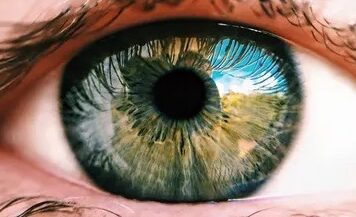
Close-up of a green-brown eye showing the iris, pupil and eyelashes

Refractive lens exchange

From around 45 with long-sightedness, otherwise from around 55, if reading glasses bother you or your values are too high for the laser. An artificial lens replaces your natural lens, permanently and with protection against cataract. More about refractive lens exchange

Two women of different ages, one with grey hair and one with red hair, cheek to cheek

ICL lens

Approved from 21 to 60 (from 18 with a stable prescription), mainly up to about 45; with high short- or long-sightedness, a thin cornea or dry eyes. The cornea stays untouched, the lens is reversible. More on the ICL

Black glasses lying on a rock in front of a blurred waterfall

Cataract surgery

If the lens is cloudy, basic insurance pays for the operation. You only decide whether the artificial lens should cover one or several distances. More on cataract

Close-up of a green-brown eye showing the iris, pupil and eyelashes

Refractive lens exchange

From around 45 with long-sightedness, otherwise from around 55, if reading glasses bother you or your values are too high for the laser. An artificial lens replaces your natural lens, permanently and with protection against cataract. More about refractive lens exchange

Two women of different ages, one with grey hair and one with red hair, cheek to cheek

ICL lens

Approved from 21 to 60 (from 18 with a stable prescription), mainly up to about 45; with high short- or long-sightedness, a thin cornea or dry eyes. The cornea stays untouched, the lens is reversible. More on the ICL

Black glasses lying on a rock in front of a blurred waterfall

Cataract surgery

If the lens is cloudy, basic insurance pays for the operation. You only decide whether the artificial lens should cover one or several distances. More on cataract

How lens surgery works with us

Three steps, each backed by measurements. After the pre-assessment we also tell you if we advise against surgery or consider another procedure safer.

Pre-assessment: what we measure

Lens calculation is very precise today, but only as precise as its measurements. So it includes:

  • Optical biometry (axial length, corneal curvature) for calculating the lens power
  • Corneal topography and tomography with the MS-39: front and back surface, astigmatism, regularity
  • OCT of the retina and optic nerve: macular disease rules out multifocal lenses
  • Anterior chamber depth and endothelial cell count, decisive for the ICL
  • Pupil size in the dark, kappa angle, tear film
  • Your habits: night driving, screen work, reading, sport

Afterwards you know the procedure, lens type and binding price. CHF 300, credited against a treatment.

The procedure: 15 to 20 minutes per eye

Outpatient, with drop anaesthesia, without injection and without general anaesthetic. Lens exchange and cataract: Through an access of around 2 mm your own lens is liquefied with ultrasound and removed; the folded artificial lens unfolds in the capsular bag. On request the femtosecond laser takes over the incisions and the opening of the capsule (FLACS, plus CHF 1’000). ICL: The folded lens is inserted through a 3 mm access and placed behind the iris; your own lens stays.

For refractive lens exchange and ICL, we operate on both eyes on the same day or separately, entirely as you prefer; for cataract, also on the same day if medically suitable. You must not drive yourself on the day of the procedure.

Aftercare: the first three months

Check-ups on the following day, after one week, after one month and after three months are included in the price; after that, the annual check-up is charged. In the first few days a protective shield prevents rubbing; you use eye drops for three to four weeks according to a schedule; they are available on prescription from the pharmacy and are not included in the price. Most people can see well enough for everyday life by the following day; screen work is possible after two to three days. After a refractive lens exchange, the capsule can become cloudy months later (after-cataract); we treat this on an outpatient basis in a few minutes with the YAG laser. After an ICL, the annual check-up remains important for life.

Meet Your Eye Surgeons in Zurich Personal care from trusted vision correction experts.

Discover our laser eye surgeons in the heart of Zurich

Dr. Victor Derhartunian
Ophthalmologist, specialist in refractive surgery
FEBO, FWCRS

Having learned his craft from the two pioneers of laser surgery, Dr. Victor Derhartunian has performed some 25,000 refractive procedures. The head eye surgeon at EyeLaser in Zurich can consult his patients in 5 languages.

LEARN MORE
Dr. med. Valery Vinzent Wittwer
Ophthalmologist and Eye Surgeon
FEBO

Dr. Valery Vinzent Wittwer joined the EyeLaser Zurich team in 2024. He specializes in lens surgery and performs refractive lens exchange at our clinic.

Learn more
Dr. med. Myron Kynigopoulos, Augenchirurg bei EyeLaser Zürich
Dr. med. Myron Kynigopoulos
Ophthalmologist and Eye Surgeon
FEBO

Dr. med. Myron Kynigopoulos is an ophthalmologist and eye surgeon, FEBO. At EyeLaser Zurich he performs cataract and lens surgery.

Dr. Victor Derhartunian
Ophthalmologist, specialist in refractive surgery
FEBO, FWCRS

Having learned his craft from the two pioneers of laser surgery, Dr. Victor Derhartunian has performed some 25,000 refractive procedures. The head eye surgeon at EyeLaser in Zurich can consult his patients in 5 languages.

LEARN MORE
Dr. med. Valery Vinzent Wittwer
Ophthalmologist and Eye Surgeon
FEBO

Dr. Valery Vinzent Wittwer joined the EyeLaser Zurich team in 2024. He specializes in lens surgery and performs refractive lens exchange at our clinic.

Learn more
Dr. med. Myron Kynigopoulos, Augenchirurg bei EyeLaser Zürich
Dr. med. Myron Kynigopoulos
Ophthalmologist and Eye Surgeon
FEBO

Dr. med. Myron Kynigopoulos is an ophthalmologist and eye surgeon, FEBO. At EyeLaser Zurich he performs cataract and lens surgery.

Laser, ICL or lens exchange? The suitability test in 45 seconds

Corneal measurement with the MS-39 before laser eye surgery

Seven questions about age, prescription, eyes and lifestyle. You receive a first assessment of which option, and therefore which price, may apply to you. The pre-operative examination makes it binding.

Check suitability

Frequently asked questions about lens surgery

Answered briefly. What applies to your eye we tell you after the pre-assessment.

Lens exchange or ICL: which suits me?

Roughly by age: before presbyopia, with high refractive errors or a thin cornea, the ICL is the first choice because your natural lens and its ability to focus are preserved. With long-sightedness, refractive lens exchange becomes an option from around 45, with all other refractive errors from around 55; from around 60 it usually makes more sense than the laser. With a clear lens and good distance vision, the laser (PresbyMAX) can also correct presbyopia.

What does lens surgery cost in Zurich?

Refractive lens exchange CHF 5’000 per eye regardless of the lens chosen, CHF 6’000 with femtosecond laser. ICL CHF 4’500 per eye. For cataract with basic insurance the insurer pays for the operation; you pay the surcharge for the lens, CHF 700 for one distance or CHF 2’700 for several distances, femtosecond laser plus CHF 1’000. The pre-assessment costs CHF 300 and is credited.

Does health insurance pay?

For cataract, yes: basic insurance covers the operation under TARDOC; you only pay the surcharge for a lens that does more than the standard model. Refractive lens exchange and ICL you pay yourself; some supplementary insurances contribute. We issue all receipts, also for your tax return.

How long does the procedure take, and when will I see clearly?

15 to 20 minutes per eye, outpatient, with drop anaesthesia. Most people see well enough for everyday life the next day. With multifocal and EDOF lenses the brain needs a few weeks to make full use of the new optics; night-time light effects fade during this period. After three months we assess the final result.

Are both eyes operated on the same day?

For cataract, yes, if medically suitable; on request also in two appointments around one week apart. For refractive lens exchange and ICL, we operate on both eyes on the same day or separately, entirely as you prefer.

How long does an artificial lens last?

Artificial lenses are made to remain in the eye permanently and are generally not replaced. Rarely, a lens has to be removed again, for example in the case of a large deviation from the target power or optical complaints; in a series of 1’438 multifocal lenses this was 0.83 % (Kermani and Gerten 2016). More often, the lens capsule becomes cloudy later (after-cataract), which the team at EyeLaser Zurich treats in a few minutes with the YAG laser. The ICL can be removed if necessary.

Who performs the surgery at EyeLaser Zurich?

At EyeLaser Zurich, cataract surgery is performed by our highly specialised team led by Dr. med. Myron Kynigopoulos. Depending on the case, refractive lens exchange is performed by Dr. med. univ. Victor Derhartunian, Dr. Kynigopoulos or Dr. med. Valery Vinzent Wittwer; the ICL is implanted by Dr. Derhartunian or Dr. Kynigopoulos. Dr. Derhartunian is the medical director, oversees all findings and measurement data and personally performs every laser treatment. The pre-examination and follow-up examinations take place at Strehlgasse 33 in Zürich.

What are the risks of lens implantation?

The most common consequence after refractive lens exchange and cataract surgery is after-cataract: in a British registry study, 5.8 to 19.3 % of eyes needed YAG laser treatment within five years (Ursell 2020). An infection in the eye occurred in 0.023 % of operations in Sweden (Friling 2024). After an ICL, the annual check-up remains important for life. At EyeLaser Zurich, we discuss your personal risk after the pre-examination.

Laser eye surgery or lens implant: which suits me?

With a healthy, sufficiently thick cornea and values within the laser range, laser eye surgery at EyeLaser Zurich is usually the smaller procedure (CHF 1’500 to 3’000 per eye). A lens implant is an option if the cornea is too thin or irregular, the values exceed the laser limit according to the recommendations of the KRC, or reading glasses become necessary with presbyopia (from around 45 with long-sightedness, otherwise usually from around 55). According to the KRC, the ICL is an equivalent option from as little as around ±1 dpt.

Is there a free initial consultation for cataract?

No. For cataract, the examination is a service covered by basic insurance and is billed under TARDOC. The free initial consultation at EyeLaser Zurich applies to the ICL, refractive lens exchange and laser eye surgery. For cataract, you book an examination directly at Strehlgasse 33 in Zürich; afterwards you will know whether and when surgery makes sense and which surcharge (CHF 700 or 2’700 per eye) applies.

Decision aid

Which lens operation for which starting point?

Guide values from practice. The binding recommendation follows the measurement of cornea, anterior chamber, lens and retina.

Your starting point Procedure Price per eye Why
21 to 60 (mainly up to about 45), high myopia or a thin cornea ICL lens CHF 4’500 No tissue removal, cornea and own lens remain; reversible.
Under 45, prescription within laser range Laser eye surgery CHF 1’500 to 3’000 With a healthy cornea the laser is the smaller procedure.
From about 45, good distance vision, clear lens, reading glasses annoy PresbyMAX, with long-sightedness or from around 55 also refractive lens exchange CHF 3’300 / 5’000 The laser keeps your own lens; the exchange settles the question for good.
Long-sightedness from around 45, short-sightedness or astigmatism from around 55; from around 60 usually refractive lens exchange instead of the laser Lens exchange CHF 5’000, with femto 6’000 Distance, near and astigmatism in one procedure, no cataract any more.
Early lens clouding, no insurance indication yet Lens exchange CHF 5’000, with femto 6’000 A laser on the cornea would be wasted; the clouding would take the result away again.
Cataract with Swiss basic insurance Cataract surgery Surcharge CHF 700 or 2’700 Surgery under TARDOC; the surcharge covers the lens tier, toric included.
Cataract without Swiss basic insurance Cataract surgery CHF 5’000, with femto 6’000 Self-payers pay as for lens exchange, every lens at the same price.

Astigmatism up to around 6 dioptres is corrected at the same time with a toric lens in all lens procedures, at no extra cost; toric ICLs correct up to 6 dioptres; custom-made lenses outside this range CHF 6’000 per eye (made specifically for you, delivery time a few weeks).

Which lens: Monofocal Plus, EDOF, trifocal or toric?

Within one situation every lens costs the same. The choice follows your everyday life and the measurements, not the price.

Monofocal Plus

One distance sharp, usually far, with a little more depth of focus than classic monofocal lenses. Glasses remain for reading. Those who drive a lot at night and live well with readers are often best served here.

EDOF

EDOF lenses cover distance and intermediate vision (screen, dashboard). Halos are possible; whether they are less frequent than with trifocal lenses depends on the lens model (Karam 2023; Hovanesian 2022). Light reading glasses may still be needed for small print.

Trifocal

Trifocal lenses provide three focal points: distance, intermediate, near. The greatest freedom from glasses, with more halos at night at first. More under multifocal lenses.

Toric

Each of the three lenses comes in a toric version against astigmatism. A regular astigmatism is the requirement; the topography shows it.

When we advise against it: In the case of macular disease, pronounced dry eyes without prior treatment or irregular astigmatism, we advise against multifocal lenses and suggest a different lens or a different procedure.

One-minute treatment checkFree consultationAll lens prices

Transparency

What risks there are, and how we manage them

Lens operations are among the most common procedures in medicine. They are not risk-free. What can occur, written down openly:

Posterior capsule opacification

After a lens exchange the lens capsule clouds months to years later in some patients. Treatment with the YAG laser takes minutes, is painless and done once.

Light effects at night

Halos and glare are normal with multifocal and EDOF lenses in the first weeks and fade with adaptation. With the ICL they are rarer and usually temporary.

Eye pressure

After an ICL the pressure can rise in the first days; we monitor closely. Long term, the distance to your own lens and the endothelial cell count are the reasons for the annual check.

Infection and retina

An infection in the eye is rare (0.023 % in a Swedish registry study) and shows itself through pain, redness and rapid deterioration in the first few days; in that case, call immediately. Highly short-sighted eyes retain their increased risk of retinal detachment, regardless of the procedure.

During the first 24 hours after surgery your surgeon can be reached around the clock.

What are the risks of lens implantation, and how common are they?

Study figures, not our own data. We discuss your personal risk after the pre-examination.

Risk Frequency in studies Source What we do
After-cataract (after refractive lens exchange and cataract surgery) 5.8–19.3 % of eyes with YAG treatment within five years, depending on the lens model Ursell 2020 YAG laser in a few minutes at Strehlgasse, billed via basic insurance
Halos with multifocal lenses around 3.6 times more frequent than with monofocal lenses (7 studies, 662 eyes) de Silva 2016 Lens choice based on daily life; the brain adapts over weeks to months (Rosa 2017)
Infection in the eye 0.023 % (177 of 764’513 operations) Friling 2024 Antibiotic into the anterior chamber at the end of the procedure; available around the clock for the first 24 hours
Retinal detachment after refractive lens exchange/cataract surgery 0.99 % in four years; around six times higher with high short-sightedness, higher in younger patients Daien 2015 Retinal examination beforehand; for young, highly short-sighted eyes, ICL is preferable
ICL: loss of inner corneal cells 3.8 % after around 21 months Kisiel and Gurumurthy 2024 Endothelial cell count at every annual check-up
ICL: lens opacity 1.7 % (3 of 177 eyes) in eight years Kamiya 2021 Monitoring; if necessary, ICL removal and refractive lens exchange

After the procedure, you can reach the surgeon around the clock for the first 24 hours; after that, the surgeon during the day, and at night and in an emergency the emergency department of the hospital on duty.

Sources

Study figures come from published research and are not our own data. Study populations differ in age, baseline values and lens model.

  1. Ursell PG, Dhariwal M, O’Boyle D et al. 5 year incidence of YAG capsulotomy and PCO after cataract surgery with single-piece monofocal intraocular lenses: a real-world evidence study of 20,763 eyes. Eye (Lond) 2020;34(5):960–968. (Study funded by Alcon.) PubMed 31616057
  2. de Silva SR, Evans JR, Kirthi V et al. Multifocal versus monofocal intraocular lenses after cataract extraction. Cochrane Database Syst Rev 2016;12:CD003169. PubMed 27943250
  3. Rosa AM, Miranda ÂC, Patrício MM et al. Functional magnetic resonance imaging to assess neuroadaptation to multifocal intraocular lenses. J Cataract Refract Surg 2017;43(10):1287–1296. PubMed 29120714
  4. Friling E, Bro T, Lundström M, Montan P. Endophthalmitis after cataract surgery and effect of different intracameral antibiotic regimes in Sweden 2011–2017: national registry study. J Cataract Refract Surg 2024;50(8):828–835. PubMed 38661497
  5. Daien V, Le Pape A, Heve D et al. Incidence, Risk Factors, and Impact of Age on Retinal Detachment after Cataract Surgery in France: A National Population Study. Ophthalmology 2015;122(11):2179–2185. PubMed 26278859
  6. Kisiel FB, Gurumurthy GJ. Endothelial cell loss post-implantable collamer lens V4c: meta-analysis. J Cataract Refract Surg 2024;50(4). PubMed 38194352
  7. Kamiya K, Shimizu K, Takahashi M et al. Eight-Year Outcomes of Implantation of Posterior Chamber Phakic Intraocular Lens With a Central Port for Moderate to High Ametropia. Front Med (Lausanne) 2021;8:799078. PubMed 34977099
  8. Kermani O, Gerten G. Explantation von Multifokallinsen – Häufigkeit, Ursachen und Verlauf. Klin Monbl Augenheilkd 2016;233(8):928–932. PubMed 27385256
  9. Karam M, Alkhowaiter N, Alkhabbaz A et al. Extended Depth of Focus Versus Trifocal for Intraocular Lens Implantation: An Updated Systematic Review and Meta-Analysis. Am J Ophthalmol 2023;251:52–70. PubMed 36736751
  10. Hovanesian JA, Jones M, Allen Q. The Vivity Extended Range of Vision IOL vs the PanOptix Trifocal, ReStor 2.5 Active Focus and ReStor 3.0 Multifocal Lenses: A Comparison of Patient Satisfaction, Visual Disturbances, and Spectacle Independence. Clin Ophthalmol 2022;16:145–152. (Sponsored by Alcon, not randomised.) PubMed 35082481
  11. German Commission for Refractive Surgery (KRC) of DOG and BVA: recommendations, as of 2022. augeninfo.de/krc

Further reading

Lens exchange · ICL lens · Cataract surgery · Femtosecond laser cataract (FLACS) · multifocal lenses · EDOF lenses · Trifocal lenses · Presbyopia · PresbyMAX · Lens implantation costs · Laser eye surgery