Free suitability test or comprehensive preliminary examination:

Proper preparation is just as important as the lens surgery itself. Precise measurement data and your requirements for the treatment are the basis for successful, safe and satisfactory lens surgery. This is the only way we can determine the best possible treatment method for your eyes, select the artificial lens to be used and, if necessary, customise it for your eyes.

Top treatments with state-of-the-art equipment in our eye laser centre in Zurich. World-renowned surgeons who the Schw

Suitability test
0 CHF

Would you like to know whether your refractive error/eye condition can be corrected with laser eye surgery or lens surgery? We will tell you for free.

Preliminary examination
290 CHF

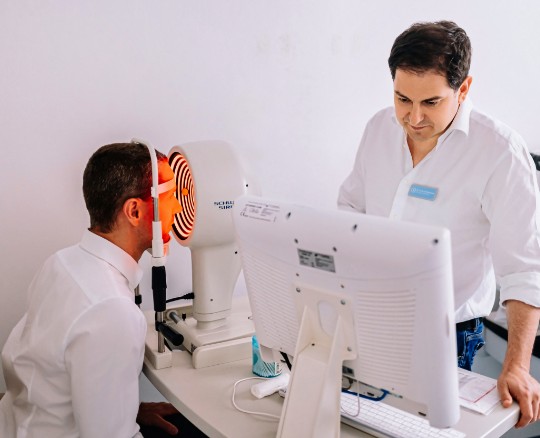
Examination, measurement of your eyes, evidence-based and personal consultation, and creation of an individual treatment plan. Time for your questions so you can make the best decision.

Book a preliminary examination with no obligation & no risk

If you are not suitable for lens surgery or decide against the procedure at short notice after the examination, we will only charge you for the ophthalmological examination (+ contact lens simulation if applicable).

As part of your preliminary examination, we take 90 minutes—just for you, your eyes and your questions. Individual consultation, evaluation of measurement data, information about the pros and cons and risks are just as much a matter of course as transparent communication when it comes to lens surgery prices.

So you can make your decision voluntarily, without pressure and with a good feeling—one that will sustainably change your life for the better.

Lens replacement / cataract surgery costs

The best and most effective method of refractive lens exchange. Your natural lens is replaced with a state-of-the-art artificial lens (multifocal lens with multiple focal points or an EDOF lens with extended depth of focus). This lens corrects all refractive errors and can treat or prevent cataracts. Never having to wear glasses or contact lenses again.

Affordable alternative at an EyeLaser eye laser clinic abroad:

Swisslaser Warsaw

CHF 2,500 instead of CHF 5,000

Lifestyle
5000 CHF
  • Never again glasses or contact lenses
  • High-quality multifocal lenses / EDOF lenses
  • Cataract, presbyopia, short-sightedness & long-sightedness
  • Astigmatism correction included
  • Surcharge: lens replacement with femto laser

The femtosecond laser makes lens replacement/cataract surgery even safer, more precise and gentler. Instead of a manually guided scalpel, the computer-assisted femto laser uses the measurement data to make the optimal, delicate incision in the cornea. However, this has no effect on visual acuity.

Affordable alternative at an EyeLaser eye laser clinic abroad:

EyeLaser Vienna

CHF 4,500 instead of CHF 6,000

Surcharge
1000 CHF
  • Lens replacement Premium + Laser
  • Highly precise incision with femto laser
  • Ziemer Z8 laser
  • Maximum safety & precision

ICL EVO lens implantation + phakic lens costs

For severe refractive errors, we implant a modern ICL phakic lens in addition to the natural lens, correcting the refractive error so that you can see clearly again without glasses or contact lenses. Lens implantation has already been used successfully millions of times—even in patients for whom laser eye surgery is not possible (e.g. due to a cornea that is too thin).

Affordable alternative at an EyeLaser eye laser clinic abroad:

Swisslaser Warsaw

CHF 2,800 instead of CHF 5,000

Surcharge
5000 CHF
  • Severe myopia & hyperopia
  • Even if laser eye surgery is not possible
  • High-quality EVO/EVO+ Visian lenses
  • Astigmatism correction included

Lens surgery financing: sharp vision in affordable instalments

Not everyone who wants sharp vision can pay the cost of lens surgery immediately. We understand that, which is why we offer you the attractive option of spreading your treatment costs over 6 smaller monthly instalments:

  • No interest
  • No hidden fees
  • Without down payment
  • As flexible as your life
Lens replacement LIFESTYLE
883 / Monat*
Lens replacement with femto laser
1000 CHF / Monat*
ICL phakic lens implantation
833 € / Monat*
Lens replacement LIFESTYLE
883 / Monat*
Lens replacement with femto laser
1000 CHF / Monat*
ICL phakic lens implantation
833 € / Monat*

We are currently working with exclusive partner banks to be able to offer long-term financing with a fixed interest rate for our Swiss customers as well. With a term of five years, the monthly instalment per eye would then be under CHF 100 (Lens Replacement Lifestyle).

We will be happy to advise you on your financing options and develop suitable solutions that will also enable you to enjoy the luxury of unrestricted vision!

Make an appointment

Lens surgery & health insurance: when does it pay?

Basic health insurance in Switzerland is mandatory and generally does not pay for lens surgery. This is because, strictly speaking, these procedures are not medically necessary—even though the level of suffering can be high.

However, there are exceptional cases in which either basic insurance or supplementary insurance will cover your costs in full or in part:

  • Intolerance to glasses and contact lenses
  • Contact lens intolerance with at least +/- 10 dioptres
  • Contact lens intolerance with a difference in visual acuity between both eyes of at least +/- 3 dioptres
  • Cataract surgery with monofocal lenses
  • Supplementary insurance that, according to the contract, covers laser eye surgery / lens surgery

Cataract surgery cost coverage: what you need to know

Cataract surgery is medically necessary and is therefore covered by health insurance (including basic insurance). However, insurers only cover the cost of a procedure with standard monofocal lenses, which allow you to see clearly only over one distance range. With this option, you will therefore need glasses after the minimally invasive procedure.

At EyeLaser Zurich, we use modern multifocal lenses (including EDOF lenses with extended depth of focus) to correct cataracts and all refractive errors at the same time. Afterwards, you will no longer suffer from:

  • Myopia
  • Farsightedness
  • Astigmatism
  • Presbyopia
  • Cataracts

So if you want to have your cataracts treated optimally and then be able to do without visual aids entirely, your insurance will cover as much as the standard procedure would have cost. You can pay the rest yourself through a private co-payment.

Significantly lower cost burden thanks to partial cost coverage + a small surcharge for the best possible vision—for life!

LENS SURGERY COST COVERAGE TABLE

Request cost coverage with your medical report

During your preliminary examination, we check the key decision-making criteria and, on request, provide you with your clinical medical report. You must submit this for a binding statement from your insurer.

This allows you to find out whether and how much of the lens surgery costs will be covered—before you decide on treatment at EyeLaser. Be financially protected!

Make an appointment

Save on taxes: deduct lens surgery from your taxes

See clearly and save money on taxes at the same time? Many people do not know this, but laser eye surgery or lens surgery can, in most cases, be claimed on your income tax return. Declared as a so-called “special expense”, lens surgery costs reduce your taxable income and thus lower your tax burden.

Whether these costs are deductible usually depends on cantonal regulations. Check the website of your cantonal tax authority or ask the responsible staff about the tax treatment and recording of laser eye and lens surgery costs.

Meet Your Eye Surgeons in Zurich Personal care from trusted vision correction experts.

Discover our laser eye surgeons in the heart of Zurich

Dr. Victor Derhartunian
Augenarzt, Spezialist für Refraktive Chirurgie
FEBO

Having learned his craft from the two pioneers of laser surgery, Dr. Victor Derhartunian is among the leading surgeons in Europe. The head eye surgeon at EyeLaser in Zurich can consult his patients in 5 languages.

LEARN MORE
Dr. med. Valery Vinzent Wittwer
Ophthalmologist and Eye Surgeon
FEBO

Dr. Valery Lenzt Wittwer joined the EyeLaser Zurich team in 2024. He specializes in lens surgery and enables patients to live without cataracts and/or refractive errors through cataract surgery and ICL lens implantation.

Learn more
Dr. med. Myron Kynigopoulos
Ophthalmologist and Eye Surgeon
FEBO

With over 20 years of experience and 10,000+ surgeries, Dr. Myron Kynigopoulos is among Switzerland’s leading experts. Specializing in high-end lens surgery and laser procedures, he combines precision with empathetic patient care.

Dr. Victor Derhartunian
Augenarzt, Spezialist für Refraktive Chirurgie
FEBO

Having learned his craft from the two pioneers of laser surgery, Dr. Victor Derhartunian is among the leading surgeons in Europe. The head eye surgeon at EyeLaser in Zurich can consult his patients in 5 languages.

LEARN MORE
Dr. med. Valery Vinzent Wittwer
Ophthalmologist and Eye Surgeon
FEBO

Dr. Valery Lenzt Wittwer joined the EyeLaser Zurich team in 2024. He specializes in lens surgery and enables patients to live without cataracts and/or refractive errors through cataract surgery and ICL lens implantation.

Learn more
Dr. med. Myron Kynigopoulos
Ophthalmologist and Eye Surgeon
FEBO

With over 20 years of experience and 10,000+ surgeries, Dr. Myron Kynigopoulos is among Switzerland’s leading experts. Specializing in high-end lens surgery and laser procedures, he combines precision with empathetic patient care.

Lens surgery costs: FAQ

How long does an artificial lens last?

We use high-quality lenses that are designed to stay in the eye for a lifetime. The ICL lenses have a durability of at least 90 years on. If a cataract develops with increasing age, the lens implant can simply be exchanged for a monofocal or multifocal artificial lens (standard or lifestyle lens exchange / cataract).

Multifocal lenses also usually do not need to be exchanged become. If you have your natural lens replaced with such an artificial lens, you can no longer develop cataracts. This is because the multifocal lens cannot become cloudy.

The costs of lens surgery are therefore an investment that pays off for you every day. In rare cases, a visual defect persists after lens surgery. This can usually be corrected by laser eye treatment. You only pay 50 percent of the regular price for this fine-tuning.

Is lens implantation / lens exchange better than laser eye surgery?

No. Lens surgery and laser eye surgery are two different procedures for the correction of vision defects and eye diseases, which are equally good work. Only the There are different areas of application. Whether you need lens implantation, lens replacement or laser eye surgery depends on you and we at EyeLaser will find the safest and most promising treatment method.

Refractive lens exchange: It is particularly suitable for the treatment of cataracts because the clouded lens cannot be replaced / cleared with a laser alone. The indication is therefore the healing of cataracts – the correction of visual defects is a positive side effect. Lens replacement is also an attractive alternative to laser eye surgery for presbyopia, as multifocal lenses can correct all visual defects (short-sightedness, long-sightedness and astigmatism) at the same time. You then no longer need glasses or contact lenses and cannot develop cataracts. Presbyopia can, however, also be treated with a laser through the PresbyMAX.

ICL Phake lens (lens implantation): Often used when the visual defect is so severe that conventional laser treatment is not possible. The artificial lens is inserted behind the pupil and can therefore also compensate for extreme short-sightedness, long-sightedness and astigmatism.

The costs for a lens operation are usually higher than the laser eye surgery costs. For this reason, these methods are usually used when they are the Safer, more effective and sometimes the only alternative to laser eye surgery are. Lens exchange and lens implantation enable patients to live without visual defects and visual aids, who would otherwise be permanently restricted and may even go blind due to cataracts.

Are multifocal lenses covered by health insurance?

Even though multifocal lenses are the most modern and advantageous variant of artificial lenses in the course of lens surgery, they are not usually covered by statutory or private health insurance. not covered by statutory or private health insurance. Formally, these are considered “not medically necessary”. Even if a cataract is present, the health insurance company will unfortunately only monofocal lenses (with EyeLaser: standard cataract surgery).

If you meet the requirements for the costs of lens surgery to be covered, you can clarify with your health insurance company whether a private co-payment (for the better multifocal lenses) is possible. This means that your private share only amounts to the difference between monocular and multifocal lenses.

At EyeLaser, we work with high-quality multifocal lenses for the benefit of our patients and for the best refractive lens exchange results. with high-quality multifocal lenses. However, we also offer the use of monofocal lenses in the course of lens replacement (due to cataracts or other visual defects).

Why are lens operations so expensive?

This question (understandably) arises for many people. A variety of factors play a role in pricing. Excessive money due to the suffering of patients with defective vision and eye diseases is not one of them.

The main cost driver is the equipment at the EyeLaser Clinic. The diagnostic equipment alone costs around 300.000 €. Our modern femto laser of the latest generation – which is only used for the first incision – beats the laser with approximately one half a million euros to book. In practice, the cost of consumables is between 350 and 450 € per use (eye).

In addition, there are the costs for your premium lens implants (EVO/EVO+ VISIAN ICL), standard monofocal lenses or lenses manufactured just for you (trifocal / EDOF) multifocal lenses. must also be included in the calculation:

  • Premises
  • Employees
  • Insurances

In the end, wisdom prevails: Quality has its price. And with such an important medical procedure, you should not save money at the wrong end.

For a fair price, EyeLaser provides you with the latest equipment (lasers, lenses & co.), experienced surgeons (e.g. Dr. Derhartunian: 18 years of training, decades of professional experience and renowned worldwide) and therefore the safest, most promising treatment to the highest standards.

Can the cost of lens surgery be deducted from tax?

Yes! In principle, you can deduct at least part of the costs incurred for lens surgery from your tax bill. This means that you compensate for part of the treatment costs through the reduced tax burden.

A decision has clarified that laser eye surgery and lens replacement as well as lens implantation may not be categorized as business expenses. Instead, these are Medical expenses in the sense of “extraordinary expenses”. Similar to claiming the purchase price of glasses, you are generally entitled to a tax rebate.

The “extraordinary burden” is defined in § 34 EstG and can be checked using these three criteria:

  1. Exceptionality: higher expenses than the majority of the taxable population. In the case of laser eye surgery or lens surgery, which can cost several thousand euros, this condition is usually assumed.
  2. Inevitability: Normally unproblematic for lens operations. It is more controversial with care services, for example.
  3. Impairment of economic performance

Please note that the tax deductibility of medical expenses (which are classed as extraordinary expenses) is subject to a deductible is provided for. This is determined as a percentage of annual income and is between six and 12 percent. In special circumstances, it can be reduced by one percent (e.g. for single earners or single parents). With a certificate stating that a special medical service has been provided, a full deduction possible.

According to the law, the term “medical expenses” covers all therapeutic measures that are intended to cure an illness. Unlike cataracts, defective vision is not a recognized medical condition, but treatment costs are still covered. This is because expenses for medical aids (e.g. glasses) are also recognized.

If the requirements are met, you can pay the costs for the medical treatment (lens replacement or lens implantation) and the costs of medical care and accommodation. medical care and the stay deductible. If your health insurance covers all or part of your lens surgery, this also has an impact on your tax treatment.

If you are unsure, it is best to ask your tax advisor, your contact at EyeLaser or the relevant tax office.

Discover which eye treatment is best for you with this 1-minute quiz

Dr. Victor Derhartunian

Things like age, eye shape, history and lifestyle make an eye treatment perfect for one person, but not another. Find out which treatment (if any) could free you from glasses and contacts

Take a quiz

FAQ

How much does lens surgery cost?

The cost of lens surgery at EyeLaser Zurich depends on various factors, such as the variant and the type of lenses used:

  • ICL phakic lenses cost CHF 5,000 per eye
  • Lens replacement Premium: CHF 5,000 per eye
  • Lens replacement Premium + Laser: CHF 6,000 per eye

These prices include the entire treatment—from the preliminary examination and the procedure itself to the materials and aftercare.

What factors influence the cost of lens surgery?
  • Type of lenses: monofocal lenses generally cost less than multifocal or toric lenses.
  • Technology: using laser technology in lens surgery often involves an additional charge.
  • Complexity of the procedure: patients with special anatomical needs may require more complex procedures.
  • Clinic location: prices can vary depending on the location of the eye laser centre.

At EyeLaser Zurich, for example, Femto-LASIK is used for Lens Replacement Premium + Laser, which alone costs around half a million euros to purchase.

Are there financing options for lens surgery—and if so, which ones?

Yes, EyeLaser Zurich offers interest-free instalment payments over a period of up to 6 months. In addition, a preliminary examination is offered for CHF 350.–, which is credited towards subsequent treatment.

Do health insurance companies in Switzerland cover the costs of lens surgery?

In Switzerland, health insurance companies generally only cover the costs of lens surgery if there is a medical necessity, such as cataracts. In such cases, only the standard treatment with monofocal lenses is often covered. For premium options such as multifocal or toric lenses, patients usually have to pay themselves.

How long does it take to see clearly again after lens surgery?

Vision usually improves within the first few days after treatment. However, complete healing and stabilisation of vision can take up to three months. During this time, patients should avoid certain activities such as intense sport or rubbing their eyes to support healing.