Medical excellence meets Zurich discretion

In our practice on Zurich’s Bahnhofstrasse, we understand that the decision to undergo vision correction is a matter of trust. Many of our patients hesitated for a long time before coming to us. But as over 10,000 satisfied patients can confirm: the fear of the procedure is usually greater than the procedure itself.

Presbipia

The boutique clinic principle

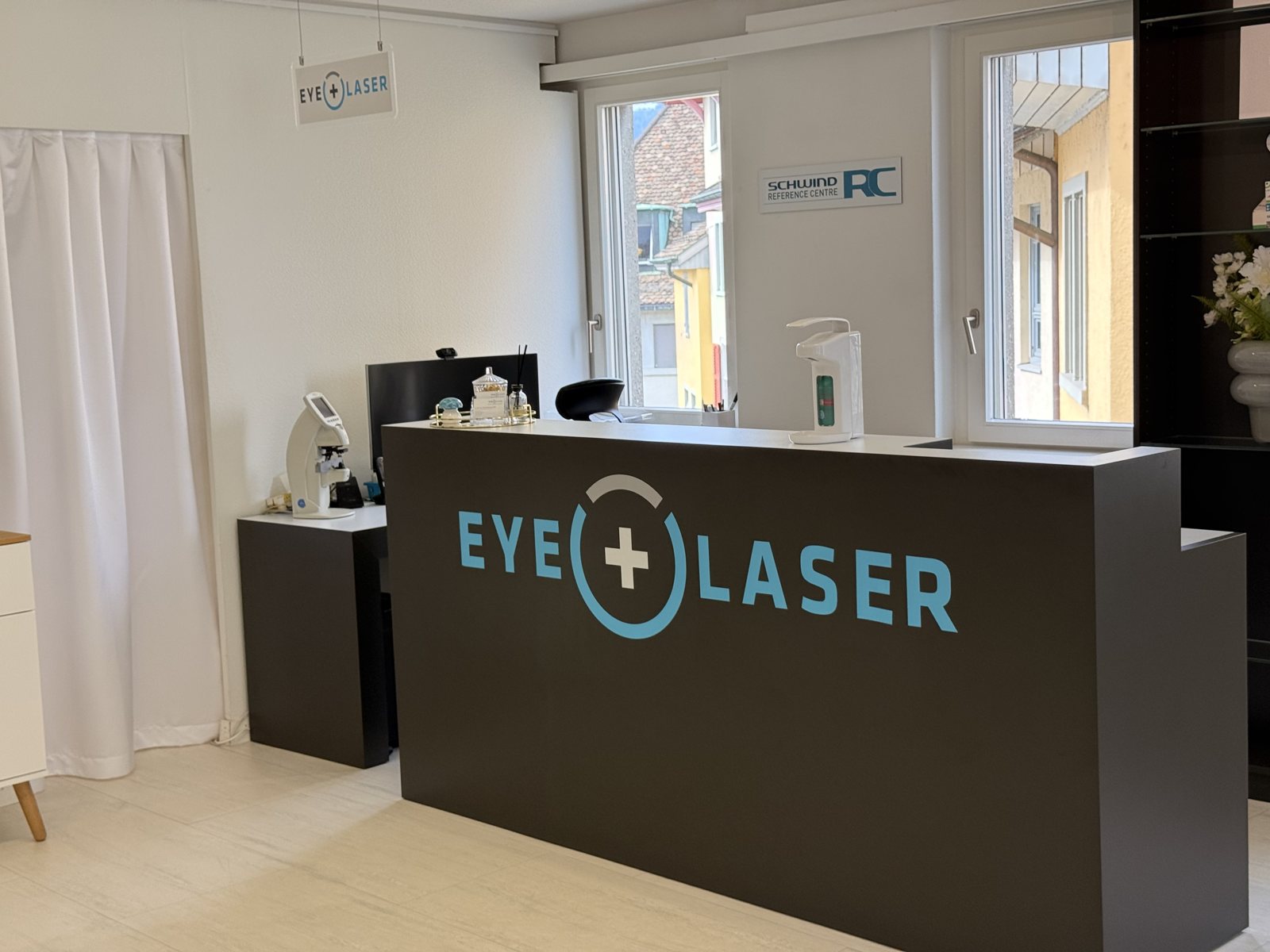
In contrast to impersonal large clinics or commercial chains, where you often only meet your doctor in the operating room, we focus on “doctor-led care”. At EyeLaser Zurich, you are not a number in the system. Dr. Victor Derhartunian accompanies you personally – from the first handshake through the operation to the aftercare. This guarantees that no detail of your medical history is lost.

International Patients Welcome

Zurich is a global hub. We fully understand the needs of expats. Our team and Dr. Derhartunian are fluent in English (and German, French, Italian, Russian, Polish). All medical documents are available in English to ensure you feel completely at home.
Your journey at EyeLaser Zurich

Orientation & initial contact

Before you decide, you want certainty.

  • The non-binding suitability check: In a short appointment, we clarify whether your eyes are generally suitable for correction (laser or lens).
  • Transparency from the start: We do not sell operations; we diagnose solutions. If an operation does not make medical sense, we will tell you honestly.
The comprehensive preliminary examination – next-generation technology

This is where EyeLaser differs significantly from the market standard. We do not rely on older technologies.

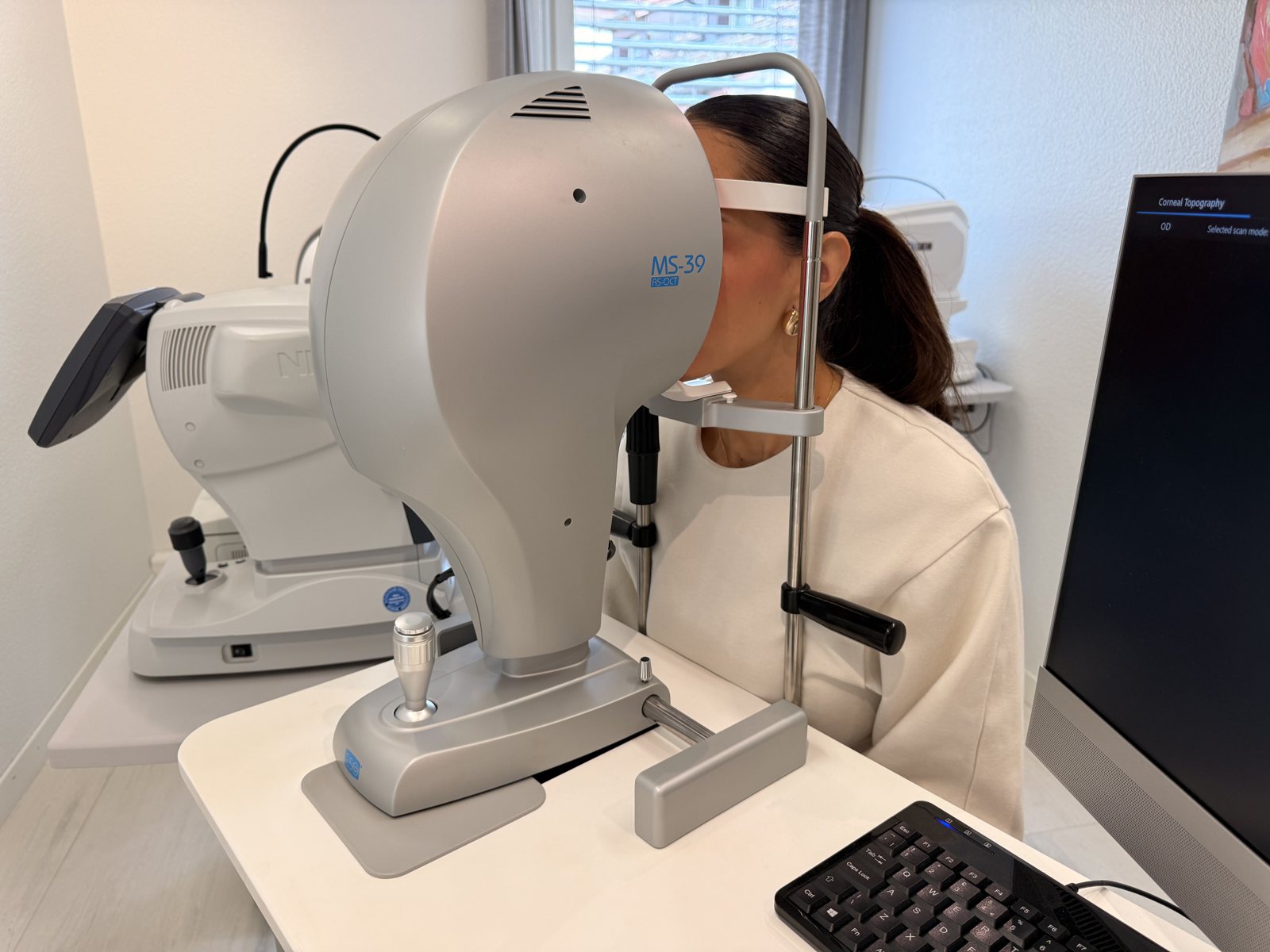
The technological centerpiece: MS-39 (2nd Gen)
Instead of conventional topographies, we use the MS-39 from CSO. This device combines Placido disk topography with high-resolution OCT (Optical Coherence Tomography).

  • Why is this important for you? The MS-39 can measure the epithelium (the outermost layer of the cornea) separately. This allows us to detect even the earliest stages of corneal weakness (such as keratoconus) that might be overlooked in standard Pentacam examinations. This is your safety guarantee.
Choice of method & consultation

After the analysis, we discuss the strategy. We do not follow a “one-size-fits-all” approach.

For patients < 45 years:

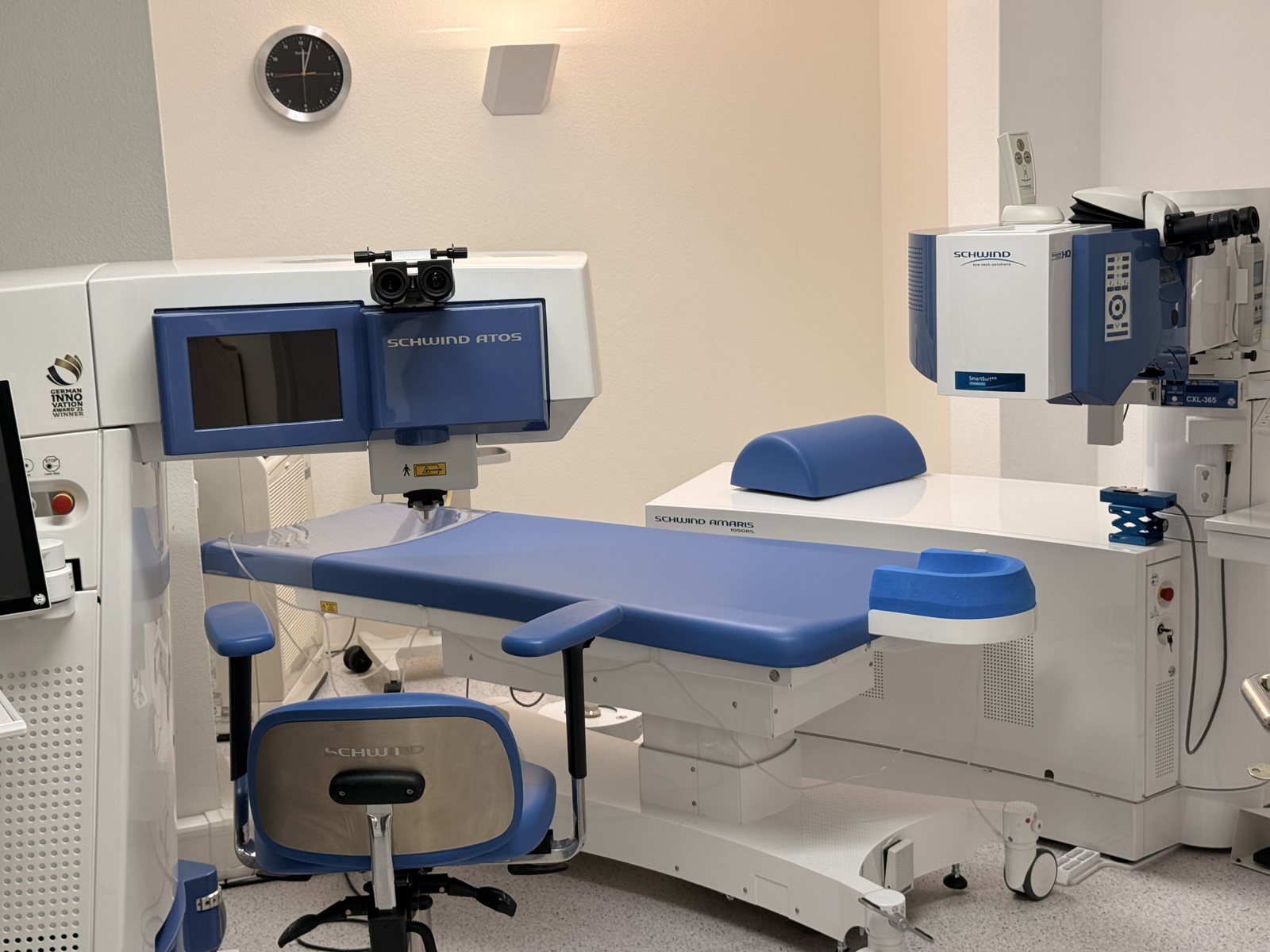
  • SmartSight (Schwind ATOS): The further development of lenticule extraction (similar to SMILE, but more precise thanks to eye tracking and cyclotorsion control). Ideal for athletes and for dry eyes.
  • Femto-LASIK: The proven classic for fast healing.
  • ICL (Implantable Contact Lens): For very high diopters or thin corneas.

For patients > 45 years (focus on presbyopia):

  • PresbyMAX (Hybrid Laser): Increases depth of field, ideal for the transition phase.
  • RLA (Refractive Lens Exchange): The most sustainable solution. The eye’s natural lens is replaced by a premium artificial lens (Trifocal/EDOF). Advantage: Cataracts are thus excluded forever.
The treatment day – relaxed on Bahnhofstrasse

The day is designed to eliminate stress factors.

  1. Arrival: Arrive conveniently by public transport (Zurich HB or Paradeplatz).
  2. Your accompanying person: Of course, your partner or a friend is welcome to come along! We have a comfortable lounge with Wi-Fi and coffee where your companion can wait in a relaxed atmosphere while you are being treated (total stay approx. 1–1.5 hours).
  3. The procedure:
    • SmartSight / Laser: Takes only a few seconds per eye.
    • Lenses (ICL/RLA): A microsurgical procedure of approx. 15 minutes.
  4. Afterwards: You relax briefly with a view of Zurich and then go home.
Aftercare & long-term safety

We do not leave you alone after the procedure.

  • Safety around the clock: You will receive the personal mobile number of the surgeon for emergencies. Regardless of whether it is a weekend or a public holiday.
  • The check-up schedule: First check-up usually the day after surgery, followed by checks after 1 week/month, 3 months, and 1 year.

Decision-making confidence

SCHWIND ATOS & SCHWIND AMARIS

We know that Zurich patients make rational and quality-conscious decisions.

  • Fear of “twitching”: Our lasers (Schwind Amaris & Atos) have extremely fast eye trackers (up to 1050 Hz). If you move your eye, the laser stops immediately. You cannot ruin the result by “looking the wrong way.”
  • Social proof: You are not alone. Thousands of patients have taken this step and describe it in retrospect as “one of the best decisions of their lives.” Read our Google reviews to see how others have experienced our care.

The suitability traffic light

Ein Leben ohne Brille – Erfolgsgeschichten aus Zürich

🟢 Green light: Healthy eyes, stable values.

🟡 Yellow light: Dry eyes (therapy beforehand), pregnancy, autoimmune diseases.

🔴 Red light: Advanced keratoconus (laser contraindicated), unstable diopters, severe glaucoma.

Comparison of methods

Feature SmartSight (Lenticule) Femto-LASIK TransPRK ICL Lenses RLA / PresbyMAX
Technology Schwind ATOS (Incision-free) Femto + Excimer Excimer only EVO+ Visian ICL Trifocal / EDOF / Laser
Age group 20 – 45 years 20 – 45 years 20 – 45 years 20 – 45 years From 45 – 55+ years
Corneal incision No (only 2mm access) Yes (flap) No No (implant) No (implant) / Laser
Dry eyes Very low risk Low risk Higher risk (temp.) No risk Low risk
Healing (vision) Fast (1-2 days) Very fast (1 day) Slow (4-7 days) Very fast (1 day) Fast (a few days)
Special Feature Most modern procedure, tissue-sparing Proven standard For martial artists Reversible! Freedom from reading glasses

Start your treatment process with confidence

Book your suitability check in Zurich. Experience what happens when state-of-the-art technology (MS-39, SmartSight) meets genuine Swiss treatment quality.

Book an appointment for a suitability check

FAQ – The 15 most important questions

Does the treatment really not hurt?

Modern procedures such as SmartSight or Femto-LASIK are virtually painless. The eye is completely numbed with drops. You only feel a slight pressure or a touching of the eyelids, but no pain. After the anesthesia wears off (after approx. 2–3 hours), the eye may water or burn slightly – similar to cutting onions. This usually passes after a short sleep.

What does a treatment in Zurich cost and is installment payment available?

Quality and safety have their price, but we focus on absolute transparency with no hidden costs. Prices vary depending on the method (laser vs. lenses). In Switzerland, these procedures are usually not covered by basic insurance (KVG). However, we offer partnerships for installment payments to make the investment in your quality of life predictable.

Why EyeLaser on Bahnhofstrasse and not an eye clinic abroad?

It’s about continuity of safety. In the event of complications – as rare as they are – you need immediate access to your surgeon, not a flight to Turkey. Furthermore, the strictest hygiene standards apply in our Zurich practice. With the MS-39 OCT and the Schwind ATOS, we use technologies that are often more modern than those of many foreign clinics.

What is the difference between SmartSight and SMILE?

Both are minimally invasive “keyhole” procedures (lenticule extraction). SmartSight is, however, the technological further development. It uses the Schwind ATOS laser, which features intelligent eye tracking . This means: the laser compensates for rotations of the eye (cyclotorsion control), which leads to more precise results than older systems, especially in cases of astigmatism.

I am afraid that I will blink or move my eye

This concern is unfounded. A lid holder gently prevents blinking. Should you move your eye, our high-frequency eye tracker reacts in milliseconds and compensates for the movement or stops the laser immediately. You cannot ruin the result by “looking the wrong way.”

Am I too old for correction at over 45?

No, but the method changes. From around age 45, presbyopia begins. Lasers (such as PresbyMAX) can help here in the transition phase. However, Refractive Lens Exchange (RLA) with trifocal or EDOF lenses is often the more sustainable solution, as it permanently frees you from reading and distance glasses while simultaneously preventing cataracts.

How quickly can I return to work?

With SmartSight, Femto-LASIK, and ICL/RLA, most patients already see well enough the next day that they can return to work (after the medical check-up). We nevertheless recommend taking 1–2 days of rest. With TransPRK, healing takes a bit longer (approx. 4–5 days).

Am I allowed to do sports after the surgery (skiing, swimming)?
  • Jogging/Fitness: After 2–3 days.
  • Skiing: After approx. 10 days (mandatory with UV protection goggles!).
  • Swimming (Lake Zurich/indoor pool): Please take a 2-week break due to the risk of infection, then 2 weeks with swimming goggles.
  • Martial arts: Here we often recommend TransPRK or SmartSight, as there is no “flap” that could shift.
What happens in the case of dry eyes?

We analyze your tear film precisely beforehand with the MS-39. If you tend to have dry eyes, SmartSight or ICL is often better than LASIK, as fewer nerve fibers are severed. After the procedure, moisturizing drops are standard for a few weeks; permanent dryness is very rare.

Is Dr. Derhartunian always present?

Yes. Dr. Victor Derhartunian is not a “guest doctor” but your treating surgeon. He performs the preliminary examination, the surgery, and the check-ups (or monitors them closely). You have a direct contact person. This is the core of our boutique concept.

Can I have both eyes treated on the same day?

Yes, this is the international standard and also the rule with us. It is significantly more pleasant for the brain (stereo vision) and your comfort to go through only one healing phase.

How long do the lenses (ICL/RLA) last?

The artificial lenses are made of biocompatible material that does not age or become cloudy. They remain in the eye for a lifetime. With ICL, they can theoretically be removed again; with RLA, they replace the eye’s own lens permanently.

Am I allowed to wear makeup?

Please refrain from eye makeup (mascara, eyeliner) for 1 week to prevent particles from entering the fresh wound. Face creams are allowed as long as they do not get into the eye.

What if my values deteriorate again later?

This is called regression. It is rare (approx. 1–2%). Should this happen, we offer a free or discounted follow-up correction in most cases (depending on your warranty package), provided it is medically justifiable.

Do you also speak English or other languages?

Yes. Zurich is international. Our team and Dr. Derhartunian speak fluent German and English (and often other languages such as French or Italian). We care for many expats and international patients and provide documents in English.