In brief

What is SmartSight?

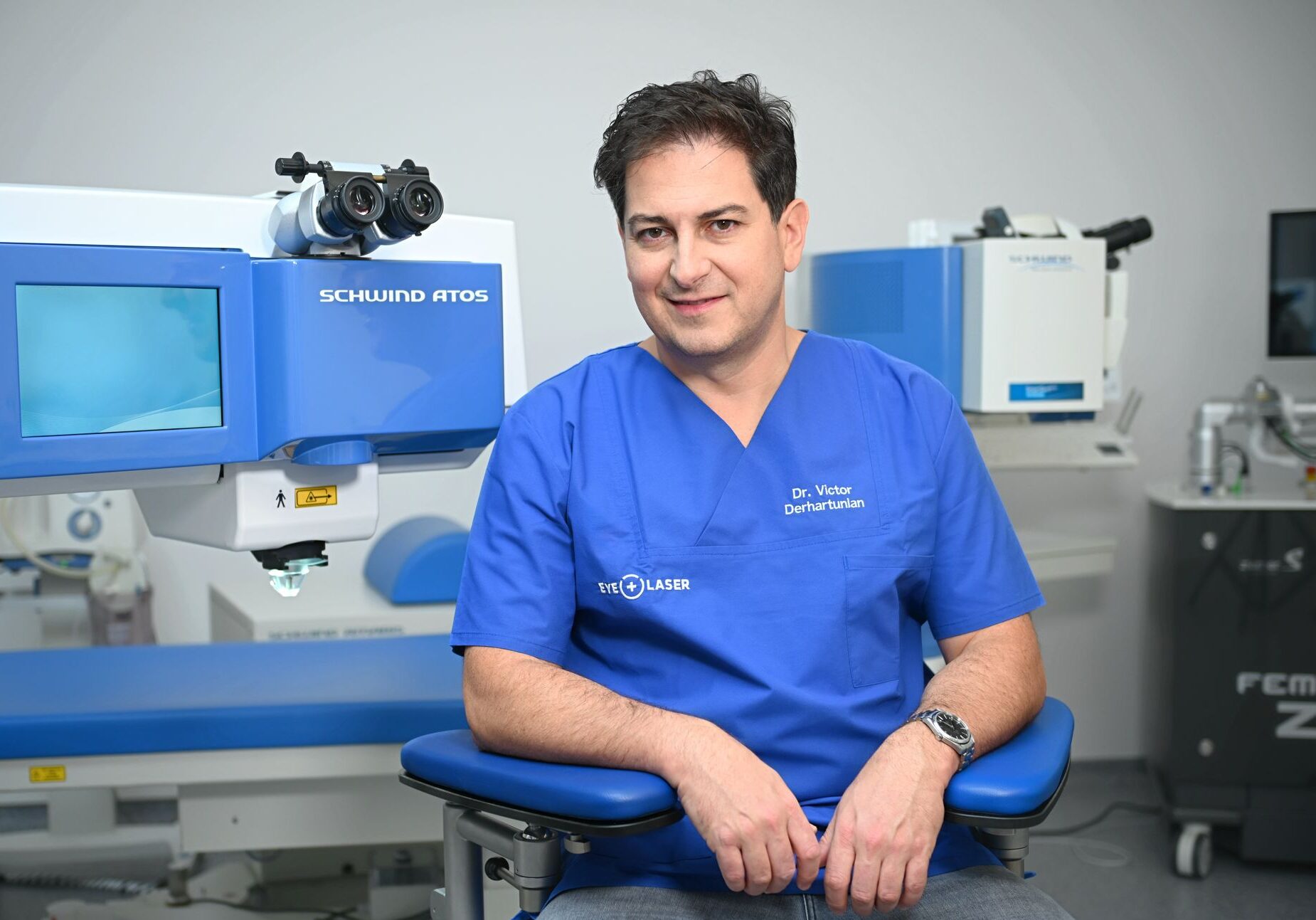
SmartSight is a lenticule extraction without a corneal flap: the SCHWIND ATOS femtosecond laser separates a small disc of tissue inside the cornea, which is removed through an opening of about 2 mm. At EyeLaser Zurich, Dr. Victor Derhartunian performs SmartSight personally. In Zurich, SmartSight costs CHF 2’500 per eye, SmartSight NOVA CHF 3’000.

SmartSight at EyeLaser Zurich at a glance
Method Lenticule extraction (KLEx) without a flap
Laser SCHWIND ATOS femtosecond laser
Suitable for Short-sightedness and astigmatism; limit according to the KRC recommendations and your corneal thickness
Not suitable for Long-sightedness, keratoconus, a cornea that is too thin or unusually shaped, unstable prescription, pregnancy and breastfeeding
Duration about 20 minutes for both eyes, of which about 20 seconds of laser per eye
Anaesthesia Eye drops, no injection, no general anaesthesia
Back at the office usually the day after the procedure
Driving after clearance at the check-up, usually after 1 to 3 days
Sport without body contact after two to three days; contact sport, swimming and sauna after four weeks, in each case after clearance at the check-up
Follow-up checks Day 1, week 1, month 1, month 3 included; thereafter annual check CHF 180
Enhancement included up to ten years after the procedure, provided you attend the annual check with us
Surgeon Dr. med. univ. Victor Derhartunian personally
Price per eye CHF 2’500; SmartSight NOVA CHF 3’000; pre-examination CHF 300, credited
25’000refractive procedures performed personally by Dr Derhartunian
CHF 2’500fixed price per eye, SmartSight NOVA CHF 3’000
4,9 / 5from 118 Google reviewsAs of September 2026
Kreis 1Strehlgasse 33, two minutes on foot from Paradeplatz

How does SmartSight differ from LASIK?

Phake Linsen (ICL) in Zürich

Imagine standing on the Lindenhof, looking over the Limmat city and recognizing every detail of the roofs and church towers in sharp focus – without any aids. In our practice on Strehlgasse, we make this freedom a reality.

With SmartSight we offer you not just eye laser surgery. We offer the lenticule extraction of the SCHWIND ATOS. Because no corneal flap is created, the risks associated with a flap do not arise.

Prices & services

What does SmartSight cost in Zurich?

What is included in the price and what is not.

FIXED PRICE

SmartSight — lenticule extraction without a flap
CHF 2’500 per eye
Premium variant SmartSight NOVA with CenTrax centring: CHF 3’000 per eye.
Included in the fixed price
✓Follow-up checks of the first three months included — the annual check thereafter is chargeable
✓Fixed price — no surcharges after the preliminary examination
✓Enhancement included — if ever needed, at no extra cost
✓Emergency contact after surgery — your surgeon can be reached around the clock during the first 24 hours
✓Preliminary examination CHF 300 — credited towards the treatment
✓Six months interest-free directly with us (CHF 417 per month and eye); longer terms via heylight with credit check and interest
Charged separately
iMedication and eye drops after the procedure — on prescription from the pharmacy
iAnnual check CHF 180
Results

How good are the results of SmartSight?

SmartSight has been in use since 2020. The figures come from case series, not from comparative studies, and not from us.

59 to 98 %

achieved 20/20 or better without glasses

Systematic review of six case series with 877 eyes (Arifaizha 2026, PMID 42573219)

up to 98 %

were within ±0.5 dioptres of the target after three months

on the first day it was only 40 % (same analysis)

1.74 → 0.10 D

residual cylinder after six months

292 eyes with astigmatism over 1 D (Pradhan 2024, PMID 38717080; one author is employed by SCHWIND)

The review itself states the limits of the evidence up front: case series with short follow-up, no randomised studies. For the same principle on a different laser (SMILE), there are data over ten years without loss of two or more lines (Blum 2019, PMID 31610002). These values come from published studies and are not our own figures. We will tell you what is realistic for your eye after the pre-examination.

Your recovery

What can you expect on the day of the procedure and afterwards?

Guide values from practice; the follow-up checks accompany your recovery.

SURGERY DAY

Vision as if through frosted glass, burning and watering for a few hours. Rest at home, keep your eyes closed.
DAY 1

Check-up with us. Usually good everyday vision, short screen work possible.
DAYS 2–3

Back at work; driving after medical clearance. Sport without body contact possible again.
WEEK 1

Eye make-up allowed again.
AFTER 4 WEEKS

Contact sport, swimming and sauna, after clearance at the check-up.
MONTHS 1–3

Sharpness stabilises; check-ups after one and after three months.

Transparency

What are the risks of SmartSight, and how common are they?

There are no large complication studies for SmartSight itself yet. The figures mostly come from SMILE, the lenticule extraction on another manufacturer’s laser, and not from us.

Risks of lenticule extraction with frequencies from studies
Risk How common Source Course and what we do
Dry eyes common for a while; after SMILE subjectively milder than after Femto-LASIK, objective measurements similar, usually back to baseline after six months Shen 2016 (291 and 277 eyes) Measure and treat the tear film beforehand, lubricating drops
Small tear at the opening, difficult lenticule removal 1.8 % and 1.9 % of eyes respectively Ivarsen 2014 (1’574 eyes) usually without consequences for visual acuity
Slight haze (trace), epithelial abrasion 8 % and 6 % respectively Ivarsen 2014 usually heals; drops, check-up
Loss of two or more lines of best-corrected visual acuity 1.5 % after three months; after an average of 18 months, all within one line Ivarsen 2014 Clarify the cause, treatment depending on the findings
Irregular corneal surface 1.0 % Ivarsen 2014 topography-guided surface treatment if necessary
Suction loss during the procedure 0.8 % Ivarsen 2014 the procedure is rescheduled
Residual refractive error no reliable frequency figure for SmartSight – Enhancement included for up to ten years, with annual check
Bulging of the cornea (ectasia) estimated 11 per 100’000 eyes after SMILE without risk factors Moshirfar 2021 Tomography before the procedure, selection according to KRC
Infection rare; no reliable frequency figure for SmartSight – Antibiotic drops, check-up the following day
When we advise against it: in long-sightedness, suspected keratoconus, a cornea that is too thin, untreated dry eyes and unstable prescription. In the first 24 hours after the procedure, you can reach the surgeon around the clock; after that, the surgeon is your contact during the day, and at night the emergency department of the hospital on duty.
Hand pointing to the lens in an anatomical eye model, with an enlarged lens model beside it

The principle: Keyhole instead of large incision

In contrast to classic LASIK, SmartSight does not cut a flap (large corneal flap). The high-precision SCHWIND ATOS laser forms a wafer-thin tissue disc (lenticule) inside the cornea. This is removed through a tiny opening (approx. 2 mm).

The Result: The surface of the eye remains almost untouched. Fewer corneal nerves are cut. As a result, dry eyes are subjectively milder in studies than after Femto-LASIK (Shen 2016).

The crucial difference: SmartSight vs. SmartSight Nova (guided by CenTrax)

Many clinics talk about “precision.” We at EyeLaser are redefining it. It is essential to understand the difference between the standard procedure and our Nova variant to understand. This is not about marketing, but about physics and your vision quality.

SmartSight

The problem with previous methods: The pupil trap

Classic methods (and older SmartSight versions) often center the treatment on the center of the pupil.

  • The catch: But we don’t look exactly with the center of the pupil. Our sharpest point of vision (fovea) defines the so-called visual axis.
  • The effect: If the laser is centered on the pupil, but you look slightly offset, the correction will not be 100% accurate. This can lead to slight blurring (aberrations) or poorer night vision.
SmartSight Nova & CenTrax®

The solution: SmartSight Nova guided by CenTrax

At EyeLaser Zurich, we use the CenTrax technology.

  1. Visual Axis Targeting: The system ignores the geometric center of the pupil and orients itself to your actual visual axis. The laser treatment lands exactly where your eye processes the light.
  2. Active Eye-Tracking: During the “docking phase” (when the laser touches the eye), the eye often rotates slightly (cyclotorsion). CenTrax recognizes this and rotates the laser profile in real time.
  3. Smoother surfaces: The Nova software polishes the lenticule microscopically smooth, which accelerates the “wow effect” when seeing.

In summary:SmartSight Nova does not compensate your eye like a machine, but respects the individual asymmetry of your natural optics.

SmartSight, Femto-LASIK, Trans-PRK or EASE?

Laser procedures at EyeLaser Zurich compared (prices per eye)
Feature SmartSight SmartSight NOVA Femto-LASIK Trans-PRK EASE
Principle lenticule inside the cornea like SmartSight, centred on the visual axis flap, excimer laser underneath ablation at the surface lentoid at the surface
Incision opening of about 2 mm opening of about 2 mm flap no incision no flap
Long-sightedness no no yes no no
Thin cornea depending on reserve depending on reserve rather not yes yes
Contact sport yes yes rather not (flap) yes yes
Clear vision 1 to 2 days 1 to 2 days 1 to 2 days days to weeks days to weeks
Price per eye CHF 2’500 CHF 3’000 CHF 1’800 CHF 1’500 CHF 2’000

Do you know ReLEx SMILE? The procedure from the company Zeiss is based on the same principle as SmartSight. We do not offer ReLEx SMILE. SMILE or SmartSight?

Check suitability (about 45 seconds)

Who performs SmartSight, and with which device?

Dr. Victor Derhartunian

All laser procedures at EyeLaser Zurich are performed personally by Dr. med. univ. Victor Derhartunian, FEBO, FWCRS: about 25’000 refractive procedures since 2006, including almost 6’000 SmartSight treatments. As medical director, he also oversees the measurement data of every pre-examination.

The SCHWIND ATOS is a femtosecond laser: it delivers very short light pulses inside the cornea, which separate the lenticule from the surrounding tissue. An eye tracker follows the eye, and the rotation of the eye when lying down is compensated for. EyeLaser Zurich is an official SCHWIND reference centre; we train colleagues and receive software updates before general release.

Who is SmartSight suitable for?

Female runner jogging across a bridge in the evening sun – sport after laser vision correction

🟢 Well suited: short-sightedness and astigmatism within the KRC recommendations and your corneal thickness; a tendency to dry eyes or contact lens intolerance; contact sport or professions with a risk of injury, because there is no flap that can slip.

Ein Leben ohne Brille – Erfolgsgeschichten aus Zürich

🟡 Assessment needed: high values with a rather thin cornea; from about 45 years of age (we then consider PresbyMAX, and from about 55 also lens replacement); rheumatism and other autoimmune diseases.

🔴 Not suitable, but there is another route: long-sightedness → Femto-LASIK; keratoconus → first crosslinking; cornea too thin → Trans-PRK or ICL lens; pregnancy and breastfeeding → measure again afterwards.

What are the steps of SmartSight at EyeLaser Zurich?

Free initial consultation

Our team clarifies questions, procedure and costs. Only the pre-examination shows whether SmartSight is right for you.

Pre-examination, CHF 300

Measurement with the MS-39, consultation with Dr. Derhartunian. The amount is credited if you go ahead with treatment.

Day of the procedure

Including preparation, about 1 to 1.5 hours with us; the procedure itself takes about 20 minutes for both eyes.

Follow-up checks

The day after, after one week, after one and after three months; included.

Am I suitable for SmartSight?

Two routes: the suitability test (seven questions, about 45 seconds, without contact details) or the free initial consultation at Strehlgasse 33 in Zurich.

Check suitability Call 044 221 95 02

Online appointment

SmartSight on video: the procedure with the SCHWIND ATOS

Dr Victor Derhartunian shows how lenticule extraction without a flap proceeds: minimally invasive and in a few minutes.

SmartSight lenticule extraction with SCHWIND ATOS – video

Overview

All procedures compared

On the overview page laser eye surgery in Zurich you find all procedures side by side, with the suitability traffic light, documented results, healing timeline, fixed prices and instalment examples.

Other procedures at EyeLaser: Femto-LASIK 7D · Trans-PRK · SMILE or SmartSight? · PresbyMAX · ICL lens

By refractive error: Short-sightedness · Long-sightedness · Astigmatism · Presbyopia · Keratoconus

Costs and financing: All prices · Health insurance · Treatment process · Testimonials

Frequently asked questions about SmartSight

How long will I be unable to work?

Plan for 1–2 days. If you come on a Friday, you will be fully fit for the office again on Monday. Working from home is often possible after just 24 hours.

Will I feel the incision?

No. The eye is numbed with drops. You will only feel slight pressure for about 20 seconds while the laser docks.

What is included in the price of SmartSight?

The price of CHF 2’500 per eye at EyeLaser Zurich covers the procedure by Dr. Derhartunian, the follow-up checks of the first three months and an enhancement up to ten years after the procedure, provided you attend the annual check (CHF 180) with us. The pre-examination (CHF 300) is credited. You receive medication and eye drops on prescription from the pharmacy.

Is the result of SmartSight permanent?

The correction of the cornea is permanent; the removed lenticule does not grow back. For the same principle on a different laser (SMILE), the deviation after ten years averaged −0.35 dioptres (Blum 2019). From about 45, presbyopia sets in, which may make reading glasses necessary. At EyeLaser Zurich, an enhancement is included for up to ten years, with an annual check.

Does health insurance pay for SmartSight?

Basic insurance (KVG) pays for SmartSight only in justified exceptional cases, for example if there is a large difference between the two eyes, and only with cost approval. Supplementary insurance policies contribute depending on the product, often CHF 500 to CHF 1’500. EyeLaser Zurich helps with the application and issues the receipts. More under laser eye surgery and health insurance.

What is the difference from LASIK?

With LASIK there is a 20 mm incision (flap). With SmartSight only 2 mm. This means fewer dry eyes and no risk of the flap slipping.

How quickly will I see clearly after SmartSight?

Immediately after the procedure, you see as if through frosted glass; after a few hours it clears up. At the check-up the next day, most patients have good everyday vision; full sharpness builds up over weeks. In one study analysis, only 40 percent of eyes were within ±0.5 dioptres of the target on the first day, and up to 98 percent after three months (Arifaizha 2026).

Does it hurt afterwards?

You will feel burning or watering for about 3–4 hours. After that the eye is calm. Real pain is extremely rare.

Are there long-term studies on SmartSight?

SmartSight has been in use since 2020; the published series so far cover months, not years. For lenticule extraction on another manufacturer’s laser (SMILE), there are results over ten years: the correction remained stable, and no eye lost two or more lines (Blum 2019, 56 eyes). At EyeLaser Zurich, we will explain in the pre-examination what this means for your eye.

What if my cornea is too thin for SmartSight?

Then at EyeLaser Zurich we consider a surface procedure such as Trans-PRK or EASE, which requires neither a flap nor a pocket in the cornea, or the ICL lens, which removes no tissue. The tomography in the pre-examination (CHF 300, credited) shows how much reserve your cornea has.

How safe is the laser?

The SCHWIND ATOS follows the eye with an eye tracker and compensates for the rotation of the eye when lying down. If the eye moves too much or the contact glass detaches, the laser stops. In a large series on lenticule extraction (SMILE), suction contact was lost in 0.8 percent of eyes; the procedure was then rescheduled (Ivarsen 2014). At EyeLaser Zurich, Dr. Derhartunian performs every procedure personally.

How long beforehand do I need to stop wearing contact lenses?

Contact lenses slightly deform the cornea and distort the measurement. Before the pre-examination at EyeLaser Zurich, leave out soft lenses for one week and rigid lenses for four weeks, ortho-K lenses for three months. We will tell you the exact times when we confirm your appointment.

Is SmartSight the same as ReLEx SMILE?

SmartSight and ReLEx SMILE are based on the same principle, lenticule extraction without a flap. ReLEx SMILE is a procedure from the company Zeiss on its own laser; SmartSight runs on the SCHWIND ATOS. EyeLaser Zurich does not offer ReLEx SMILE, but SmartSight. The differences in device, centration and eye tracking are shown on the page SMILE or SmartSight?

What does SmartSight cost for both eyes?

At EyeLaser Zurich, SmartSight costs CHF 2’500 per eye, i.e. CHF 5’000 for both eyes; SmartSight NOVA costs CHF 3’000 per eye. The pre-examination (CHF 300) is charged once and credited. You can pay in six monthly instalments interest-free, for SmartSight CHF 417 per month and eye.

Sources
  1. Arifaizha N, Adji MWK, Rachmani AV, Pujiastuti S. Visual Outcomes of SmartSight (SCHWIND ATOS) Refractive Surgery in the Correction of Myopia and Myopic Astigmatism: A Systematic Review. J Refract Surg 2026;42(8):e857–e866. PMID 42573219
  2. Pradhan KR, Arba Mosquera S. SmartSight Correction of Compound Myopic Astigmatism Treatments With Preoperative Astigmatism > 1.00 Diopter Using the SCHWIND ATOS. J Refract Surg 2024;40(5):e328–e335. PMID 38717080
  3. Ivarsen A, Asp S, Hjortdal J. Safety and complications of more than 1500 small-incision lenticule extraction procedures. Ophthalmology 2014;121:822–828. PMID 24365175
  4. Shen Z, Zhu Y, Song X et al. Dry Eye after Small Incision Lenticule Extraction (SMILE) versus FS-LASIK for Myopia: A Meta-Analysis. PLoS One 2016;11:e0168081. PMID 27992482
  5. Blum M, Lauer AS, Kunert KS, Sekundo W. 10-Year Results of Small Incision Lenticule Extraction. J Refract Surg 2019;35:618–623. PMID 31610002
  6. Moshirfar M, Tukan AN, Bundogji N et al. Ectasia After Corneal Refractive Surgery: A Systematic Review. Ophthalmol Ther 2021;10:753–776. PMID 34417707