


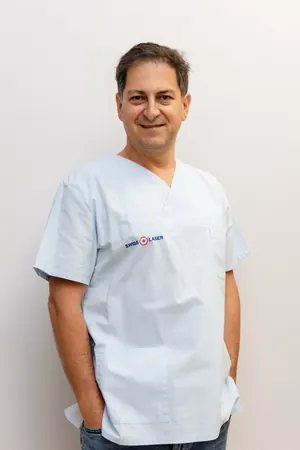
 Medically reviewed by Dr. med. univ. Victor Derhartunian, FEBO
Ophthalmologist · Last updated: 16 September 2026
Looking for a second opinion?Free consultation, also by video call · Records from the first clinic help but are not a condition
When a correction is an option at all
Not every unsatisfactory result is a case for the laser. These four situations are the most common, and they need different answers.
Residual prescription
Some short-, long- or astigmatic error remains, usually under one dioptre. If the cornea is thick enough and the values have been stable for three months, this can be fine-tuned.
Regression
The result was good at first and has drifted back over months, more often after higher corrections. What matters is that the drift has come to a stop.
Halos, glare, ghosting
Typical with a small or decentred treatment zone, a large pupil or residual astigmatism. The cause shows in topography and wavefront, and not every cause needs surgery.
Dry eyes
Common after flap procedures and usually temporary. Here we treat first and do not laser. A laser on a dry eye needlessly prolongs recovery.
What we measure at the pre-assessment
How much tissue did the first procedure use, how much remains for a correction, and how much must remain afterwards? This calculation decides whether a laser is safe at all.
The MS-39 shows flap thickness, epithelial thickness across the whole cornea and scar zones. A thickened epithelium can explain part of the regression.
Topography and tomography reveal irregularities, decentration and early signs of ectasia that remain invisible from the prescription alone.
Higher-order aberrations and pupil size in the dark explain halos and glare. They also determine whether a wavefront-guided treatment makes sense.
Dryness distorts measurements and results. It is treated before any decision and measured again.
Two measurements weeks to months apart. If the prescription is still changing, we wait.
Which routes exist
| Starting point | Possible route | Requirement |
|---|---|---|
| Residual prescription after LASIK, flap intact | Lifting the flap and re-lasering, or a surface treatment on the flap | stable values, sufficient reserve, flap clearly assessable |
| Residual prescription after SMILE or SmartSight | Surface treatment (Trans-PRK), in selected cases Femto-LASIK over the cap | regular cornea, sufficient thickness |
| Residual prescription after PRK or Trans-PRK | A repeat surface treatment | stable values after at least six months |
| Thin or unusual cornea | ICL lens inside the eye, no further tissue removal | sufficient anterior chamber depth |
| Presbyopia has been added | PresbyMAX with a clear lens, otherwise lens exchange | age, lens condition, expectations |
| Ectasia | Cross-linking or CAIRS first, then a lens | early diagnosis, no further laser ablation |
How it works with us
Initial consultation
Free, by video call on request. You describe what bothers you and send any records you have. We tell you openly whether the journey is worthwhile.
Full pre-assessment
About 90 minutes with all the measurements above. CHF 300, credited against a treatment. You receive a written assessment, even if we advise against surgery.
Decision and price
Procedure, target and price are binding before you commit. No surgery on the same day; you should decide in peace.
Procedure and aftercare
Performed personally by Dr. Derhartunian. Checks in the first three months are included, after which the annual check is chargeable. How a day of surgery unfolds is described the day of surgery.
Further reading
refractive revision surgery · keratoconus · laser eye surgery overview · all prices
Frequently asked questions about correction after surgery elsewhere
Can you correct after a LASIK or SMILE at another clinic?
Yes, if the conditions are right: stable values, a sufficiently thick and regularly shaped cornea, no sign of ectasia. The pre-assessment clarifies this. We regularly treat patients whose first procedure took place elsewhere.
How long ago must the first procedure be?
As a rule at least three months, for PRK procedures rather six. Before that the values still fluctuate, and correcting a moving target makes no sense.
Do I need the records from the first clinic?
They help a lot: values before the procedure, the method, the target and the corneal thickness. If they are missing we can measure much ourselves, in particular flap and epithelial thickness on AS-OCT. We only contact the first clinic with your consent.
What does the correction cost?
We give you the price after the pre-assessment, binding and in writing; it depends on the procedure needed. The pre-assessment costs CHF 300 and is credited against a treatment. Supplementary insurance contributes in individual cases; we issue all receipts.
Is a second procedure riskier than the first?
The risk depends less on the number of procedures than on the remaining cornea and its shape. That is why we calculate beforehand how much tissue the procedure needs and how much remains. If the reserve is tight, we advise against the laser and suggest a lens.
What if the cornea is too thin?
Then further laser ablation is not safe. Alternatives are the ICL lens, which corrects without removing tissue, or, with presbyopia, a lens exchange. Dr. Derhartunian discusses both with you based on your measurements.
What about halos and glare at night?
First we measure: pupil size in the dark, centration of the treatment zone, wavefront. If the zone is too small or decentred, a topography- or wavefront-guided correction can help. Sometimes time and treating dry eyes is enough.
Who operates?
Dr. med. univ. Victor Derhartunian personally, from the pre-assessment to the final check. He has been performing refractive procedures for over 20 years, including revisions after procedures at other clinics.
Measure first, then decide.Free consultation · Pre-assessment CHF 300, credited against a treatment